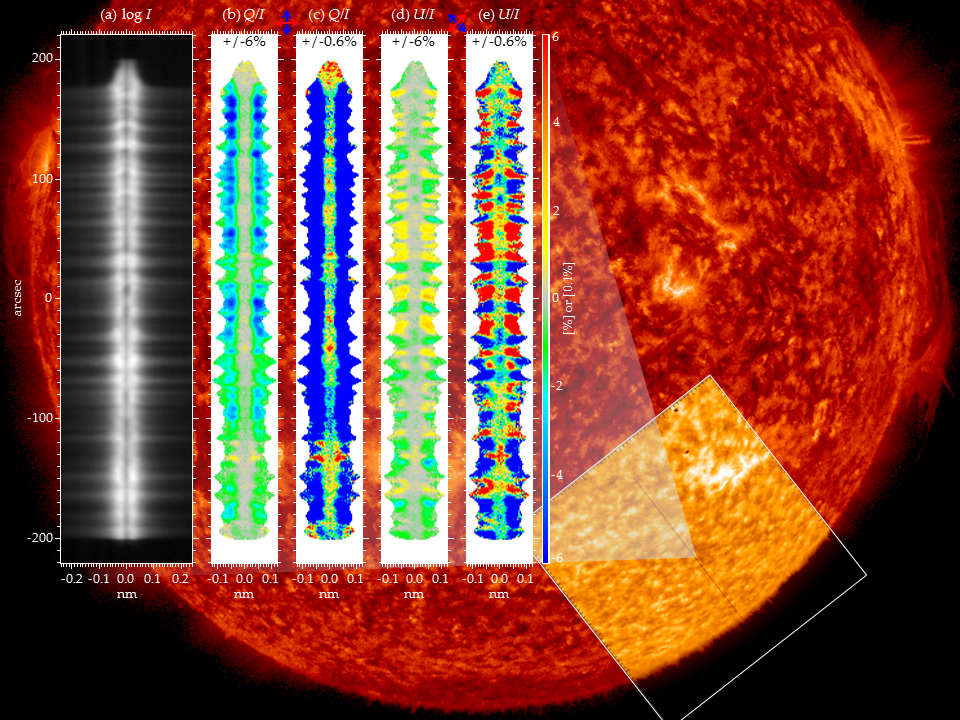
Figure 1: Position of the CLASP spectropolarimeter slit (bottom right), and polarized spectrum in the upper chromosphere and transition region (left). (©NAOJ, JAXA, NASA/MSFC)

First direct exploration of the magnetic field in the Sun's upper atmosphere: Ultraviolet spectropolarimetry opens a new pathway for solar physics

Using data from the CLASP sounding rocket spectropolarimeter, researchers have for the first time observed a direct signature of the magnetic field in the chromosphere, a region of the Sun's upper atmosphere. To determine the magnetic field in the chromosphere, CLASP measured the polarization of ultraviolet light during the 5 minutes the rocket spent in space on September 3, 2015. This validated a new magnetic field measurement technique via Hanle spectropolarimetry. It will be used in future experiments to measure the magnetic field in the chromosphere and in the chromosphere-corona transition region, thereby improving our understanding of activity in these regions of the solar atmosphere.
By analyzing light originating from the Sun, astronomers can determine how it was emitted and scattered in the solar atmosphere, and consequently deduce the prevailing conditions. Specifically, while it is established that the magnetic field plays a fundamental role in various types of solar activity, measurements to date have primarily focused on the photosphere (the Sun's surface). Very few measurements had previously been obtained higher up in the solar atmosphere. Whereas the photosphere emits primarily in the visible wavelength range, the chromosphere emits predominantly in the ultraviolet. This is why the CLASP instrument utilizes the hydrogen Lyman-α ultraviolet line.
 
The international CLASP team (Japan, United States, Spain, and France) developed a spectropolarimeter, an instrument that provides detailed information on the wavelength (color) and polarization (transverse orientation of the waves) of light passing through a narrow slit. The French team from the Institut d'Astrophysique Spatiale (CNRS / Université Paris-Sud) contributed to the optical design of the instrument and supplied the spectroscopic grating, the optical component that disperses light according to wavelength. 
 
Figure 1 shows, at the bottom right, the position of the spectropolarimeter slit on an image of the Sun captured by the CLASP context camera. The diagrams on the left display the wavelength and polarization data, demonstrating that the line is indeed polarized. The researchers found that some of the polarization characteristics align well with theoretical model predictions. However, other polarization characteristics were unexpected, indicating that the structure of the chromosphere is more complex than represented in current models. In particular, the team discovered that polarization varies on small scales, ranging from 1/50 to 1/100 of a solar radius.
 
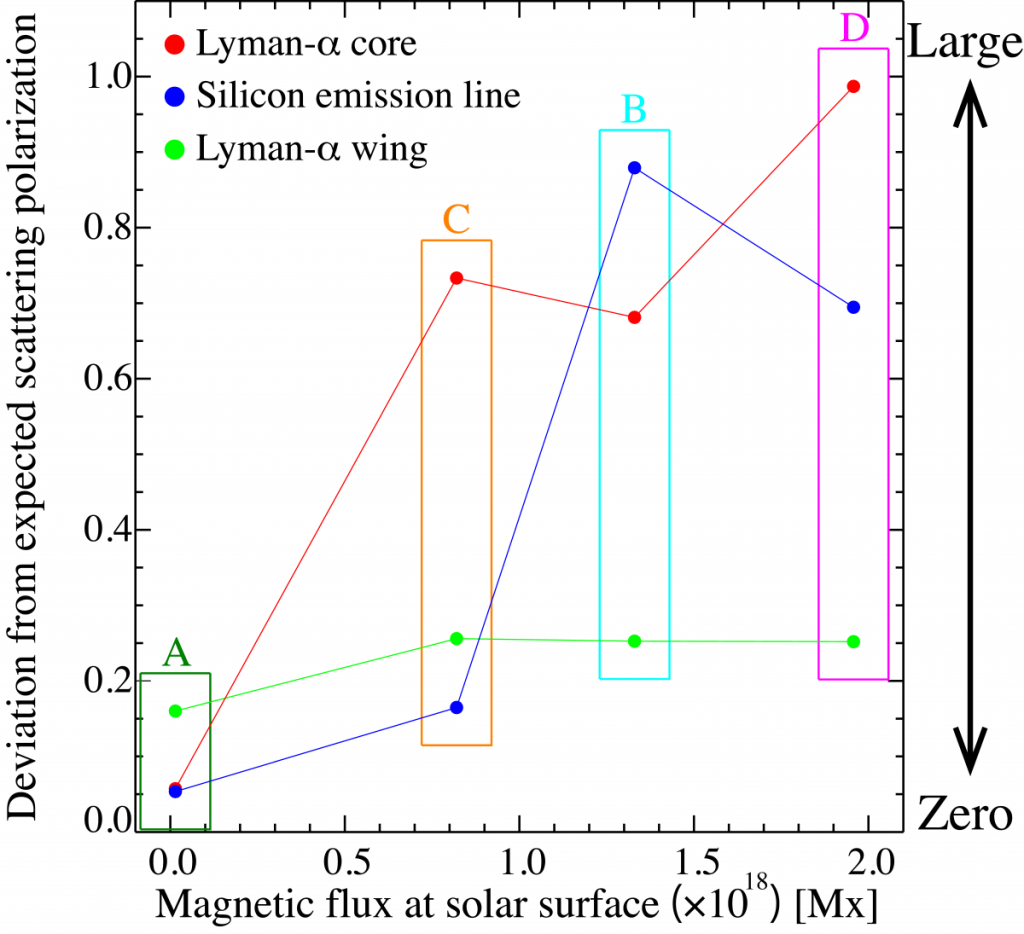
Furthermore, scattering polarization is affected by the local magnetic field. To search for magnetic field effects on polarization, the team observed three wavelength bands with varying degrees of sensitivity to the magnetic field: the core of the Lyman-α line (121.567 nm, highly sensitive), an ionized silicon line (120.65 nm, weakly sensitive), and a wing of the Lyman-α line (insensitive to the magnetic field). In Figure 2, the results for the four regions (A, B, C, and D) indicated in Figure 1 show that the polarization in the Lyman-α line wing is nearly constant, confirming that the large variations observed in the other spectral bands are driven by the magnetic field.
 
These results represent the first demonstration of Lyman-α line polarization in the chromosphere and its application to magnetic field studies. Furthermore, these findings show that sounding-rocket-borne experiments like CLASP can play a vital role in validating innovative techniques, despite their compact size and short observation windows compared to satellites.

Figure 2: Comparison of the polarization measured across three spectral lines with differing magnetic field sensitivities, within regions A, B, C, and D indicated in Figure 1. (©NAOJ)

Contacts

The principal investigators for CLASP are:
  • Amy Winebarger (NASA Marshall Space Flight Center)
  • Ryouei Kano (National Astronomical Observatory of Japan)
  • Frédéric Auchère (Institut d'Astrophysique Spatiale, CNRS/Univ. Paris-Sud)
  • Javier Trujillo Bueno (Instituto de Astrofísica de Canarias)

References

  • R. Kano, et al. (2017). Discovery of Scattering Polarization in the Hydrogen Lyα Line of the Solar Disk Radiation, Astrophys. J. Lett., 839, 10.
  • R. Ishikawa, et al. (2017). Indication of the Hanle Effect by Comparing the Scattering Polarization Observed by CLASP in the Lyman-α and Si III 120.65 nm Lines. Astrophys. J., 841, 31.
Scroll to top