ESA – R. Moorkens O’Reilly

PLATO

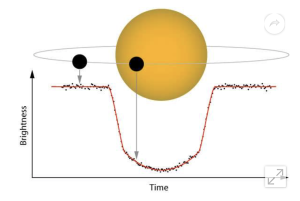
PLATO (PLAnetary Transits and Oscillations of Stars) is a mission of the European Cosmic Vision 2015–2025 program. The mission’s objective is to search for exoplanets of all sizes using the transit method, as well as to characterize their host stars through seismic analysis. It follows in the footsteps of several past, current, and future space missions, such as Corot (a French mission, CNES, 2006–2014), Kepler (a U.S. mission, NASA, 2009–), TESS (a U.S. mission, NASA, 2018–), and CHEOPS (a European mission, ESA, 2019). PLATO will be launched by a Soyuz rocket from Kourou in 2026 toward the second Lagrange point (L2), located 1.5 million kilometers behind Earth as viewed from the Sun. Figure 1 shows an artist’s rendering of the PLATO mission.

Figure 2: Illustration of the transit method

The Role of the IAS

This large-scale mission is managed by the European Space Agency (ESA). The satellite platform will be provided by the prime contractor OHB (Germany), and the instrument will be developed by the PLATO Mission Consortium (PMC). The PMC brings together more than twenty European countries, including Germany, Italy, France, Belgium, Spain, the Netherlands, Portugal, and Switzerland.

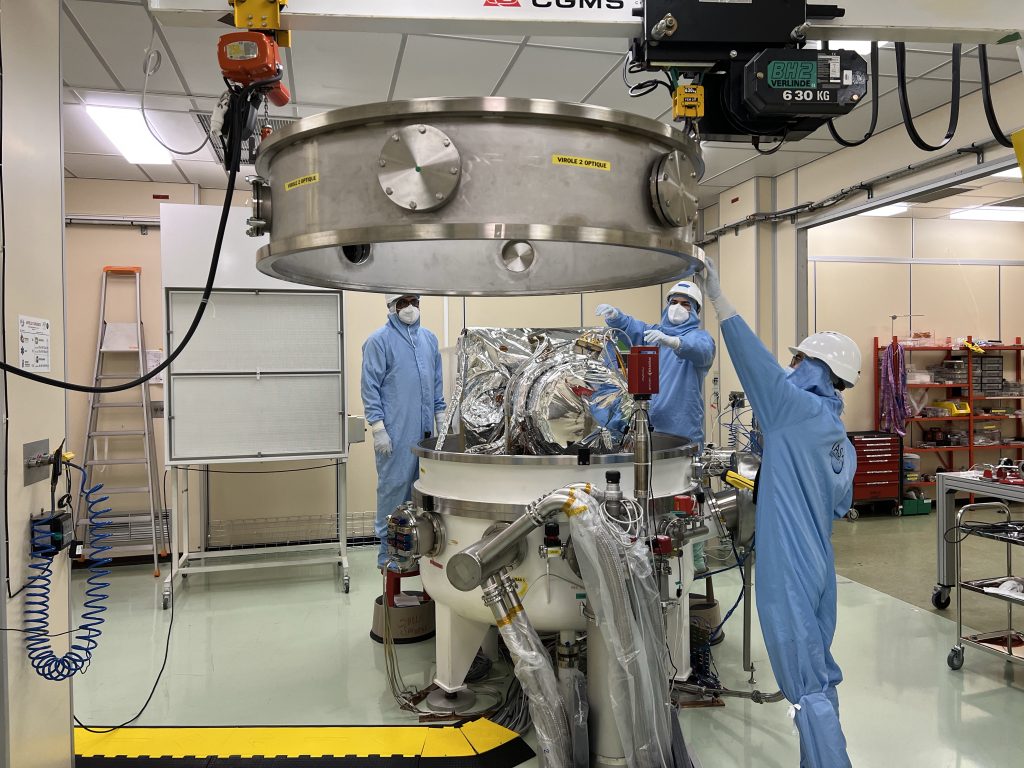
French scientists and engineers pioneered the detection of exoplanets using the transit method with the CoRoT space instrument, and they continue to be involved in the PLATO mission. One of France’s contributions to the instrument’s development involves participating in the integration and verification of camera assemblies (MAIV). The IAS is one of three test sites (Test Houses).

What sets PLATO apart from other space-based instruments is its use of multiple identical cameras, each contributing to the pupil and field of view of a single virtual instrument. This unique design makes it possible to achieve both a large pupil size and a wide field of view simultaneously.

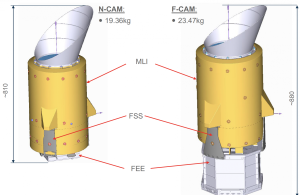
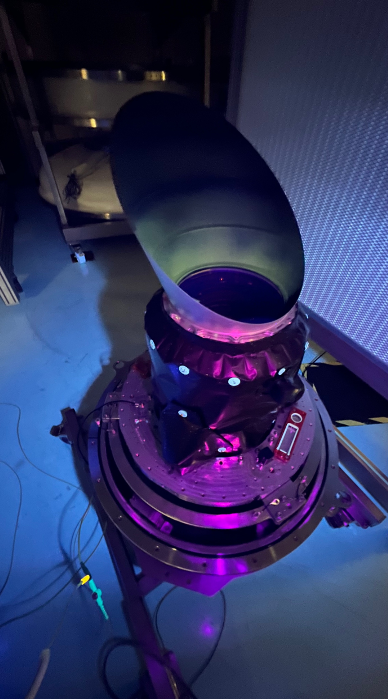
PLATO's payload will consist of a set of 26 cameras, including 24 "normal" cameras and 2 "high-speed" cameras. Figure 3 shows a CAD rendering of the N-CAM and the F-CAM.

Figure 3: CAD view of the N-CAM and the F-CAM

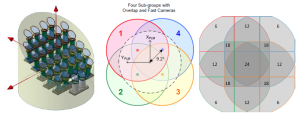
The 24 standard cameras have a 25-second exposure time for observing faint stars fainter than magnitude 8. They are organized into 4 groups of 6. The 6 cameras in each group observe the same field, and the 4 groups have offset lines of sight. Each camera has a circular field of view with a diameter of 37°, or 1,075 deg², resulting in a total instantaneous field of view of 2,232 deg². Each camera is fully dioptric, with a 120-mm exit pupil and a focal length of 200 mm. The focal plane of each camera consists of four CCDs, each with 4,510 × 4,510 pixels of 18 µm.
The two “fast” cameras have a frame rate of 2.5 s; they will be used for satellite tracking and observing bright stars of magnitudes 4 to 8.

Figure 4: Diagram of the PLATO camera array

To achieve its ultimate scientific goal, the PLATO instrument faces several technical challenges. The cameras must not only meet specific optical requirements but also maintain strict thermal stability during observation. The temperature of the camera’s telescope must be maintained within the range of -80 °C ± 10 °C with an accuracy of 0.01 °C, and the detectors must be kept below -65 °C.
Testing and calibrating the cameras are crucial to ensuring the instrument’s development and performance. We must characterize the camera’s thermal and optical performance in a space environment prior to launch.

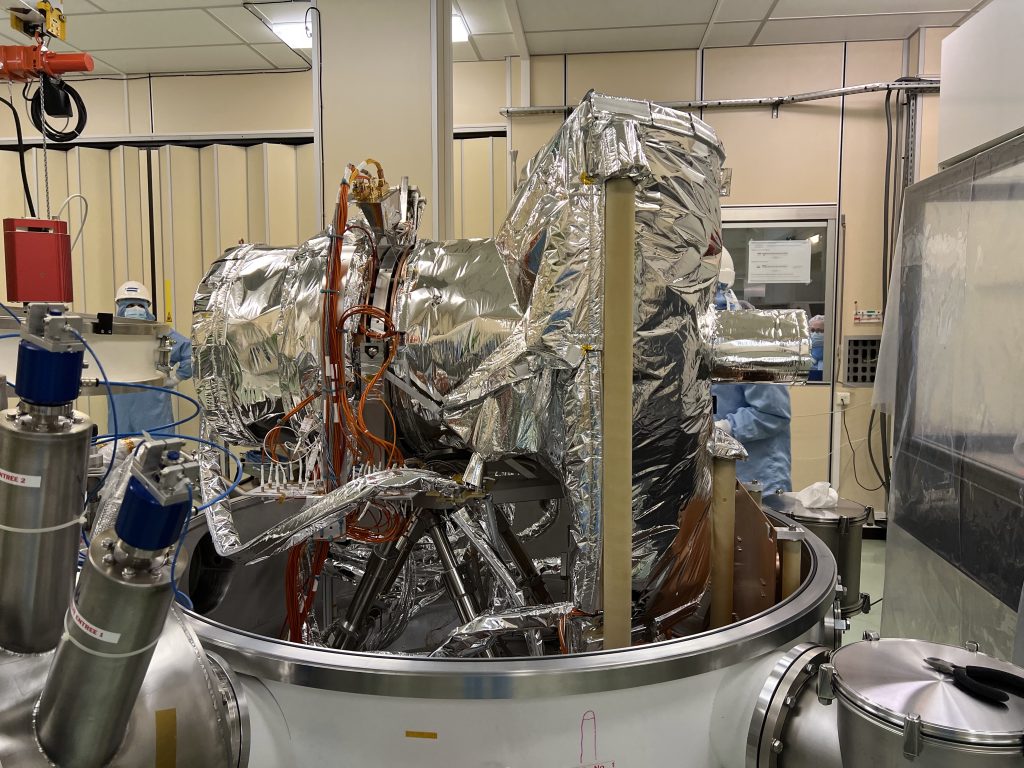
Three PMC institutes are responsible for thermal vacuum (TV) testing and performance calibration of the PLATO cameras: IAS, SRON (Netherlands), and INTA (Spain). We plan to test 1 engineering model (EM) camera, 2 qualification models (QM) cameras, and 26 flight models (FM) cameras. IAS is the only site testing both QM cameras and all fast cameras (F-CAMs).

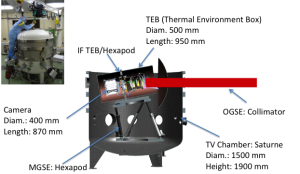
At the IAS, the cameras will be tested in the “Cuve Saturne” space simulator, a dedicated cryogenic chamber. It has been used successfully in the past for calibrations of the ISO-Cam (2K) and HFI/Planck (4K) instruments. The camera will be placed in the thermal environment box (TEB), illuminated by a collimated beam (simulating a single star), and rotated by a hexapod around its entrance pupil to simulate multiple stars (see Figure 5).

Figure 5: Test setup at the IAS

We will conduct the thermal cycling test, the equilibrium test, and the performance tests—specifically, optical image quality as a function of temperature, geometric distortion of the focal plane, and light characterization.

Currently, our team is working on the design and implementation of ground segment equipment (GSE), such as optical GSE, thermal GSE, vacuum GSE, mechanical GSE, and electrical GSE.

We plan to test the first engineering model (EM) camera in April 2020, two qualification model (QM) cameras in September 2021, and 10 flight model (FM) cameras after October 2022.

In development

Launch: December 2026

PLATO Camera

Contacts

Advisors (scientific and technical)

Scientists

  • Marc Ollivier, Astronomer, Physics of the Solar System and Planetary Systems
  • Thierry Appourchaux, Solar and Stellar Physics

Techniques

Camera Project Managers / PLATO

Scroll up