
Planck Reveals a Screen of Polarized Dust in Front of the Cosmic Microwave Background
The Planck consortium has just published a new map revealing the polarized emission from dust in our Galaxy, in the regions of the sky best suited for measuring the polarization of the cosmic microwave background. This publication shows that the polarization of galactic dust is strong enough to mask that of the cosmic microwave background across the entire sky.
Thus, the detection of gravitational waves associated with the Big Bang—whether by Planck or by other teams and experiments—will require the precise separation of cosmological and galactic contributions to the polarization of the sky. The situation is therefore far from being as clear as the BICEP2 collaboration had hoped when it announced—probably prematurely—the discovery of primordial gravitational waves last March. This publication is the result of the long-term work carried out at the IAS on the Planck project, from instrument design to data analysis.
The intensity of the cosmic microwave background has been mapped with unprecedented precision by Planck, and today researchers in the collaboration are continuing the ultra-detailed analysis of the data to measure the polarization of this radiation. Thisis one of the flagship objectives of the Planck mission, as this polarization could reveal the presence of primordial gravitational waves generated in the very first moments of the Big Bang.
Detecting these waves would validate the explanation proposed by theorists to account for the uniformity of the cosmic microwave background. It would also validate the existence of a phase known as “inflation,” during which the expansion of the Universe was exponential. The challenge is commensurate with the stakes, as the expected signal is both very weak and mixed with the radiation from our own galaxy, the Milky Way, and requires a very thorough understanding of all instrumental effects.
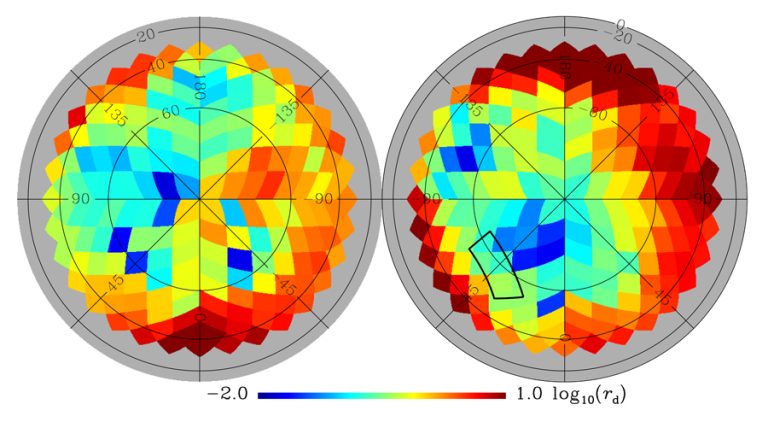
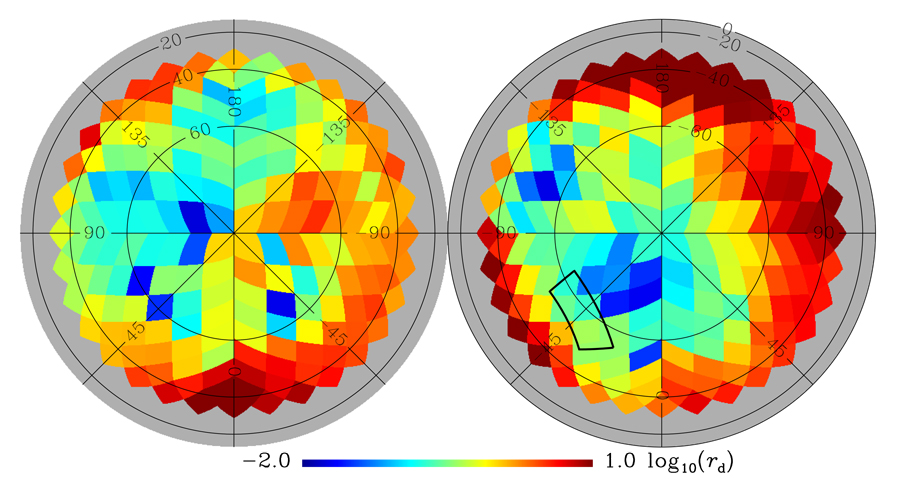
Map of the galactic signal, in units of the cosmological signal, estimated from Planck data. The bluer the areas, the less the cosmic microwave background is masked. Green corresponds to a galactic signal amplitude of the order of the signal detected by BICEP2, which studied the portion of the sky indicated by the black outline.
Credits: ESA & Planck collaboration
Contacts
Advisors (scientific and technical)
Jonathan Aumont & François Boulanger
References
Other sources of information http://fr.arxiv.org/abs/1409.5738
on planck.fr:
http://public.planck.fr/actualites-planck/244-planck-revele-l-ecran-de-poussiere-polarisee-devant-le-rayonnement-fossile
New York Times:
http://www.nytimes.com/2014/09/23/science/space/study-confirms-criticism-of-big-bang-finding.html
Washington Post:
https://www.washingtonpost.com/news/achenblog/wp/2014/09/22/planck-satellite-shows-bicep2-telescope-make-have-seen-dust-not-the-big-bang/