
Planck Reveals Our Galaxy's Magnetic Fingerprint
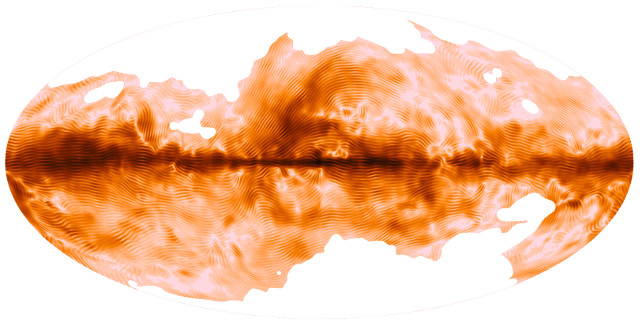
The Milky Way’s magnetic field is revealed in a new map produced by the European Space Agency’s Planck mission. This image is based on the first all-sky observations of the polarized light emitted by interstellar dust in our galaxy.
Light is a form of energy with which we are very familiar, even though some of its properties are not readily apparent. One of these—polarization—is a source of information for astrophysicists. In space, light emitted by stars, gas, or dust can be polarized in various ways. By measuring the polarization of light, astronomers can study the physical processes that give rise to it. In particular, polarization reveals the existence and properties of magnetic fields in the interstellar medium of our Galaxy.
The map shown here was created using detectors from ESA’s Planck satellite, which observed the entire sky from 2009 to 2012 in nine frequency bands in the submillimeter range, between far-infrared and radio wavelengths. Data from the High-Frequency Instrument (HFI) were essential for this finding on the magnetic field. This instrument was designed and assembled under the leadership of the IAS with funding from CNES and CNRS.
The analysis of Planck polarization data is a major area of research for the IAS’s Interstellar Matter and Cosmology team, as part of the Planck consortium. Several permanent researchers are working on this project, as well as early-career researchers funded through the ERC MISTIC project. The IAS team aims to use the polarization of interstellar dust emission to describe the interaction between the magnetic field, turbulence, and the structure of the interstellar medium. To do this, it is necessary to distinguish between the polarization properties of the dust, the mechanisms of grain alignment, and the structure of the magnetic field. The interpretation work is based on a comparison between observational data and MHD numerical simulations of interstellar clouds. The team is also developing a physical model of the polarization of dust emission.
Credits: ESA – Planck collaboration
The Milky Way’s magnetic field as observed by the Planck satellite, in the 353 GHz channel of the HFI instrument. The darkest regions correspond to stronger polarized emission, and the streaks indicate the direction of the magnetic field projected onto the celestial plane.
The swirls, loops, and arcs in this image trace the structure of our Galaxy’s magnetic field. The dark band corresponds to the galactic plane, where polarized emission is particularly intense. The overall structure reveals a regular, large-scale pattern in which the magnetic field lines are mostly parallel to the plane of the Milky Way.
The data also reveal variations in the direction of polarization in clouds of matter near the Sun, as seen on either side of the dark band. There, the observations show changes in the direction of the magnetic field, the origin of which astrophysicists are studying.
Regions at high galactic latitudes have been masked. The signal is weaker there, and additional work is needed to measure and separate the polarization of our Galaxy from that of the cosmic microwave background radiation.
Beyond Our Galaxy
Planck has mapped the intensity of the cosmic microwave background with unprecedented precision, and researchers are now analyzing the data to measure the polarization of this radiation. This is one of the main objectives of the Planck mission, as this polarization could reveal the presence of primordial gravitational waves generated by inflation, shortly after the birth of the Universe. The galactic and cosmological objectives are closely linked because, at the frequencies covered by Planck in polarization, the two types of radiation are mixed together.
In March 2014, scientists from the BICEP2 collaboration announced the first detection of such a signal in data collected by a ground-based telescope observing a small fraction of the sky (1%) at a single frequency. Their result is based on the assumption that the polarization of the foreground emission from our galaxy is negligible in this region.
By the end of this year, the Planck collaboration will release its data based on all-sky observations made by the Planck satellite in the seven frequency bands where the detectors are sensitive to the polarization of light. These multi-frequency measurements should enable astrophysicists to estimate and separate the primordial polarized signal from the foreground signal of our Galaxy. This study will allow for a much more detailed investigation of the early history of the cosmos, from its expansion when the universe was only a tiny fraction of a second old to the birth of the first stars, several hundred million years later.
Contacts
Advisors (scientific and technical)
- François Boulanger (polarization)
- Jean-Loup Puget (Planck)
References
The first four articles on galactic polarization, which have just been submitted to the journal *Astronomy & Astrophysics*:
- Planck Interim Results. XIX. An Overview of the Polarized Thermal Emission from Galactic Dust
- Planck Intermediate Results. XX. Comparison of Polarized Thermal Emission from Galactic Dust with Simulations of MHD Turbulence
- Planck Interim Results. XXI. Comparison of Polarized Thermal Emission from Galactic Dust at 353 GHz with Optical Interstellar Polarization
- Planck Interim Results. XXII. Frequency Dependence of Thermal Emission from Galactic Dust in Intensity and Polarization