
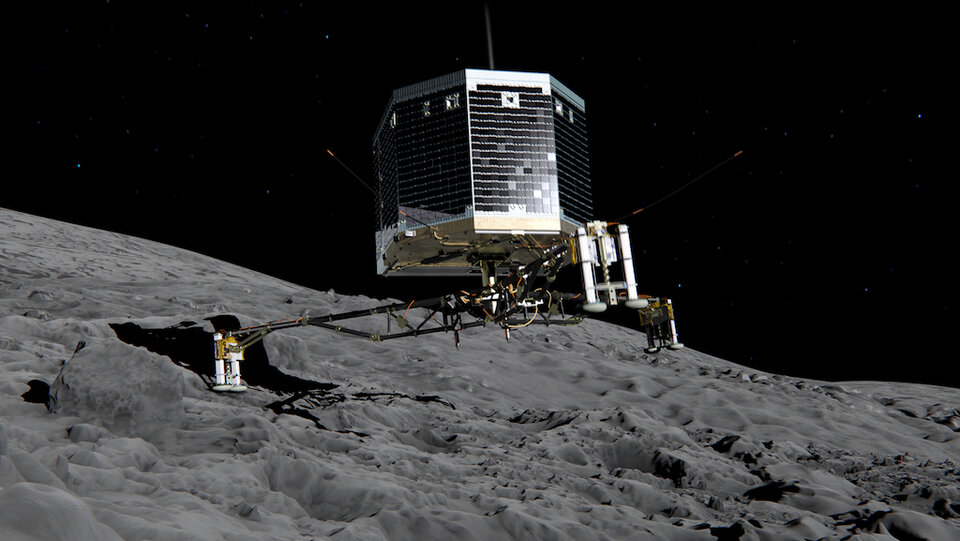
After seven months of hibernation, Philae sent two signals shortly before midnight on the nights from Saturday to Sunday and from Sunday to Monday (June 13, 14, and 15, 2015). Our hope that Philae would wake up and send us a signal has just come true.
The transmitted information (“status data”) indicates that the lander is in good overall condition and ready to resume scientific activities. Both data processing units are operational; internal temperatures are sufficient to power up the systems and recharge the batteries; the solar panels are receiving enough energy (25 W at peak) to allow for satisfactory operation—they are not covered with absorbent organic dust or reflective ice, despite cometary activity; essential functions are being maintained.
Data transmission from Philae to Rosetta (the orbiter) was very brief (85 seconds for the first contact, even less for the second), likely for purely geometric reasons: due to cometary activity, Rosetta had to be moved away from the nucleus (to more than 200 km), requiring precise pointing to establish a link with Philae (whose exact position and attitude are still unknown), which was achieved only by the skin of its teeth. It is this optimization (of Rosetta’s orbit and attitude) that will be the focus of most of the effort over the next few days, in order to achieve communication durations of several tens of minutes during each cometary rotation. Such durations will enable Philae to receive commands for the new measurement and observation sequences—which have already been prepared and tested on the ground—and then to transmit the scientific data acquired from them to Rosetta (and subsequently to Earth).
Among the very first measurements will be new images taken by the CIVA cameras under different lighting conditions to characterize Philae’s environment. Next, sample collection and analysis are scheduled to take place to further determine the composition of the cometary material.
For Philae and for the scientific and technical teams—including the IAS team, which has been deeply involved in this entire mission—the fantastic adventure continues!