NASA/JPL-Caltech/MSSS
Perseverance – Mars 2020
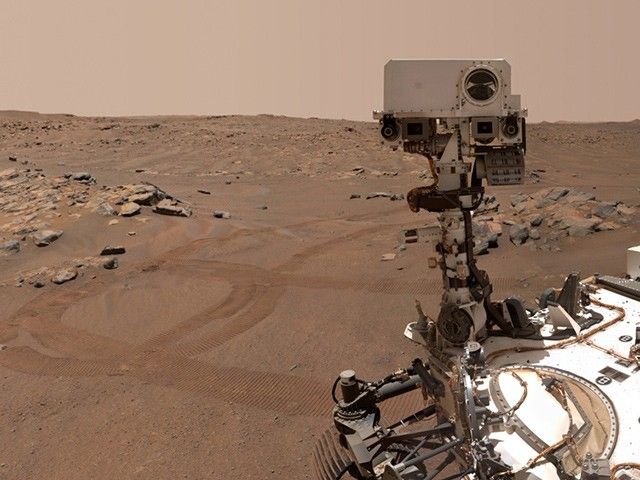
The Mars2020/Perseverance rover is NASA's second major mobile in-situ planetary exploration mission. The rover's architecture is based on that of Curiosity, with the exception that the mission will have the capability to encapsulate Martian samples, which could subsequently be retrieved by another mission known as a Sample Return Mission.
The role of IAS
IAS is responsible for the calibration of the IRS near-infrared point spectrometer developed by LESIA and IRAP within the SuperCam instrument consortium led by Los Alamos. IRS is the first near-infrared spectrometer on the Martian surface. It is one of SuperCam's primary instruments, enabling constraints on the mineralogical composition of Martian rocks and soil. We also actively participated in the selection of the landing site.
Status
Operational
Key dates (est.)
- July 30, 2020: Launch of the Mars2020/Perseverance mission.
- February 18, 2021: Landing of the rover on Mars (Jezero Crater).
- 2020–present: Operational phase, including calibration and operation of SuperCam/IRS.
Key milestones
- Design and Development :
- Adaptation of the Curiosity rover architecture for Perseverance.
- Development of the SuperCam instrument, including the IRS spectrometer (the first near-infrared spectrometer on Mars).
- Active participation in the landing site selection.
- Integration and Testing :
- Calibration of the IRS spectrometer by IAS.
- Validation of the Martian sample encapsulation capability for a future return mission.
- Launch and Mission :
- Launch of the Perseverance rover (date not specified in the text, but known to be July 30, 2020).
- Landing on Mars (known date: February 18, 2021).
- Commencement of scientific operations, including the use of SuperCam/IRS to analyze the mineralogical composition of Martian rocks and soil.
- Future Outlook :
- Preparation for a sample return mission (in collaboration with other space agencies, such as ESA).
Space instruments
SuperCam, PIXL, SHERLOC, MOXIE, MEDA, RIMFAX, MASTcam-Z
Contacts
Scientific and Technical Contacts
- François Poulet, Astronomer, Solar System and Planetary Systems Physics Team