
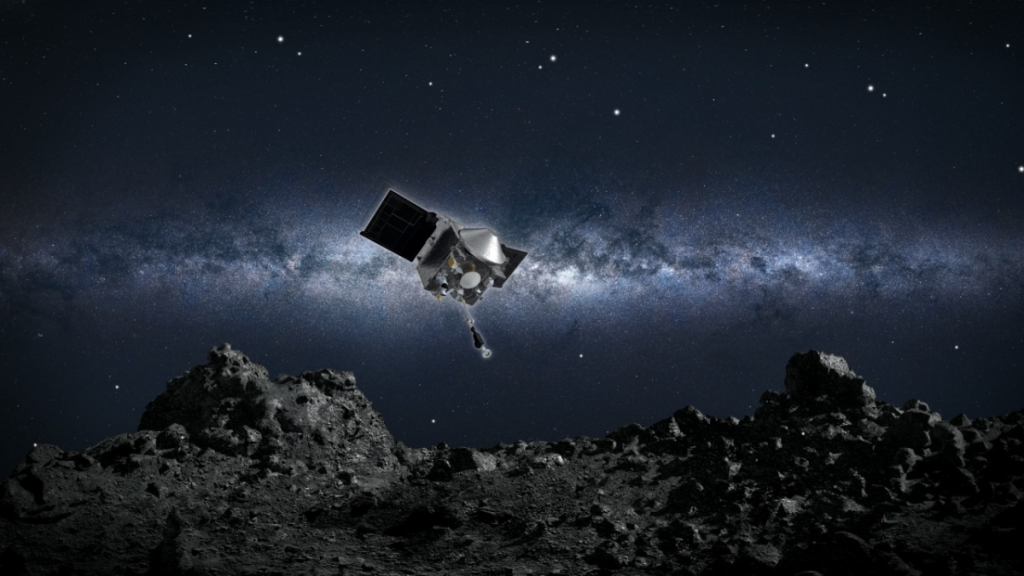
Artist's rendering of the OSIRIS-REx/NASA spacecraft preparing to collect grains from the surface of Bennu.
Credit: NASA/Goddard/University of Arizona
OSIRIS-REx
OSIRIS-REx (short for Origins, Spectral Interpretation, Resource Identification, Security, Regolith Explorer) is a NASA space mission aimed at returning samples from the carbonaceous near-Earth asteroid Bennu to Earth in late 2023.
The spacecraft was launched in September 2016 and arrived near Bennu in December 2018. Since then, it has been orbiting the asteroid to map its entire surface in order to select the best location for sample collection. The sample collection at the Nightingale site was a success in the fall of 2020.
The Role of the IAS
The IAS contributes to the interpretation of orbital data from the OVIRS and OTES spectrometers. In addition, the IAS provides expertise in understanding space weathering phenomena through comparisons with laboratory experiments that simulate these processes.
While spectroscopic measurements taken in orbit provide a better understanding of Bennu, only an in-depth laboratory analysis of the samples collected from its surface will allow us to learn more about the physicochemical properties of these small bodies.
In late 2020, JAXA’s Hayabusa-2 mission reported findings from another carbon-rich near-Earth asteroid: Ryugu. Comparing Bennu and Ryugu will provide valuable insights for the study of asteroids!
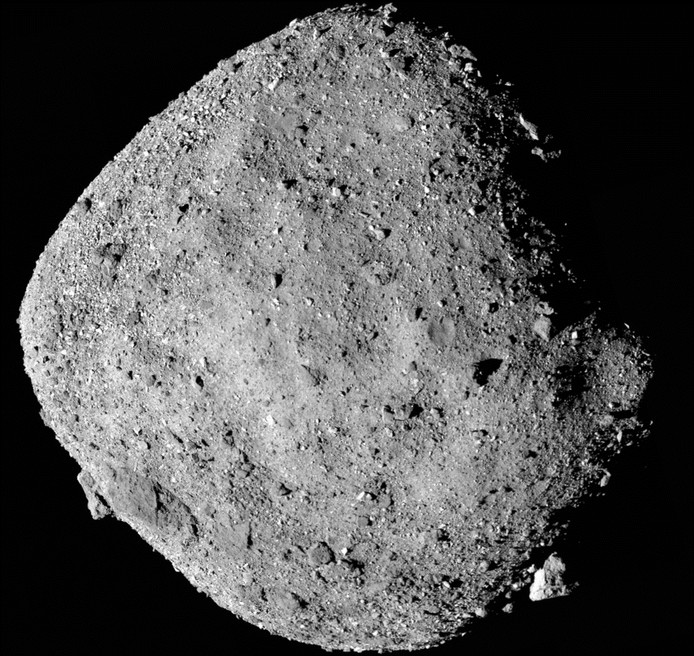
The asteroid Bennu as seen from a distance of 24 km during the OSIRIS-REx spacecraft’s approach phase (a mosaic composed of 12 images taken by the PolyCam instrument on December 2, 2018).
Credit: NASA/Goddard/University of Arizona
Status
In operation
Partners (academic / industrial)
Funding Sources
Key Dates (tentative)
Key Steps
Launch: 2016
Data collection: 2023
Contacts
Advisors (scientific and technical)
- Cateline Lantz, Assistant Astronomer, Solar System and Planetary Systems Physics Team