OSIRIS-REx (Origins, Spectral Interpretation, Resource Identification, Security, Regolith Explorer) is a NASA space mission in which a researcher from the IAS is collaborating. While data from the in-orbit mission have already provided a better understanding of Bennu, only an in-depth laboratory analysis of the samples collected from the surface and brought back to Earth will allow us to learn more about the physicochemical properties of these small bodies. Bennu is a “carbonaceous” near-Earth asteroid. There are three main reasons for studying it:
- to gain insights into the conditions that governed the early stages of the Solar System’s formation, since asteroids are the remnants of planetesimals (protoplanetary embryos);
- to understand the origin of life and water on Earth, since Bennu is rich in organic matter and hydrated material;
- to assess the risks of collision with these objects near Earth’s orbit.
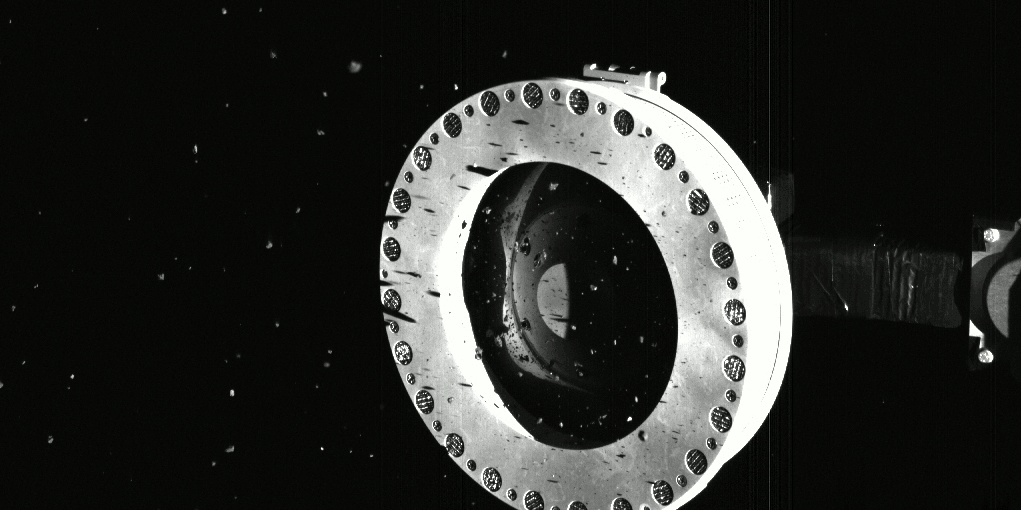
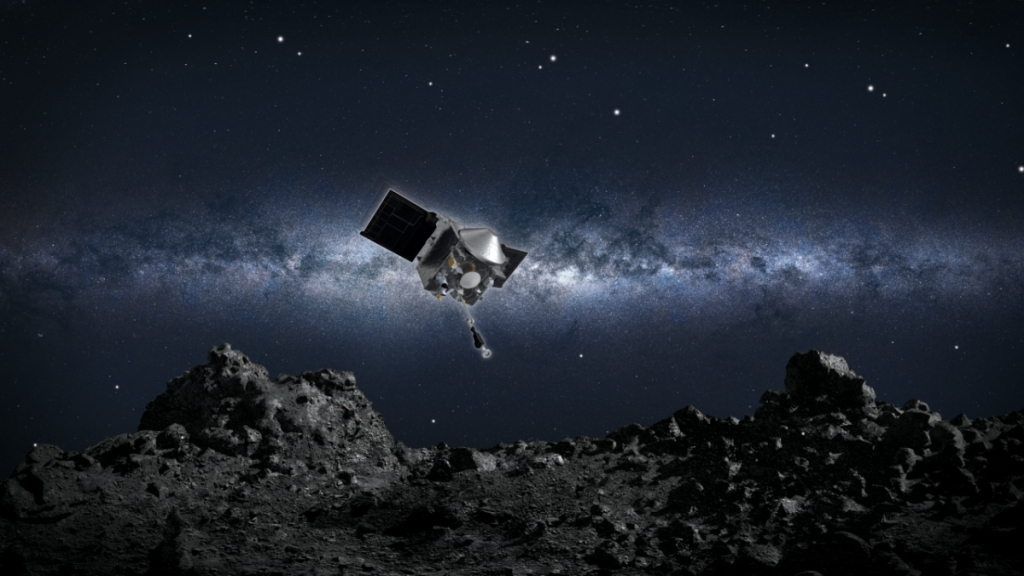
To collect samples from Bennu’s surface, OSIRIS-REx deployed an arm over 3 meters long, which is set to make contact with the surface at a site called Nightingale. At that moment, gas (nitrogen) was expelled to lift particles, dust, and other grains from the surface, which were then captured by the collection system at the end of the arm. The spacecraft was then able to safely return to orbit. An analysis of images from the probe’s onboard cameras showed that the collection system was filled with particles from Bennu. The operation was so successful that there is now too much material in the tank: the precious cargo is leaking! An urgent decision was therefore made to store the samples as quickly as possible in the capsule that will bring them back to Earth. It’s worth noting that right now, JAXA’s Hayabusa-2 mission—in which several IAS scientists are participating—is on its way back from the carbon-rich near-Earth asteroid Ryugu. Laboratory analysis is scheduled to begin in January 2021. Comparing Bennu and Ryugu will provide valuable insights for the study of asteroids!