
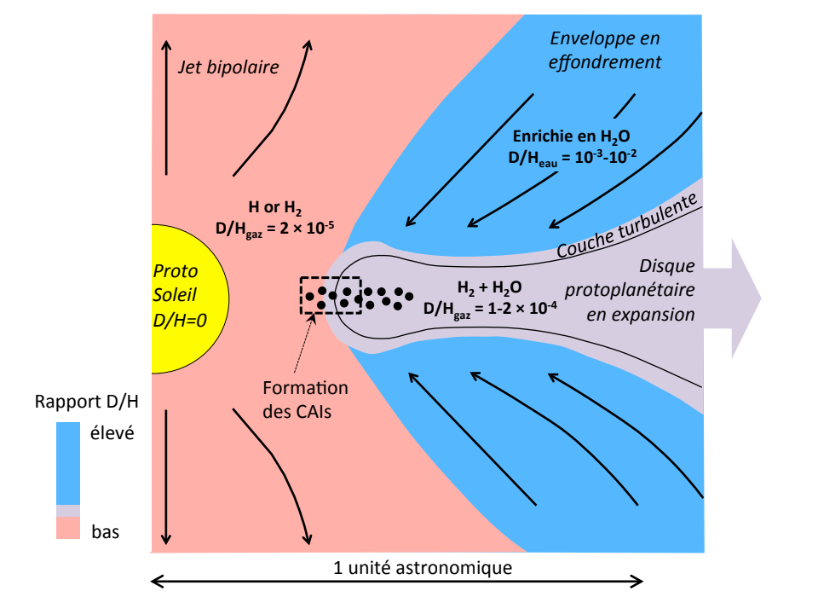
Figure 1: Schematic representation of the inflow of interstellar water into the innermost regions of the solar system while the protoplanetary disk is still forming, fed by the collapsing interstellar envelope. Cross-sectional view. 1 astronomical unit = the distance between the Earth and the Sun.
The Origin of Water in the Inner Solar System: The Initial Isotopic Composition of Hydrogen Finally Revealed!
Water-rock interactions are essential to the formation of planets, particularly the Earth. In fact, the origin of water in objects in the solar system has always been extensively studied.
In particular, the isotopic composition of the hydrogen and oxygen that make up water is a key tracer of its sources. The isotopic composition of the hydrogen in the water of terrestrial planetary bodies lies between that of interstellar water—which is very rich in deuterium—and that of gaseous hydrogen, which is depleted in deuterium due to nuclear reactions in stars. This specific composition is usually explained by a mixture of interstellar water from the cold outer regions of the solar system and solar hydrogen from the hot inner regions. This composition forms the basis for the prevailing model of a late origin of water on Earth through cometary or asteroidal bombardment. However, until now, one fundamental unknown remained that was necessary to validate all these models: the initial isotopic composition of water in the solar system, particularly in the inner regions of the solar system where the building blocks of the terrestrial planets formed.
We therefore measured the hydrogen isotopic composition of one of the oldest rocks in the solar system—a calcium- and aluminum-rich (CAI) meteorite inclusion—using an innovative methodology developed for this study to determine the isotopic composition of micrometric, hydrogen-poor minerals formed at high temperatures in the inner protoplanetary disk. Our results show the preservation of two different isotopic compositions in certain microminerals:
- A solar isotopic composition that is almost devoid of deuterium is observed in reduced minerals that have condensed directly at high temperatures.
- An Earth-like isotopic composition is observed in oxidized minerals before they are incorporated into the CAI.
In conclusion, this dichotomy reflects the existence of two gas reservoirs dating back to the formation of CAIs—that is, during the first 200,000 years of the solar system, even before the formation of the first planetary embryos. One of these reservoirs is the solar gas that gave rise to all the matter in the solar system, measured directly for the first time in a meteorite. The second is a gas enriched in water vapor, possessing the Earth’s isotopic composition from the outset. Its formation can be explained by a massive influx of interstellar water into the hot inner regions of the solar system during the collapse of the interstellar envelope and the formation of the protoplanetary disk. Its early existence implies that no late influx is needed to explain the isotopic composition of water in Earth’s oceans, since the building blocks of the terrestrial planets formed in a gas that already had this composition. The interstellar input responsible for planetary water in the solar system is likely also responsible for most planetary volatiles, such as oxygen and nitrogen.
The participating laboratories are IMPMC (Sorbonne University), IAS (Paris-Saclay University), NIMBE (CEA–Paris-Saclay University), and ICMMO (Paris-Saclay University).
Reference:
J. Aléon, D. Levy, A. Aléon-Toppani, H. Bureau, H. Khodja, and F. Brisset (2022) “Determination of the initial hydrogen isotopic composition of the solar system,” *Nature Astronomy*, published February 3.