
New discovery of a highly active galaxy protocluster dating back to when the Universe was 3 billion years old
A galaxy "proto-cluster" dating from the most active epoch of the Universe has been discovered. It is intensely forming stars at a high rate that is barely compatible with current models, and it is expected to evolve into a galaxy supercluster.
Galaxy proto-clusters are associations of very young galaxies coalescing under the effect of gravity, which will give rise to the largest known gravitational structures: galaxy clusters in the local universe. Understanding the formation mechanisms at play within these structures could prove invaluable for comprehending the history and structuring of the Universe. The results of the international team's work (France, Italy, USA, Japan), presented in two publications, provide essential insights into the properties of this proto-cluster, designated PHz G237.01+42.50 (abbreviated as G237), and its constituent galaxies.
G237 is the first spectroscopically confirmed proto-cluster from a sample of over 2,000 candidates identified by Planck, the ESA satellite launched in 2009 to probe the cosmic microwave background, developed largely at IAS. This sample complements, at a higher redshift, the closer galaxy clusters detected via the Sunyaev-Zel'dovich effect by Planck. G237 is observed as it was when the Universe was 3 billion years old (redshift z = 2.16), corresponding to the peak epoch of stellar mass density in the Universe.
The ultimate fate of this galaxy proto-cluster is to evolve into a complex system similar to the Virgo Supercluster, a massive structure in the local Universe to which our galaxy, the Milky Way, belongs. Planck observations reveal a proto-cluster with a prodigious star formation rate, ten thousand times higher than that of our galaxy.
Additional observations using several ground-based and space telescopes, including ESA's Herschel, confirmed its association with two dense concentrations of galaxies. Each of these is expected to collapse in approximately 10 billion years into a galaxy cluster whose dark matter halo will have a mass of 5 to 6×10¹⁴ solar masses, equivalent to the largest current galaxy clusters.
"The 38 galaxies identified with the MOIRCS instrument on the Subaru telescope in Hawaii," notes Y. Koyama, lead author of one of the two studies, "are the star-forming galaxies containing the least galactic dust in the proto-cluster, but there may be many more members missed by our optical selection."
"We estimate that the total star formation rate in the proto-cluster is remarkably high, at least 2,200 solar masses per year, and likely twice that based on the estimated number of dust-obscured galaxies that went undetected in optical observations but are revealed in the infrared," states Dr. Mari Polletta (INAF & IRAP), lead author of the second study and director of ground-based observations at the Large Binocular Telescope Observatory in Arizona.
"Planck detected these proto-cluster candidates from space about a decade ago. Confirming and studying them required time, numerous observations with other telescopes, and dedicated hard work by researchers and students," explains Prof. Hervé Dole, astrophysicist at IAS (CNRS / Université Paris-Saclay) and co-signatory of both studies. "It is a great achievement to finally see one of these proto-clusters studied in detail, but many questions remain open as they challenge formation models and, to some extent, our understanding of star formation within the most massive dark matter halos in the distant Universe. The upcoming European space cosmology mission Euclid, scheduled for launch in 2023, should enable the identification of similar structures, thereby establishing more general laws than those based on a few individual cases."
Further observation campaigns are underway on other Planck proto-cluster candidates, notably using IRAM millimetric telescopes. These initial results are part of a broader project aimed at better understanding the assembly of massive structures such as galaxy proto-clusters, the mechanisms driving their star formation rates, and the interaction between the dense environment and the rapid evolution of galaxies inhabiting these dark matter halos.
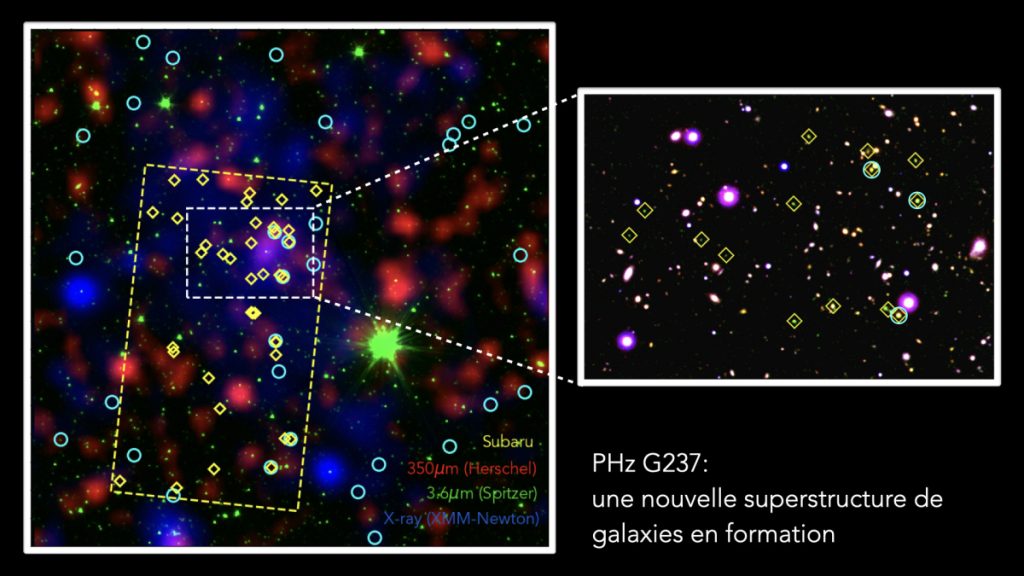
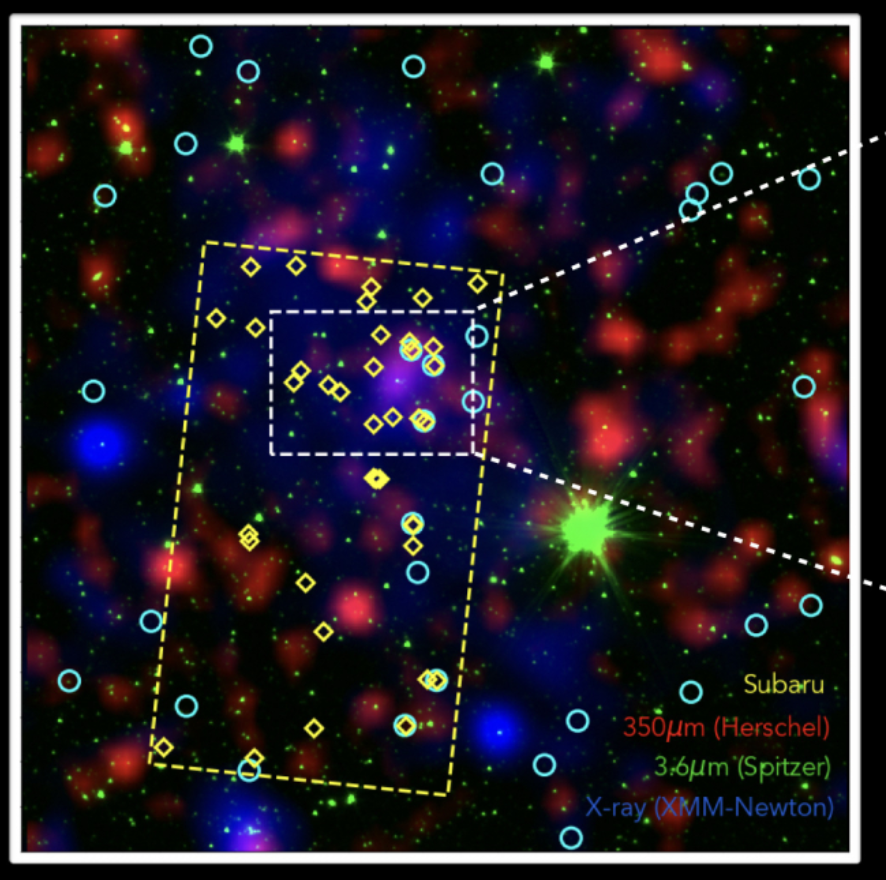
Region of the sky showing the galaxy proto-cluster G237 when the universe was approximately 3 billion years old. Left: 11×11 arcminute field of view. Right: 2.7×1.9 arcminute zoom. © ESA/Herschel and XMM-Newton; NASA/Spitzer; NAOJ/Subaru; Large Binocular Telescope; ESO/VISTA; Polletta et al. 2021; Koyama et al. 2021.
The French laboratories involved are IAS (CNRS/Univ. Paris-Saclay), IRAP (CNRS/Université Toulouse III – Paul Sabatier/CNES), IAP (CNRS/Sorbonne Université), LAM (CNRS/Aix-Marseille Université/CNES), and CRAL (CNRS/Université Claude Bernard Lyon 1/ENS de Lyon).
References:
- A Planck-selected dusty proto-cluster at z=2.16 associated with a strong over-density of massive Hα emitting galaxies, authored by Yusei Koyama, Maria del Carmen Polletta, Ichi Tanaka, Tadayuki Kodama, Hervé Dole, Geneviève Soucail, Brenda Frye, Matt Lehnert, Marco Scodeggio, 2021, MNRAS, 501, L1, https://ui.adsabs.harvard.edu/abs/2021MNRAS.503L…1K/abstract and https://arxiv.org/abs/2008.13614
- Spectroscopic observations of PHz G237.01+42.50: a galaxy protocluster at z=2.16 in the Cosmos field, authored by M. Polletta, G. Soucail, H. Dole, M. D. Lehnert, E. Pointecouteau, G. Vietri, M. Scodeggio, L. Montier, Y. Koyama, G. Lagache, B. L. Frye, F. Cusano, and M. Fumana, 2021, A&A, 654, A121, https://arxiv.org/abs/2109.04396
References
- UPSaclay Press Release
- CNRS Press Release
- Subaru Press Release (Japanese, English)
- LBTO Press Release
- INAF Press Release