
New Planck Results: The First Stars Formed Later Than Previously Thought
New insights into dark matter, neutrinos, the first stars, and the cosmological model: the Planck collaboration—which includes significant participation from the Institute of Space Astrophysics—has just published nearly twenty new papers, revealing important findings that will lead to a better understanding of certain pivotal periods in the history of the Universe.
The history of the universe is a true cosmic epic that began some 13.8 billion years ago. For many decades, scientists have been working to unravel it in ever-greater detail. One of their primary sources of information is the Cosmic Microwave Background (CMB), the fossil radiation emitted by the Universe when it was very dense and hot, approximately 380,000 years after the Big Bang. The data collected by the Planck satellite after four years of observing the CMB—including, notably, the highest-resolution image of the fossil radiation—was eagerly awaited by the scientific community. For the first time, analysis of this data provides scientists not only with a static image of the universe, but also a dynamic one, allowing them to explore the inner workings of the cosmological model in detail.
The First Stars: Younger Than Expected.
Among the new insights gleaned from the Planck data, cosmologists have determined the current rate of expansion of the universe. This has allowed them to re-estimate the current age of the universe at 13.77 billion years. Even more surprising, their refined estimate of when the very first stars formed places this event at approximately 550 million years after the Big Bang—much later than previously thought. Finally, thanks to the high precision of the data, astrophysicists were able to determine the proportions of the Universe’s constituents: it consists of 4.9% ordinary matter, 25.9% dark matter—whose nature remains unknown—and 69.2% dark energy, a form of energy distinct from dark matter but of an even more mysterious nature. However, the most significant new development comes from the information on the polarization of light from the FDC. Thanks to this data, scientists are now able to test numerous hypotheses underlying their cosmological models, concerning both the physical laws governing the Universe and the properties of its constituents (neutrinos and dark matter, for example). Today, these new data provide scientists around the world with a particularly solid foundation for exploring the earliest epochs in the history of the Universe, moving ever closer to the Big Bang.
Understanding the Cycle of Matter in the Interstellar Medium
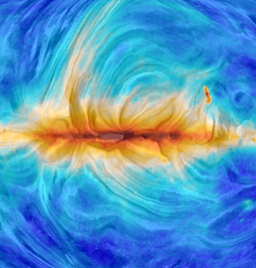
Another fundamental area in which Planck’s observations will enable the scientific community to deepen its understanding of the Universe concerns our Galaxy’s magnetic field. This field is very important because it plays a key role in the life cycle of interstellar matter. The discovery of magnetism in our Galaxy is closely linked to that of cosmic rays. Without the magnetic field, these particles—accelerated by supernovae to speeds approaching that of light—would have quickly left the interstellar medium. However, the force exerted by the magnetic field keeps these particles confined within the Galaxy. Furthermore, the magnetic field itself is closely linked to interstellar matter. Finally, in the presence of a magnetic field, collisions and coupling with the stellar radiation field tend to align interstellar dust grains. This alignment is responsible for the polarization of the radiation emitted by the dust. For the first time, the Planck satellite measured this polarization across the entire sky.
Interstellar matter, magnetic fields, and cosmic rays form a dynamic system: they are strongly coupled to one another, and one cannot fully understand one of them without taking the other two into account. The importance of the magnetic field in this “three-way relationship” has long been known, but the observations available to scientists until now have been relatively fragmented. The latest results from the Planck mission will be of great help in this regard, particularly through its two unprecedented maps of the polarized sky. The polarization of synchrotron radiation, much like that of dust, traces the magnetic field lines. Thus, the Planck data reveal, with an unprecedented level of detail, the overall structure of the Galactic magnetic field.
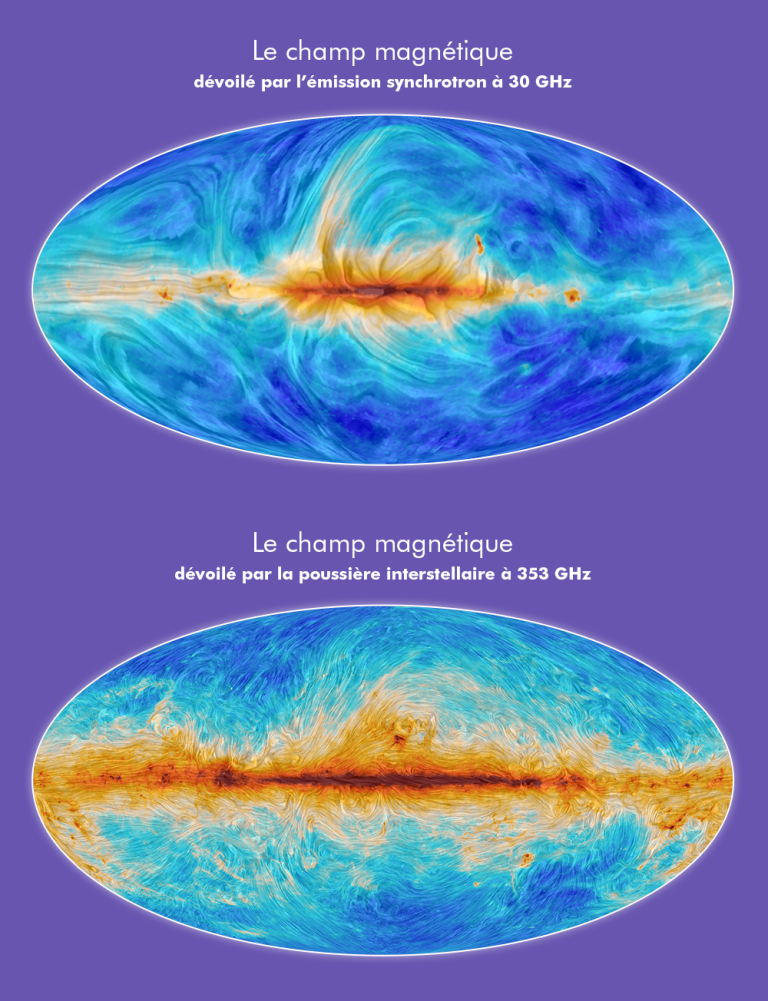
Planck images of synchrotron radiation polarization (left) and dust (right). The colors represent the intensity of the emission, while the texture reflects its polarization. In regions where the texture is smooth, it indicates the direction of the magnetic field. The data are more difficult to interpret where the texture is very irregular. Credits: ESA / Planck collaboration / M.-A. Miville-Deschênes, CNRS – Institute of Space Astrophysics, Paris-Sud University, Orsay, France
Contacts
Advisors (scientific and technical)
Jean-Loup Puget, François Boulanger, Marc-Antoine Miville-Deschênes, Jonathan Aumont
References
Additional information on the recent results from the Planck mission :
- Scientific articles submitted for publication: http://www.cosmos.esa.int/web/planck/publications
- Summary in French with interactive maps: http://public.planck.fr/actualites-planck/264-planck-devoile-le-cote-dynamique-de-notre-univers