
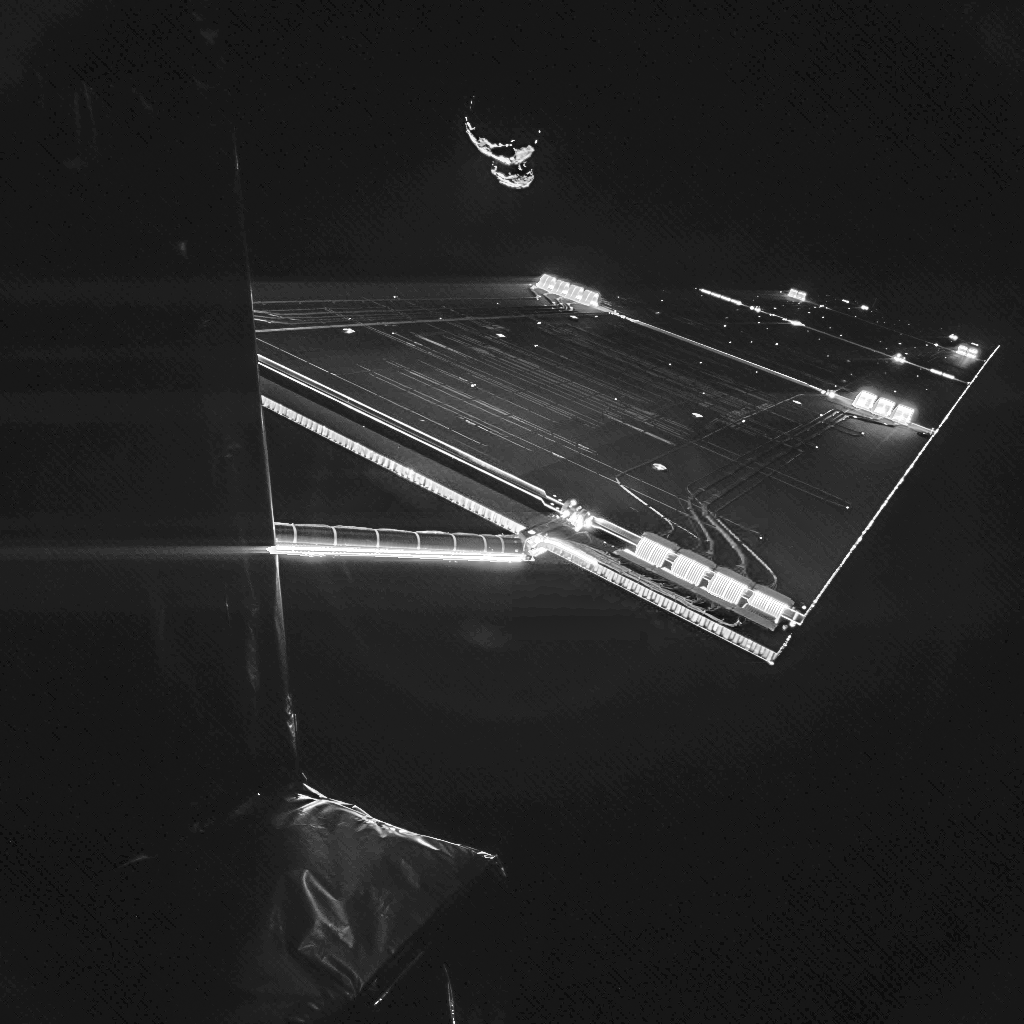
On October 7, 2014, one of the cameras on the CIVA instrument captured a striking new image of Rosetta and Comet Churyumov-Gerasimenko, which was then only 16 km away. CIVA is a set of cameras mounted on the Philae lander of the Rosetta spacecraft and developed under the leadership of the IAS.
In the foreground, this image shows one of the solar panels and part of the structure of the Rosetta orbiter, from which Philae will be ejected on November 12 to land on the nucleus of Comet Churyumov-Gerasimenko. The image, obtained by combining two different exposure times, is the last one expected to be taken by CIVA before Philae’s ejection.
The comet, visible here from a distance of 16 km, is currently located halfway between the orbits of Mars and Jupiter, more than 470 million km from Earth. The planned landing site is located on the lower part of the nucleus’s lower lobe.
The CIVA cameras were developed under the leadership of the IAS, in collaboration with the Marseille Astrophysics Laboratory. They were designed to capture a complete panorama (including a stereoscopic view) once Philae has landed. This image demonstrates the performance achieved, in terms of dynamics and optical properties, despite a very low operating temperature (-90°C).