


JUICE/MAJIS
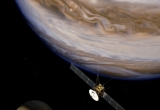
The main objectives of the JUICE (Jupiter Icy Moons Explorer) mission are to perform detailed observations of the giant planet Jupiter and three of its largest icy moons: Ganymede, Europa, and Callisto. IAS is scientifically and technically responsible for the visible and infrared imaging spectrometer MAJIS (Moons And Jupiter Imaging Spectrometer), a major instrument of the JUICE payload. The instrument was delivered in 2021, and the launch took place on April 14, 2023, from Kourou aboard Ariane 5.
Contacts : François Poulet (PI), Cydalise Dumesnil (project manager)

JUICE is the L1 mission of ESA’s science program. It aims to better understand the physical processes governing the Jovian system and to constrain the habitability of the icy moons, particularly Ganymede and Europa.
The MAJIS instrument and its scientific objectives
MAJIS is a hyperspectral imaging spectrometer covering the spectral range 0.5–5.56 µm, enabling the acquisition of a detailed spectrum for each pixel.
MAJIS contributes to some major JUICE objectives:
- characterization of icy surface composition,
- study of surface–interior exchanges,
- identification of habitability indicators,
- analysis of geological processes,
- understanding of surface alteration processes,
- study of Jupiter’s atmosphere.
Cruise phase
JUICE is currently in its 8.5-y cruise phase. This phase is a key step for the in-flight validation of MAJIS. It enables:
- verification of radiometric, spectral, and geometric performance,
- validation of observation modes and ground segment tools,
- preparation of data processing pipelines.
Observations performed on spatially resolved objects during planetary flybys are of great interest, as they provide data covering a wide range of illumination and geometric conditions in flight, which is not achievable during ground validation tests prior to launch.
Moon–Earth flyby (August 2024)
During the combined gravity assist on August 19–20, 2024, MAJIS acquired several hyperspectral cubes of the Moon and Earth.
Objectives:
- in-flight validation of instrument performance,
- testing under high flux and high dynamic range conditions,
- assessment of stray light and saturation effects.
Main results:
- lunar observations with spatial resolution down to ~100–150 m,
- simultaneous access to reflectance and thermal emission up to 5.56 µm,
- Earth observations covering day/night geometries,
- detection of atmospheric signatures and characterization of cloud microphysics,
- validation of radiometric and geometric performance.
These data constituted a key milestone in the in-flight qualification of the instrument and in the preparation of observations of the icy moons. The results are presented in a series of papers (https://angeo.copernicus.org/articles/44/163/2026/).
News: Observation of the interstellar comet 3I/ATLAS in November 2025
During the cruise phase, MAJIS observed the interstellar comet 3I/ATLAS as part of a coordinated campaign with other JUICE instruments.
Context:
- object of extrasolar origin,
- challenging observation conditions (distance, geometry, thermal constraints),
- unique opportunity to study primitive material.
MAJIS contributions:
- spectral analysis of the coma,
- identification of volatile ices and organic compounds.
These observations demonstrate MAJIS’s capability to exploit scientific opportunities beyond the core Jovian mission and validated the instrument’s low-signal operating modes.
Consortium
IAS is in charge of the scientific and technical leadership of MAJIS.
LPG (OSUNA) and LAB (OSUA) contribute to instrument operations, while LIRA (Paris Observatory) is in charge of the production of geometric cubes.
MAJIS was developed within an international consortium involving in particular France and Italy, with support from CNES, ASI, and ESA.
