
A wealth of scientific findings from the Solar Orbiter mission
Although the mission has only just entered its scientific operations phase, Solar Orbiter has already produced many remarkable results. A special issue of *Astronomy and Astrophysics* published recently brings together a wealth of studies and observations obtained during the mission’s cruise phase. No fewer than 56 articles were published, each containing data produced by one or more of Solar Orbiter’s instruments, in which numerous laboratories—including the IAS—were heavily involved.
After launching in February 2020 and traveling nearly two billion kilometers over 21 months, the probe used Earth’s gravitational assist one last time on November 27, marking the end of its cruise phase and the beginning of its scientific operations phase. During the cruise phase—which was primarily used to commission, test, and calibrate the probe’s ten instruments (remote sensing and in-situ measurement instruments)—the data collected proved to be of such high quality that it has already enabled several scientific studies to be undertaken.
The scientific operations phase, which has just begun, is therefore promising. It will be marked in late March 2022 by a first perihelion (closest approach to the Sun) at 0.3 astronomical units, which is roughly the minimum distance between Mercury and the Sun.
The IAS is heavily involved in three of Solar Orbiter’s instruments: PHI (Polarimetric and Helioseismic Imager), EUI (Extreme Ultraviolet Imager), and SPICE (SPectral Imaging of the Coronal Environment). The IAS serves as co-principal investigator for EUI and principal investigator for SPICE.
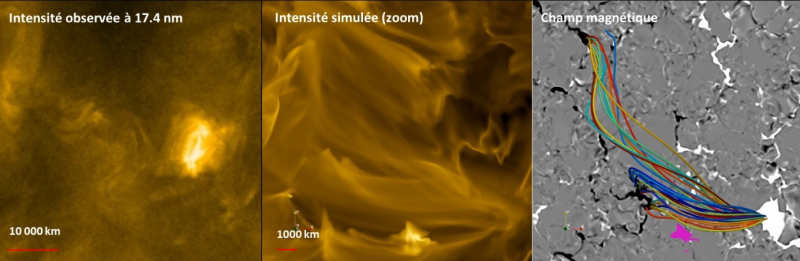
The first observations from EUI immediately yielded some of the highest-resolution images ever obtained of the solar corona. These images revealed bright structures on a very small scale (as small as 400 km) that appear to be the signature of the “nano-eruptions” envisioned by Eugene Parker more than 20 years ago to resolve the problem of solar corona heating: how to explain that our star’s atmosphere has a temperature of over a million degrees while its surface is only 5,000 degrees? The main characteristics of the events observed by EUI are in good agreement with magnetohydrodynamic (MHD) models. However, these high-resolution observations obtained during the in-flight acceptance testing phase lasted only 5 minutes and do not allow for the statistical analysis needed to determine whether nano-eruptions alone can maintain the temperature at such a high level. Dedicated observations are therefore planned for the next perihelion, during which the spatial resolution will be twice as high.
The SPICE spectrograph was designed to provide maps of the chemical composition of the Sun’s atmosphere, with the aim of identifying the sources of the solar wind by comparing them with in situ composition measurements. SPICE observations conducted during the in-flight acceptance testing phase identified bright spots of unusual intensity and duration. It is possible that there is a link between these structures and those observed by EUI (see above). Here again, observations during the first perihelion of Solar Orbiter’s scientific operations phase are eagerly anticipated.
Contacts
Advisors (scientific and technical)
Contact at the IAS: Frédéric Auchère (Solar and Stellar Physics)