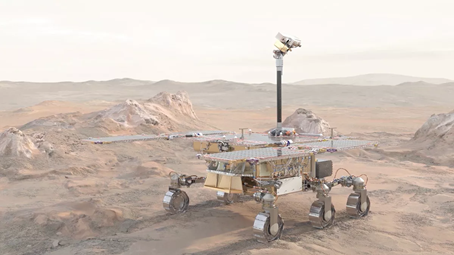
The European Space Agency’s (ESA) ExoMars mission aims to characterize this exobiological potential. The mission consists of an orbiter (Trace Gas Orbiter / TGO), launched in 2016 and currently in orbit around Mars, and a rover scheduled for launch in 2028.
The ExoMars rover will be equipped with a drill that will allow it to collect samples from depths of up to 2 meters, where traces of life may have been preserved.
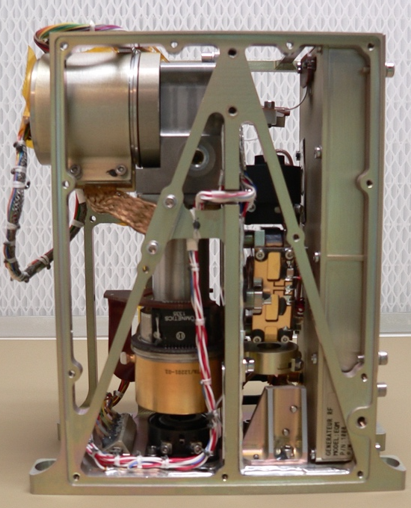
Once the samples have been collected using the drill, they will be ground up and then distributed via a carousel (SPDS / Sample Preparation and Distribution System) to the various instruments in a small laboratory located inside the rover itself: the MicrOmega visible/near-IR hyperspectral microscope developed by the IAS, the RLS Raman spectrometer, and MOMA (Mars Organic Molecule Analyzer), a mass spectrometer coupled with a gas chromatograph.
The scientific objectives of MicrOmega, which are central to those of the ExoMars mission, are to perform non-destructive mineralogical and molecular (organic) analysis of the samples down to scales of ~20 µm. The objectives are, on the one hand, to identify and characterize the main constituents of the samples, and on the other hand, to locate (“Regions of Interest,” RoI) those whose composition is of particular interest in light of the mission’s primary objectives; this will allow the two instruments (RLS and MOMA), which are point spectrometers, to continue and refine the analysis using complementary techniques.
MicrOmega therefore combines its own scientific objectives and contributes to the “combined science” that is a key feature of this mission: indeed, such coupled studies on a microscopic scale have never before been conducted aboard a Mars space mission. In this regard, MicrOmega will play a pivotal role in maximizing the mission’s scientific success.