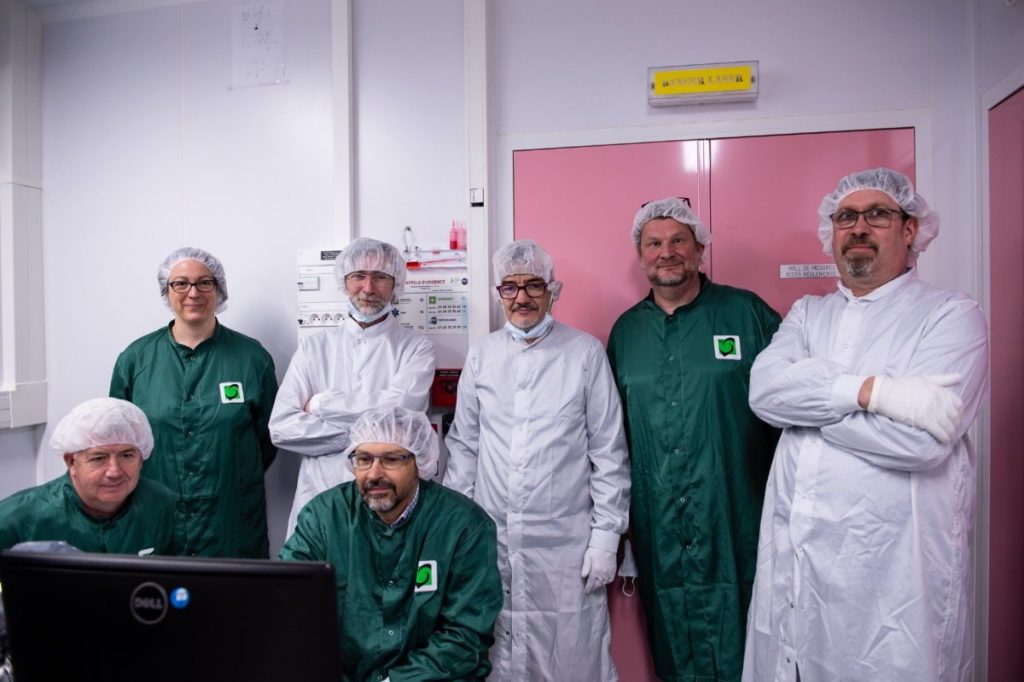
On Monday, March 12, 2019, the IAS delivered the flight model of the calibration unit (CU) for the VIS instrument of the Euclid mission. Euclid is an M2 mission under ESA's Cosmic Vision program, with the scientific objective of mapping the Universe to determine the cause of accelerating expansion. It will achieve this by looking back up to 10 billion years in time and making highly precise measurements of the shape and distribution of galaxies in the Universe.
The Euclid telescope will feed the two payload instruments: NISP (Near InfraRed SPectrometer, managed by LAM, France) and VIS (VISible instrument, managed by MSSL, United Kingdom). The IAS designed, built, and tested the calibration unit (CU) for the VIS instrument. The objective of the CU is to provide a highly uniform light beam covering the focal plane to enable flat-field calibrations throughout the mission's lifetime. The primary technical complexity lies in achieving a beam uniformity better than 83% across the entire large focal plane (measuring 300 mm by 360 mm) and better than 98% across all local 6 mm x 6 mm regions. Furthermore, beam extinction must occur within a transition zone of less than 13 mm to limit stray light within the instrument.
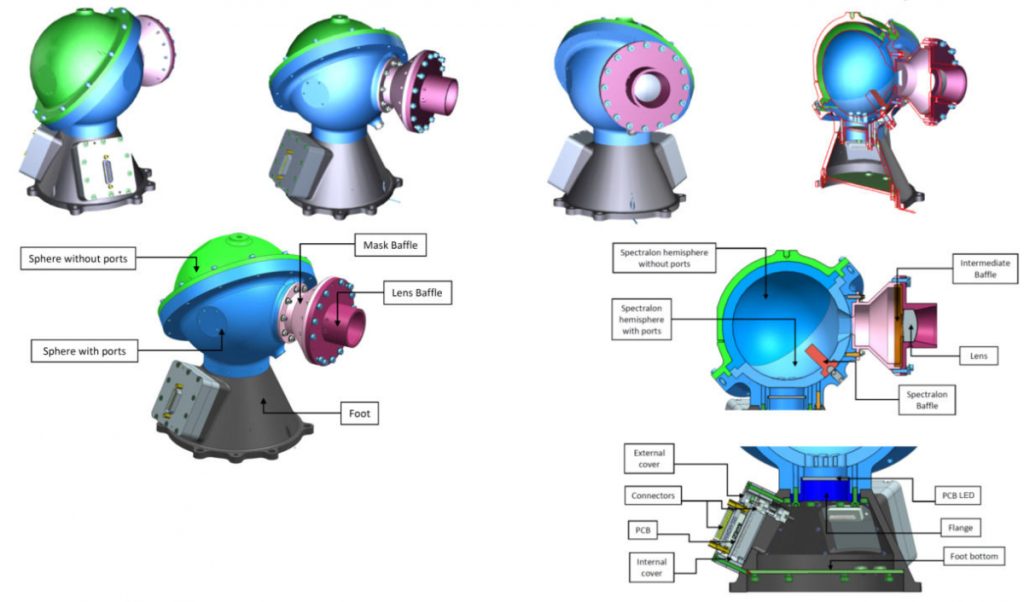
The CU consists of an integrating sphere illuminated by 6 LEDs with wavelengths spanning a spectral range from 590 to 885 nm (VIS and near-infrared), producing a beam shaped at the sphere's exit by a mask, a lens, and a baffle. Following the delivery of the CU flight model by the IAS, the flight model of the entire VIS instrument will be delivered by MSSL in November 2019 for integration into the Euclid payload. The mission launch is scheduled for July 2022 aboard a Soyuz rocket from Kourou. The development of the CU at the IAS is funded by CNES, CNRS, and Université Paris-Sud.