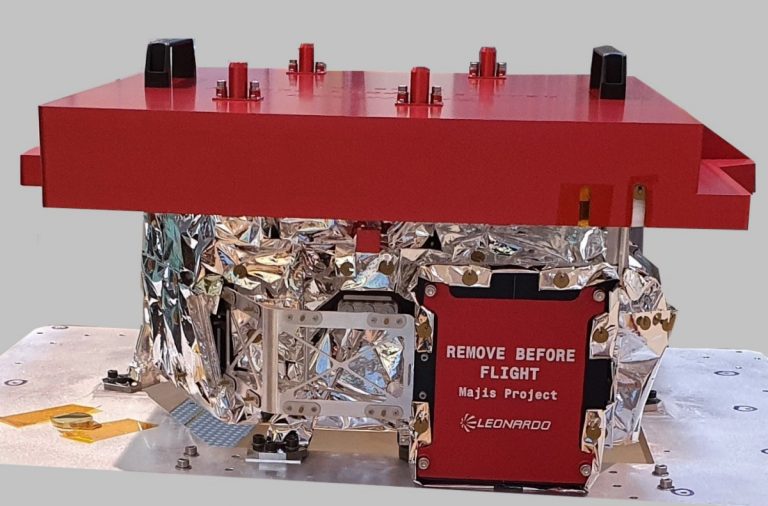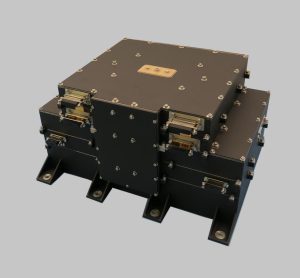
The MAJIS optical head represents the final piece of hardware for the MAJIS project, following the delivery of the main electronics and the harness connecting the optical head to the electronics unit (delivered in August 2019). Both of these latter components are already integrated onto the satellite. The instrumental development and implementation involved dozens of engineers, technicians, and scientists across France (IAS, CNES, Safran, Matra, Steel, etc.), Italy (IAPS, Leonardo Cie, ASI, TASI), Belgium (BIRA-IASB), and the United States (Viavi, Teledyne, etc.) over several years.
The mission is scheduled for launch aboard an Ariane 5 rocket in late August 2022 from the Guiana Space Centre in Kourou, with arrival in the Jupiter system planned for July 21, 2031. The nominal mission phase is set to conclude in September 2035 following numerous flybys of Jupiter, Callisto, Ganymede, and Europa, concluding with insertion into an elliptical and subsequently circular orbit (lasting 130 days) around Ganymede.
MAJIS will acquire spectral cubes across a wavelength range from 0.50 to 5.54 µm with a spatial sampling of 150 µrad (75 m during the circular phase around Ganymede). MAJIS's scientific objectives range from an in-depth study of Jupiter's atmosphere to the icy moons, with a particular focus on Ganymede and Europa and their past and present habitability conditions. Observations of Jupiter's rings, the moon Io, and potentially certain irregular satellites are also planned to enhance our understanding of the broader Jovian system. The IAS, with support from the CNRS, Université Paris-Saclay, and OSUPS, acts as the principal investigator and scientific lead for the instrument, while CNES serves as the contracting authority.