Through its mid-infrared observations, the James Webb Space Telescope (JWST) will revolutionize our understanding of the Universe. Following a rigorous selection process, its first observation programs have been unveiled. Out of roughly a hundred proposals submitted by researchers worldwide, only 13 were selected. One of these will be led by a collaboration involving researchers from IAS.
Often presented as Hubble's successor, the JWST will be the largest telescope ever deployed in space. Developed by NASA, the European Space Agency (ESA), and the Canadian Space Agency (CSA), in partnership with numerous laboratories worldwide, its launch is scheduled aboard an Ariane 5 rocket in 2019.
Six months post-launch, astronomers worldwide will have immediate access to data from the very first observation programs. These so-called "Early Release Science Programs" have just been selected by the Space Telescope Science Institute (STScI), which manages the JWST's scientific operations on behalf of NASA. They will highlight the potential of the four onboard scientific instruments by covering themes as varied as the study of the most distant galaxies, exoplanets, Jupiter and its moons, and the search for organic molecules around stars.
One of the selected programs is jointly led by the Institut de Recherche en Astrophysique et Planétologie in Toulouse (IRAP, CNRS/Université de Toulouse III Paul Sabatier), the Institut d'Astrophysique Spatiale (IAS, CNRS/Université Paris-Sud), and the University of Western Ontario (Canada), with 119 collaborators across 18 countries. The selection of this program in an extremely competitive international context is a major achievement for the involved French scientific community.
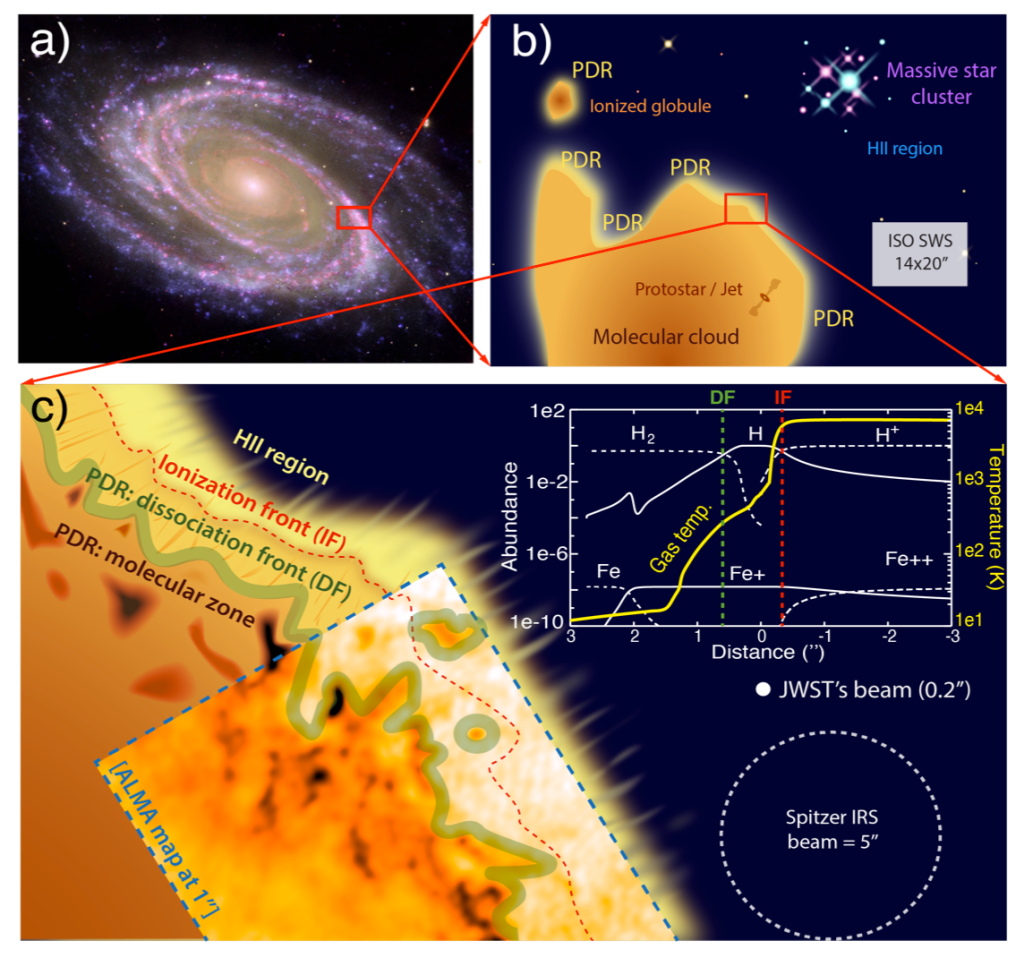
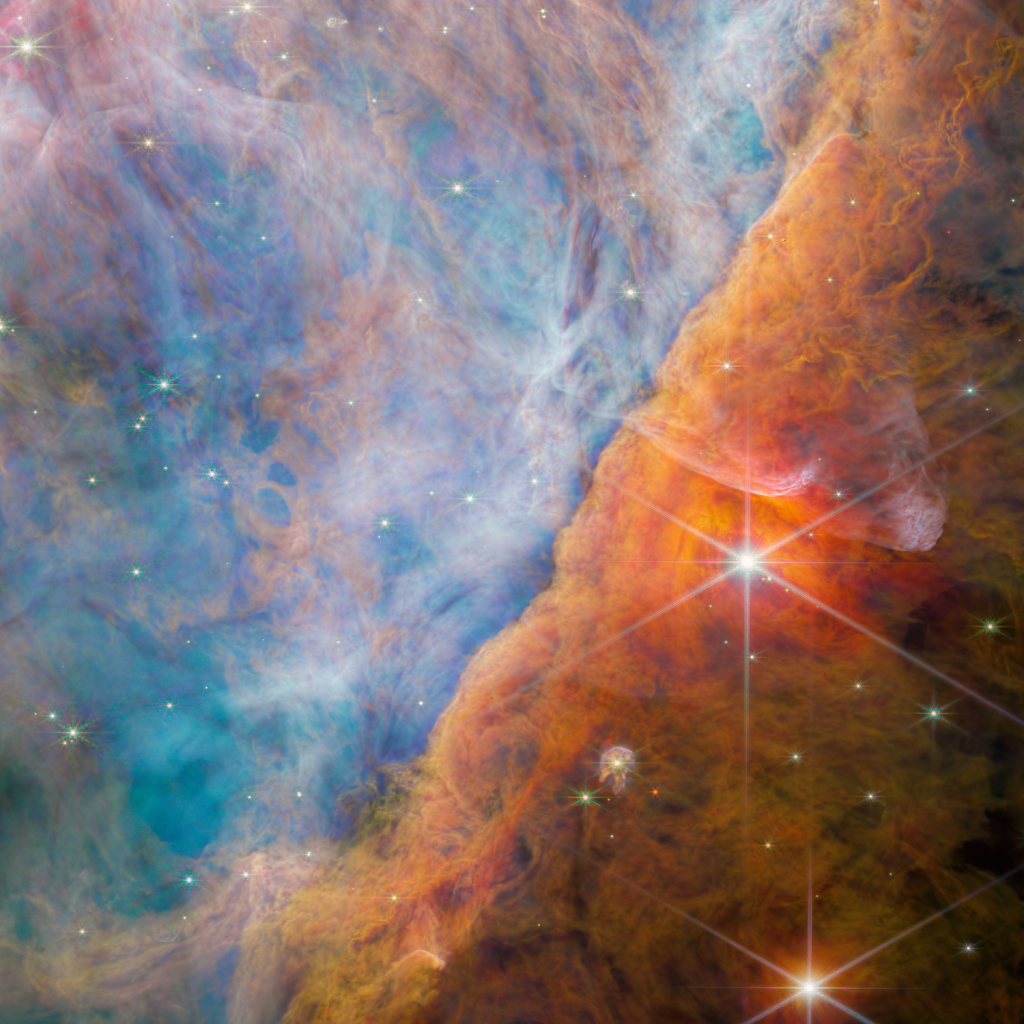
This program aims to observe regions of our galaxy located at the interface between dense clouds, where stars are born, and diffuse, ionized regions. As sites of intense physicochemical processes, these interfaces emit a remarkably rich spectrum of radiation, accounting for a large portion of the galaxy's infrared emission. These regions thus constitute unique laboratories for studying the numerous, still poorly understood microphysical processes that lead in particular to the formation of stars and their planetary systems.
Previously, observations offered only a very global view of a complex combination of physical, chemical, and dynamic processes. Soon, the JWST will observe these interface regions with unprecedented precision. Its extraordinary angular resolution and sensitivity will enable mapping on a very small spatial scale. Across the various physical and chemical boundaries, we will gain access to the physical conditions of a hyper-structured medium (featuring intertwined filaments and "globules") and the chemical composition of the species present. Thus, the JWST will offer an unprecedented look at the evolution of interstellar matter and the causal relationships between existing stars and ongoing star formation.
This program builds on the expertise developed at IAS since its inception with the support of CNRS, Université Paris-Sud, and CNES: the implementation of long-wavelength space instruments (ISOCAM, Planck, PILOT), the calibration station, in-flight instrument operations and data processing within the IDOC center, data analysis, astrophysical modeling, and laboratory analyses of extraterrestrial materials and interstellar dust analogs. The laboratory collaborates on these subjects with numerous partners within Université Paris-Saclay and the Labex P2IO (DAp/AIM, CSNSM, IPNO, etc.).