This study is published in two articles in the November 30, 2018 issue of Astronomy & Astrophysics.
The most massive galaxies experienced their most rapid growth phase when the Universe was about 20% of its current age. The immense amounts of dust and gas triggered true starburst fireworks, with a star formation rate roughly a hundred times higher than in the present-day Milky Way. Stars formed primarily within gaseous, compact, and highly massive regions, the interactions of which with their host galaxies remain largely unexplored.
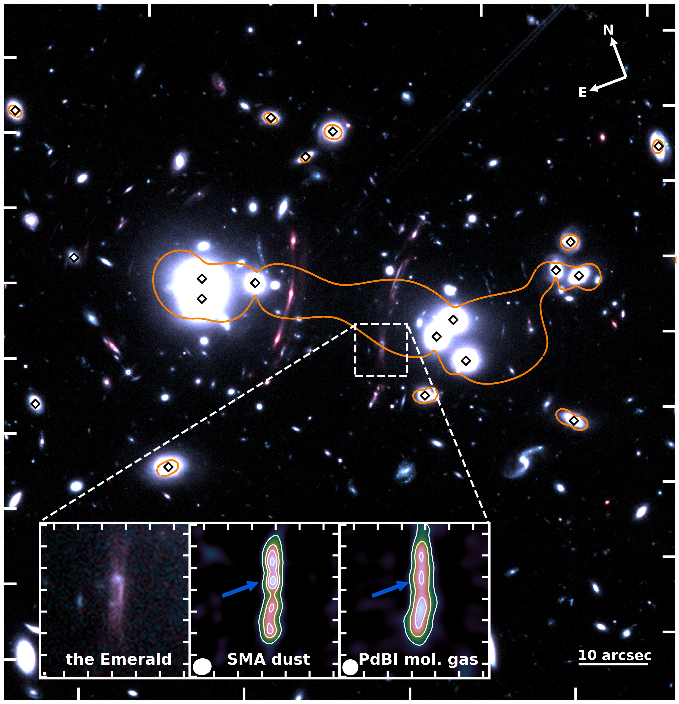
Using the two IRAM radio telescopes—the NOEMA interferometer located in the French Alps and the 30-meter telescope on Pico Veleta (Spain)—researchers found that these stellar nurseries are not isolated, but constantly exchange gas with the surrounding interstellar medium. "This is the first time we have detected molecular gas ejected from one of these nurseries, producing a galactic wind capable of evacuating the majority of the gas from this region in just a few million years," explains Raoul Cañameras, lead author of the new study, which began during his PhD at IAS and continues at DARK (University of Copenhagen). "We discovered this wind in a galaxy observed about 3 billion years after the Big Bang, recently identified and nicknamed 'the Emerald', by detecting a faint additional spectral component on a carbon monoxide emission line." Carbon monoxide is a molecule commonly used to trace molecular gas (in which most atoms are in molecular form).
Additionally, a galaxy cluster is located between Earth and the Emerald, producing a gravitational lensing effect that magnifies the image of the distant galaxies. This phenomenon enabled astronomers to study star formation within the Emerald on scales of a few hundred light-years, which are usually only accessible for nearby galaxies.
“The gas reaches velocities high enough to leave this region but not the galaxy itself, and will therefore remain trapped there,” adds Nicole Nesvadba from IAS. “This means the wind can limit the growth of the star-forming region, but not of the galaxy as a whole.” Furthermore, if this region ejects its gas faster than it accumulates it, it could dissolve and release its contents into the host galaxy. Dense star-forming zones thus appear to be transient structures that evolve rapidly within galaxies.
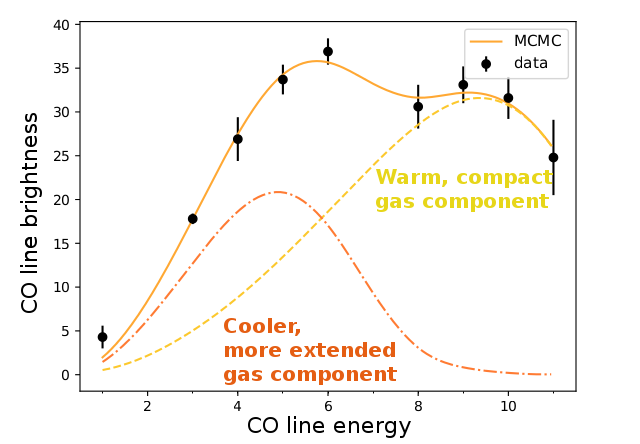
The scientists also studied the physical properties of molecular clouds in the Emerald and other similar galaxies by observing multiple carbon monoxide emission lines with the IRAM 30-meter telescope. “These transitions require different energies to be excited. Therefore, by measuring their relative intensity, we can determine the density and temperature of the gas, as well as the intensity of the radiation produced by newly formed young stars,” comments Chentao Yang of ESO, co-author of the study.
Previous observations have shown that in starburst galaxies close to the Milky Way, gas reaches the most extreme densities and temperatures within stellar nurseries and is more diffuse in the surrounding regions. However, the emission of molecular gas between stellar nurseries is even fainter, and therefore very difficult to probe in galaxies of the early Universe. In addition to the gas directly associated with star formation, IRAM observations revealed a second, less dense component accounting for up to half of the total gas mass in these galaxies. Its properties correspond to large-scale gas reservoirs capable of fueling the formation of new giant stellar nurseries.
These galaxies were discovered thanks to the submillimeter survey conducted by the ESA Planck satellite. “Although Planck was primarily designed to study the cosmic microwave background radiation, it also proved extremely useful for identifying the brightest and rarest galaxies in the early Universe,” states Hervé Dole of IAS, coordinator of the extragalactic sources study within the Planck collaboration. “The combined use of Planck and IRAM brilliantly illustrates the exceptional scientific potential of European space and ground-based observatories in advancing our understanding of the Universe,” concludes Nicole Nesvadba, who leads the characterization of these galaxies.