
The Sun's gravity modes reveal rapid rotation of its thermonuclear core
Data from the GOLF instrument on board the SOHO spacecraft (ESA and NASA) have enabled the first detection of gravity modes, seismic waves that carry the physical properties of the deepest solar layers. These waves, now unambiguously detected, have shown that the solar core rotates nearly four times faster than the intermediate and outer layers of the Sun.
Just as seismology reveals the internal structure of the Earth through the manner in which waves propagate within it, solar physicists use helioseismology to probe the interior of the Sun, utilizing waves excited by convective motions in our star. These waves are notably detected by the GOLF (Global Oscillations at Low Frequencies) instrument on the SOHO spacecraft (ESA and NASA, launched in 1995). IAS is responsible for the scientific and technical oversight of GOLF.
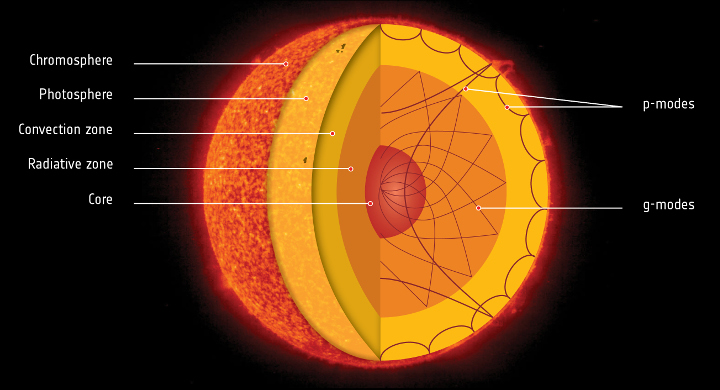
High-frequency pressure waves (p-modes) are easily detectable at the photosphere, the visible surface of the Sun, and have thus revolutionized our knowledge of the internal Sun for over 30 years by strongly constraining the physics incorporated into models. Consequently, helioseismology has made an essential contribution to the discovery of neutrino oscillation, awarded the 2015 Nobel Prize.
However, despite the successes of helioseismology, the dynamics of the Sun's thermonuclear core remained poorly constrained: p-modes propagate very rapidly through this region and are very insensitive to its rotation. Conversely, it is known that lower-frequency oscillation modes also exist, whose restoring force is gravitation, to which they are highly sensitive. The signature of these gravity modes, or g-modes, is nevertheless very weak at the surface, and over 20 years of research had failed to detect them with certainty on the Sun.
The signature of g-modes has now been found by Éric Fossat (Observatoire de la Côte d'Azur) and his colleagues, not directly through their surface signal, but in the modulation of a parameter extracted from p-modes: the transit time (4h 7min) taken by acoustic waves to complete a round trip across a solar diameter passing through the center. GOLF measurements have provided continuous access to this data for 20 years with an accuracy better than one minute.
The primary result derived from this detection is the measurement of the average rotation rate of our star's thermonuclear core, which was previously completely unknown: it rotates on its axis once a week (at a frequency of 1644 ± 23 nHz), which is 3.8 times faster than the average rotation of the outer and intermediate layers.
This provides a new and strong constraint for modeling stellar evolution and angular momentum transport from the early stages of solar system formation. New questions arise: can the shear between the rapid core rotation and the rotation of the upper layers be highlighted? Can g-modes provide information on the chemical composition of the core? What are the implications for stellar evolution and thermonuclear processes within the core?
Beyond the advancement it represents for solar physics and astrophysics, this result is remarkable in more ways than one. On the one hand, it was made possible thanks to the still-operational GOLF instrument and a very broad international collaboration spanning several decades; this underlines the importance of ensuring a stable long-term environment for fundamental research. On the other hand, GOLF is a space metrology instrument which, while not providing spectacular images (sometimes used to justify the continuation of research programs to the general public), nevertheless produces crucial data for numerous fundamental questions in solar physics.
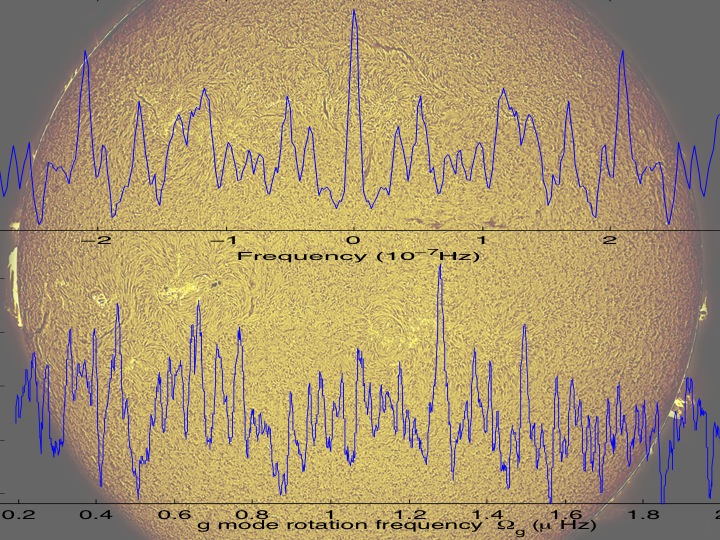
Top: Average profile of 76 dipolar g-modes, featuring a central peak and two symmetrical components at ±210 nHz due to the rotation of the deep layers, viewed from the deep regions where the p-modes acting as a detector resonate.
Bottom: Sidereal rotation velocity of 1.28±0.01 μHz associated with the detected dipolar and quadrupolar g-modes, corresponding to a one-week rotation period for the core.
Contacts
Patrick Boumier, Solar and Stellar Physics Team
References
- ESA Press Release: https://www.esa.int/Science_Exploration/Space_Science/Gravity_waves_detected_in_Sun_s_interior_reveal_rapidly_rotating_core
- Scientific Article: E. Fossat, P. Boumier, T. Corbard, J. Provost, D. Salabert, F. X. Schmider, A. H. Gabriel, G. Grec, C. Renaud, J. M. Robillot, T. Roca-Cortés, S. Turck-Chièze, R. K. Ulrich and M. Lazrek (2017). Asymptotic g modes: Evidence for a rapid rotation of the solar core, Astronomy & Astrophysics, 604, A40. (arXiv:1708.00259)