
The anhydrous ingredients on the asteroid Ryugu come from far away
Infrared spectra of anhydrous grains from the carbonaceous asteroid Ryugu indicate a connection between one of the reservoirs that gave rise to Ryugu’s parent body and the reservoirs that formed early comets and asteroids in the outer protoplanetary disk.
Ryugu is a second-generation carbonaceous asteroid formed by the reassembly of fragments from a larger, ancient body in the main asteroid belt. In late 2020, Japan’s Hayabusa2 mission returned 5.4 g of material collected from Ryugu to Earth. Most of the samples from Ryugu consist of hydrated minerals that formed in Ryugu’s parent asteroid through the aqueous alteration of primordial anhydrous grains. These grains reveal the composition of the protoplanetary dust from which Ryugu’s parent asteroid formed.
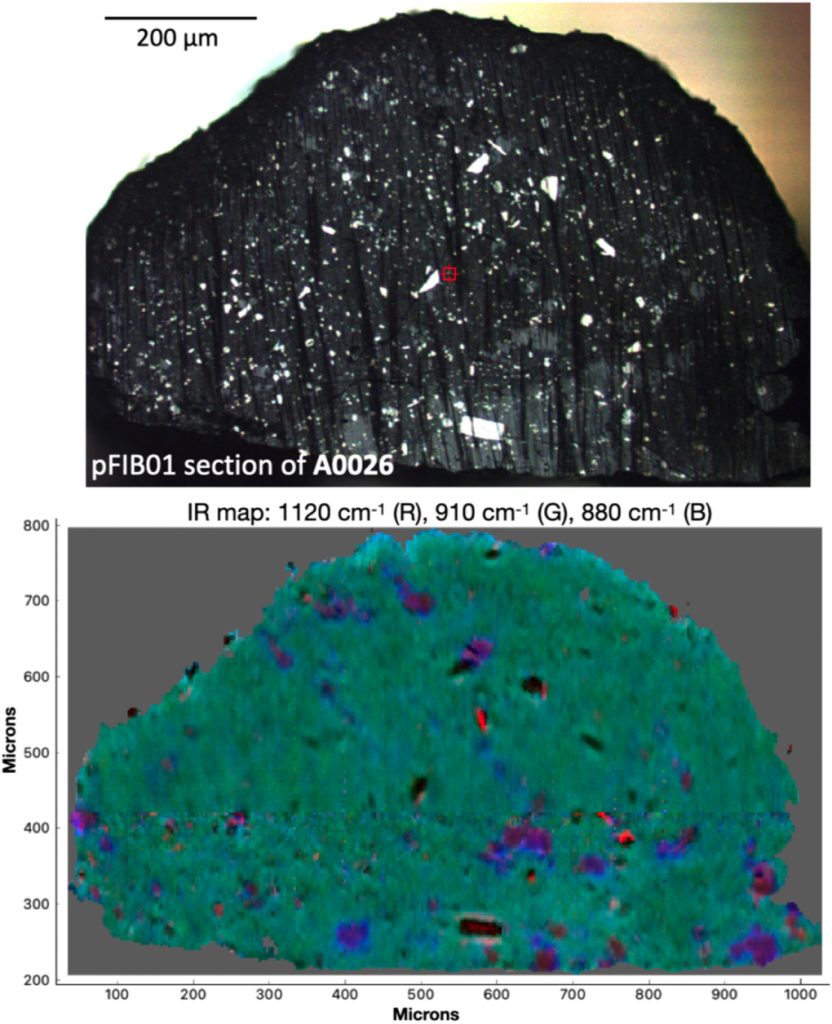
A new study conducted by the IAS (Orsay, France), Tohoku University (Japan), and the SMIS beamline at the SOLEIL synchrotron (France) used infrared hyperspectral imaging of two millimeter-sized “rocks” from Ryugu to determine their mineral composition and compare it with that of other extraterrestrial materials in the laboratory (meteorites and interplanetary dust) and in space (asteroids and comets).
Infrared analysis of Ryugu’s anhydrous grains shows that some are rich in amorphous silicates with a mineral composition similar to that of certain anhydrous primitive asteroids, comets, and interplanetary dust of cometary origin. These grains formed through pre-accretion processes in the protoplanetary disk that gave rise to the solar system.
Ryugu’s parent asteroid would thus be a large planetesimal that formed in the outer solar system from a reservoir near the comet accretion region. Planetary migrations would have later transferred Ryugu’s parent asteroid to the main asteroid belt. Water-related weathering would then have determined the diversity of “primitive” asteroid classes that we observe today.
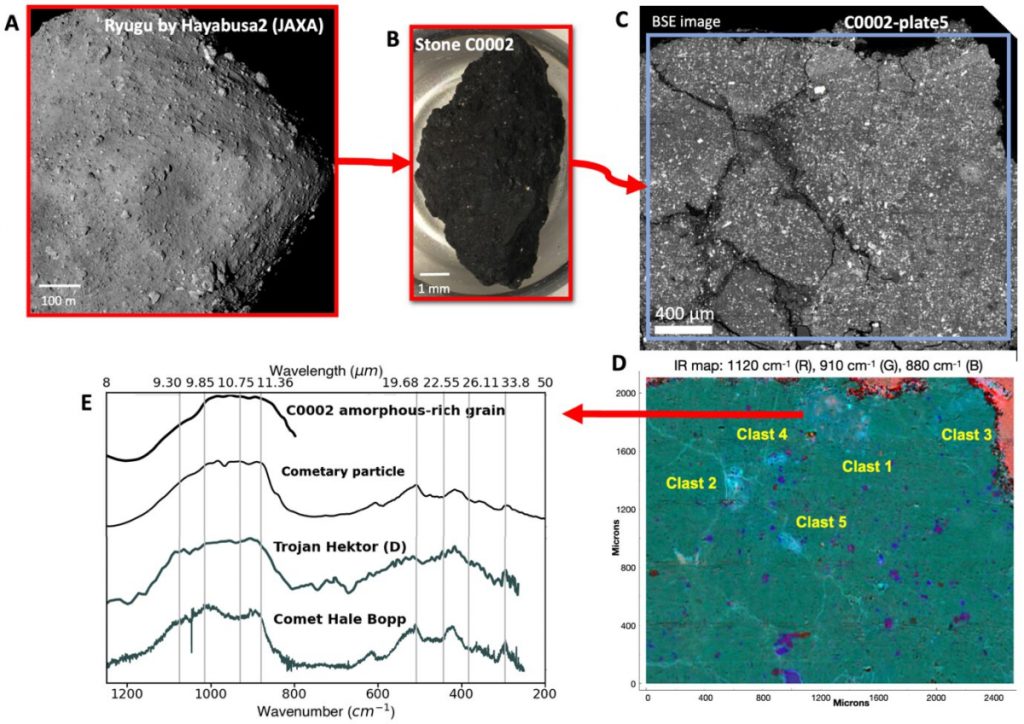
A: Ryugu as seen by Hayabusa2. B: The “rock” C0002 collected by Hayabusa2. C: Electron microscope image of a cross-section of C0002. D: Infrared image showing the anhydrous regions. E: Spectra of a grain rich in amorphous silicates, a cometary particle, the primitive asteroid Hektor, and Comet Hale-Bopp.
Contacts
Rosario Brunetto, Research Fellow, Astrochemistry & Origins Team
References
Scientific article: Brunetto, R., Lantz, C., Fukuda, Y., et al., “Ryugu’s Anhydrous Ingredients and Their Spectral Link to Primitive Dust from the Outer Solar System.” The Astrophysical Journal Letters, July 10, 2023. DOI:10.3847/2041-8213/acdf5c