
Samples from Ryugu Reveal Their First Secrets
Initial analyses of samples collected from the primitive asteroid Ryugu—conducted in part using the MicrOmega instrument developed at the IAS—have provided an initial characterization of the grains’ physicochemical properties.
In December 2020, JAXA’s Hayabusa2 mission returned to Earth more than 5 grams of samples collected from two sites on the carbonaceous asteroid Ryugu—a first in space exploration! These samples potentially contain material that still bears witness to the conditions and processes involved in the Solar System’s early formation and evolution. Furthermore, the samples collected from Ryugu’s surface were shielded from any contact with the Earth’s environment until they were stored in ISAS/JAXA’s ultra-clean “curation facility” in Sagamihara, Japan. They therefore constitute a collection without parallel in our laboratories.
A comprehensive characterization of these samples is currently being conducted within this facility. These analyses allow for an initial determination of the physical and compositional characteristics of the grains using a high-precision balance, an optical microscope, a near-IR point-source spectrometer, and—in a first of its kind—a hyperspectral microscope operating in the near-IR, thanks to the MicrOmega instrument developed by the IAS in Orsay, which participates remotely in the data acquisition process. These initial analyses, conducted in a completely non-invasive and non-destructive manner—without any contact, processing, or preparation—in a controlled dry nitrogen atmosphere, are essential and unique in that they are performed on all samples, characterizing them down to the microscopic scale. They also make it possible to establish a link between the observations made remotely by the probe and the more detailed characterizations performed in the laboratory on grains extracted from the collection.
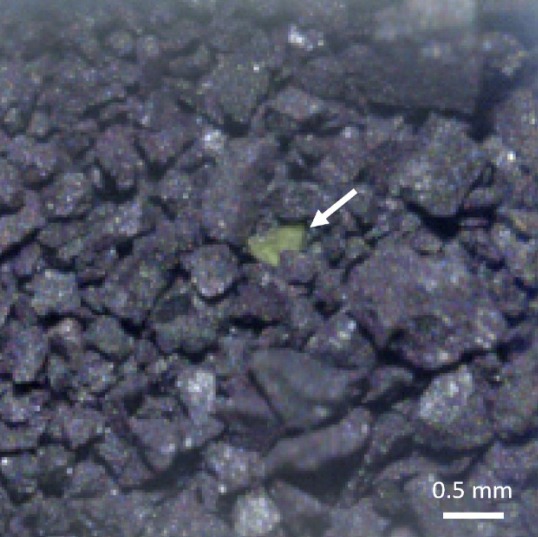
MicrOmega, qui couple l’imagerie à petite échelle (quelques dizaines de microns) à la spectroscopie, dans un domaine de longueurs d’onde permettant d’identifier dans chacun des pixels de l’image les constituants principaux, minéraux et organiques en particulier, a permis des avancées majeures. Les résultats ont montré que les échantillons collectés étaient bien représentatifs de Ryugu, et qu’à échelle macroscopique, ils sont constitués d’une matrice hydratée très sombre (réflectance < 3%) dans laquelle sont piégés des composés organiques. Aux échelles submillimétriques en revanche, des inclusions de composition distinctes ont été identifiées, dont des grains de carbonate, pour certains enrichis en fer, avec des tailles jusqu’à plusieurs centaines de micromètres. Les analyses ont également révélé la présence de composés azotés, ainsi que d’autres phases provenant d’altération aqueuse.
Two articles published in *Nature Astronomy* report on these initial results (Yada et al. 2021 and Pilorget et al. 2021).
Initial characterizations of the samples collected from Ryugu at the Curation Facility thus highlight the richness of this collection, which has preserved some of the primordial compounds. Following their characterization at the Curation Facility, selected grains were extracted and distributed to international “Analytical Teams.” The IAS is also involved in these analyses, particularly through IR characterizations conducted at the Soleil synchrotron. Finally, characterization work continues at the Curation Facility with the goal of establishing a catalog of grains accessible to the broadest possible scientific community, through a call for proposals to be launched before the summer of 2022.
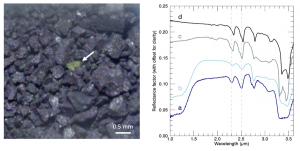
Figure 1: Average spectrum (100 pixels) of a carbonate grain detected with MicrOmega (a), compared to three reference spectra obtained in the laboratory (siderite (b), dolomite (c), and calcite (d)), and an RGB image showing this grain, indicated by an arrow (R: 2.5 µm, G: 2.7 µm, B: 3.4 µm).
Contacts
Advisors (scientific and technical)
- Cédric Pilorget, Associate Professor at Paris-Saclay University, Solar System and Planetary Systems Physics Group
- Jean-Pierre Bibring, Professor at Paris-Saclay University, Solar System and Planetary Systems Physics Group
- Rosario Brunetto, Research Fellow, Astrochemistry & Origins Team