
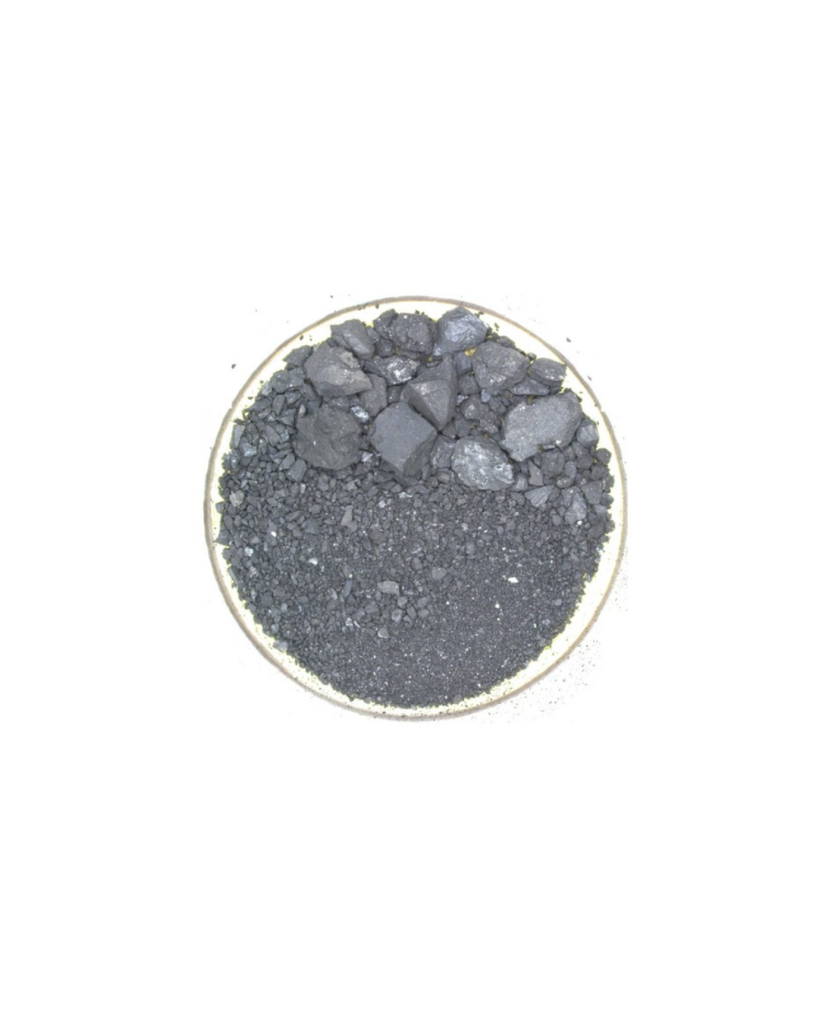
The asteroids Ryugu and Bennu exhibit characteristics typical of the same class of primordial objects
Carbonaceous asteroids are valuable remnants of the Solar System’s formation 4.5 billion years ago. They have, in part, preserved the processes that governed its early evolution and contributed minerals and chemical compounds that may have been crucial to the evolution of Earth and the terrestrial planets.
The return of samples from the asteroid Ryugu by JAXA’s Hayabusa2 mission and, subsequently, from the asteroid Bennu by NASA’s OSIRIS-REx mission offers, for the first time, the opportunity to analyze the material they are composed of in a laboratory, free from terrestrial contamination. By comparing samples from these two objects, research recently published in *Nature Communications* has demonstrated that Ryugu and Bennu belong to the same class of primordial objects, and the study has characterized their essential properties.
These analyses were conducted in the “curation” (preservation and analysis) laboratory at ISAS near Tokyo, Japan, where the samples returned from Ryugu—as well as a portion of the samples from Bennu—are stored and protected from contamination and contact with Earth’s atmosphere. This laboratory houses a French instrument, MicrOmega, an infrared hyperspectral microscope designed and developed at the Institute of Space Astrophysics (IAS – Paris-Saclay University/CNRS) with support from CNES; it is operated jointly by teams from the IAS and ISAS, who analyze the results. Coupled with an optical microscope and a point spectrometer operating in the mid-infrared, MicrOmega thus contributes to a comprehensive combined analysis of the samples, beginning with the curation phase.
These analyses showed that the Ryugu and Bennu samples exhibited very similar spectral properties in the near-infrared, down to scales of a few tens of microns. In both cases, a wide variety of diagnostic compounds was detected within the phyllosilicate-rich matrix, including phosphorus-containing compounds with high biochemical potential.
Despite certain differences, these results suggest that the two objects have very similar origins and evolutionary histories. Their main properties therefore appear to characterize a single class of primordial objects, which may have played a significant role in the evolution of objects in the solar system.
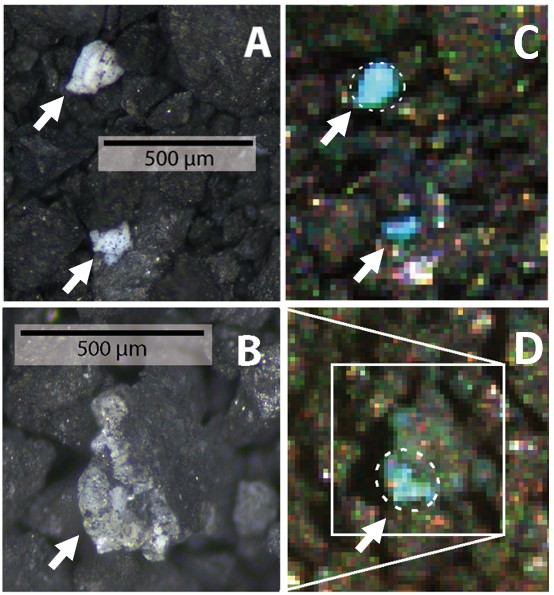
Examples of compounds detected in the matrix of Bennu samples: water- and ammonium-rich magnesium phosphates (“HAMP”) (A: optical image, C: MicrOmega RGB) and iron-rich magnesite-type carbonates (B: optical image, D: MicrOmega RGB). Credit: Pilorget et al. Nature Communications, 2025
Contacts
Jean-Pierre Bibring, Professor at Paris-Saclay University, Solar System and Planetary Systems Physics Group
References
- Link to the online publication:https://www.nature.com/articles/s41467-025-65438-z
- Press Release from Paris-Saclay University/CNRS/CNES