
Galaxy clusters baffle cosmologists
To reconcile the standard cosmological model with the abundance of X-ray-observed galaxy clusters, a team of French researchers has demonstrated that cluster masses should be 70% higher than current estimates suggest. These findings reinforce Planck's 2013 microwave observations of clusters. Nonetheless, the subject continues to intrigue cosmologists, for whom such a mass discrepancy is difficult to explain. Must our understanding of cluster physics be revised, or is the standard cosmological model incomplete?
Galaxy clusters, the largest structures to have collapsed under their own gravity, can be observed notably through X-ray imaging and spectroscopy, which reveal the presence and properties of a hot gas at temperatures reaching tens of millions of degrees. Clusters can also be detected in the millimeter and submillimeter domains by measuring the imprint this gas leaves on the cosmic microwave background radiation: this is the Sunyaev-Zeldovich effect ("SZ effect").
The observation and analysis of the cosmic microwave background by the Planck satellite have strongly reinforced the foundations of the standard cosmological model. With this model established, the abundance of galaxy clusters can be predicted and compared with observations, thereby constraining universe models. However, the Planck satellite also observed cluster abundance via their SZ effect imprint on the cosmic microwave background. The comparison conducted by IAS researchers and presented in 2013 [1] showed that, given past mass estimates based on the application of the gas hydrostatic equilibrium equation within clusters, the quantity of observed clusters is 3 to 4 times lower than expected! To reconcile these abundances with the standard model, cluster masses would need to be significantly higher—by approximately 70%—than previous estimates derived from X-ray observations. Many cosmologists are hesitant to take this step, as it would imply that the standard cosmological model must be revised, for instance by invoking the existence of massive neutrinos.
A French team addressed this issue using a novel approach [2]. First, they revisited the data used to determine the abundance of (local/nearby) clusters detected via their X-ray emission. They then evaluated the masses these clusters would need to possess to align with the standard "ΛCDM" model as manifested through the fluctuations in the cosmic background measured by Planck. Their results show strong agreement with the aforementioned conclusions: cluster masses must exceed previous estimates by approximately 70%. Consequently, there is high consistency between the conclusions drawn from X-ray observations and those obtained in the microwave spectrum from Planck's "SZ" sample.
The question of the true mass of clusters thus remains a subject of debate among specialists: are cluster masses derived from various direct observation methods genuinely underestimated, or do these measurements point toward "new physics"? Having precise and reliable cluster mass measurements therefore appears more crucial than ever for cosmology. This field is expected to make decisive progress in the coming years with the commissioning of instruments dedicated to large-scale galaxy surveys. Among them is the Euclid satellite, which will enable, inter alia, precise and reliable measurements of cluster masses via gravitational lensing.
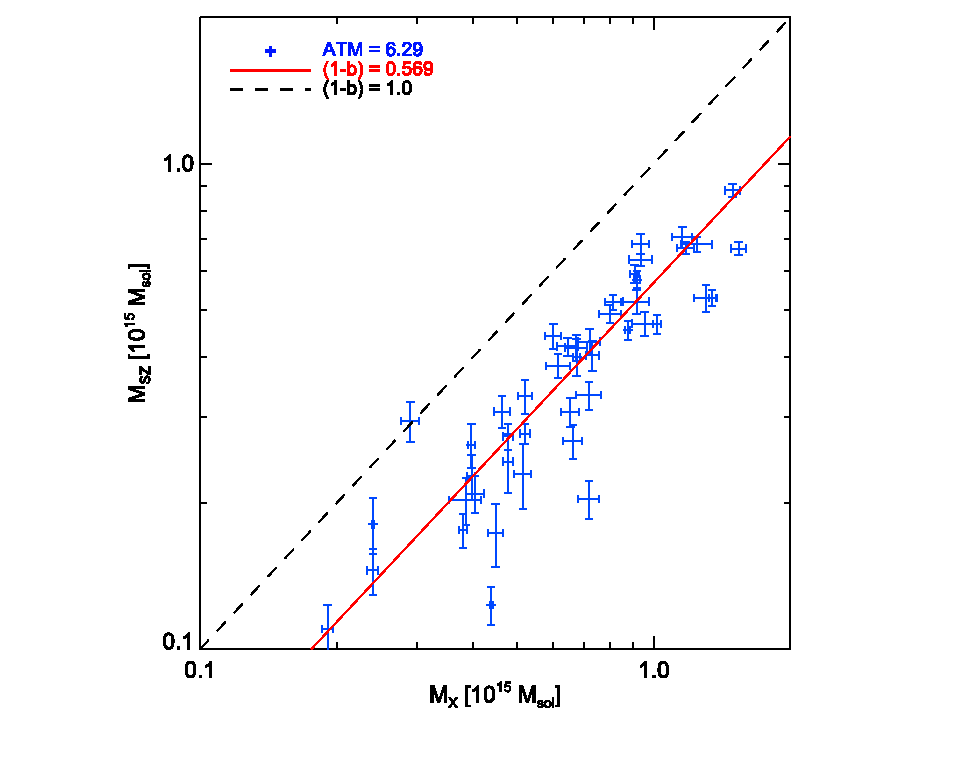
For the 45 clusters common to our sample and Planck's (see Sect. 6 for further details), the blue crosses represent the mass estimates derived from PXX as a function of the masses we deduce from their X-ray temperature and our TX − M scaling relation in our reference case, with ATM = 6.29 (best-fit value). The red line corresponds to the best fit obtained via the BCES regression technique, and its slope yields the mass bias of the Planck masses (see text for further details). SOURCE A&A
References
[1]: Planck collaboration, "Planck results 2013: XX", A&A 571, A20, 2014
[2]: S. Ilic, A. Blanchard, M. Douspis, X-ray galaxy clusters abundance and mass-temperature scaling, Astronomy and Astrophysics, 582, A79, doi:10.1051/0004-6361/201526793.
This work was supported by LABEX OCEVU, funded by the ANR under the "Investissements d'Avenir" program.
CNRS/INSU News: http://www.insu.cnrs.fr/node/5489