
Is the simplest cosmological model back in favor?
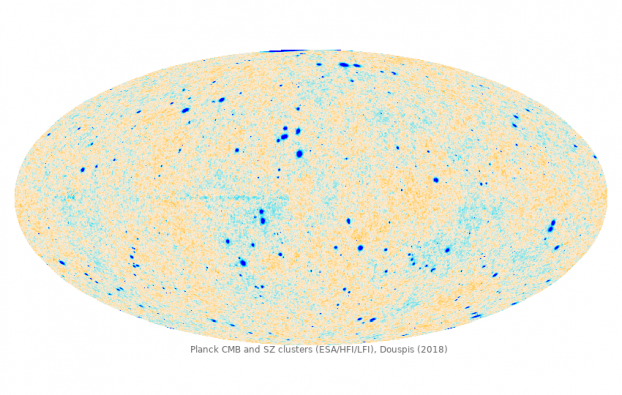
In 2013, the Planck results revealed for the first time a discrepancy between the cosmological parameters determined from the cosmic microwave background and those obtained by analyzing the abundance of galaxy clusters detected by Planck. This discrepancy was confirmed during the second Planck analysis in 2015, as well as by independent analyses involving gravitational lensing or galaxy clusters observed in the X-ray range. Researchers at the IAS have shown, based on a new analysis, that the cosmic microwave background and the abundance of galaxy clusters observed by Planck actually converge toward the simplest standard cosmological model, dominated by cold dark matter and a cosmological constant.
The cosmic microwave background and the abundance of galaxy clusters allow us to measure cosmological parameters both independently and in combination. Until 2013, when the first Planck results were released, the number of galaxy clusters available for cosmological analyses was too small. The resulting measurements of cosmological parameters were therefore subject to large error bars and were consequently unreliable. In 2013, thanks to approximately 200 galaxy clusters observed by the Planck satellite, it became possible to make precise measurements of cosmological parameters, revealing a discrepancy between the cosmological parameters determined by the cosmic microwave background and those obtained by analyzing the abundance of galaxy clusters. This discrepancy pertained in particular to the measurement of the density of matter in the universe and its distribution on very large scales. This discrepancy was confirmed during the second Planck analysis in 2015, which utilized nearly 500 galaxy clusters, as well as by independent analyses based on gravitational lensing or galaxy clusters observed in the X-ray range.
Such a discrepancy could have only two possible causes: either the mass of the observed clusters was incorrect by a factor of two—an unrealistic assumption given the current state of our understanding of galaxy clusters—or the discrepancy was a sign of a deviation from the simplest cosmological model.
In 2016, Planck published new results from its analysis of the cosmic microwave background, notably revising the cosmological parameter related to the formation of the first stars in the universe. In a study published in *Astronomy & Astrophysics*, a team of researchers from the IAS conducted an in-depth reanalysis. They used these new data in a comprehensive analysis combining the cosmic microwave background, the abundance of galaxy clusters, and their angular correlation function across the entire sky. This new study shows that the discrepancy between the parameters derived from the cosmic microwave background and those derived from galaxy clusters has been significantly reduced.
The team also explored deviations from the simplest cosmological model, such as the addition of massive neutrinos or a dark energy component different from the cosmological constant. This analysis shows that neither of these two extensions to the “standard” cosmological model resolves the remaining small discrepancy, which still needs to be studied and explained.
The simplest cosmological model—based on the time of first-star formation as newly inferred from Planck—is the one that provides the best agreement between the cosmic microwave background and the abundance of galaxy clusters, and this model therefore appears to be the most likely.
All-sky map of the distribution of galaxy clusters detected by Planck superimposed on the map of the cosmic microwave background. Credit: Nabila Aghanim
References
Scientific article: Salvati L., Douspis M., Aghanim N., “Constraints from thermal Sunyaev-Zel’dovich cluster counts and power spectrum combined with CMB,” A&A, 614, A13, 2018.