
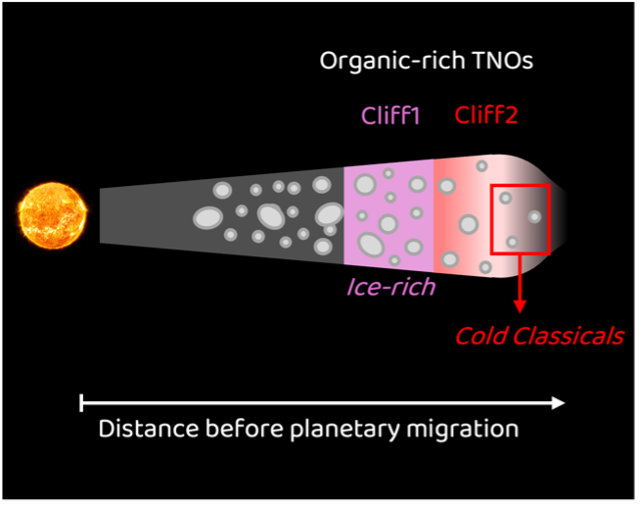
The James Webb Space Telescope (JWST) is revolutionizing our understanding of trans-Neptunian objects (TNOs), icy remnants of planetary formation. As part of the DiSCo-TNOs project, researchers used infrared data from the JWST to identify two distinct groups among spectroscopically red TNOs, which are thought to be rich in organic compounds. The main difference between these groups lies in the presence of surface ices, particularly methanol (CH₃OH).
Methanol ice forms on dust grains in cold interstellar clouds and plays a key role in prebiotic chemistry. In the Solar System, it has been detected in comets and on certain icy bodies, including Arrokoth, a small TNO visited by NASA’s New Horizons spacecraft. Its presence is a matter of debate: is it a primordial remnant or the result of later evolution?
JWST observations show that the first group of TNOs, named Cliff1, exhibits strong spectral signatures of methanol, water (H₂O), carbon dioxide (CO₂), carbon monoxide (CO), and complex organic compounds. This suggests that they formed at or beyond the methanol ice line in the protoplanetary disk, offering a rare glimpse into the disk’s early chemistry. Over time, cosmic radiation has likely altered their surfaces, gradually depleting surface methanol and creating a layered structure in which its concentration increases with depth.
The second group, Cliff2, exhibits weaker spectral bands than Cliff1, indicating a different evolutionary path. Among them, the dynamically “cold” TNOs—which formed and remained in the outermost disk—stand out as a distinct population.
The discovery of these spectral subgroups reveals that not all TNOs formed from the same molecular ingredients. Their composition reflects both their heritage (their origin and the conditions of their formation) and their evolution (the processes that have shaped them over time). These results also serve as a key reference for interpreting JWST observations of other objects, such as Neptune’s Trojans, Centaurs, and asteroids, as well as for future missions exploring the outer reaches of the Solar System.
Link to the online publication (Brunetto et al., 2025, ApJL): https://doi.org/10.3847/2041-8213/adb977