
In either case, this will provide critical information to constrain the dynamics of the forming solar system, which underlies the extraordinary diversity of planetary worlds as we reveal them today. To achieve this, the MMX mission will include a main module that will remain in orbit around Phobos to characterize its structure and composition, and subsequently perform similar measurements during flybys of Deimos. It will then land to collect samples that will be returned to Earth for analysis. Finally, a mobile rover could be deployed on the surface to extend measurements directly on the ground down to the microscopic scale.
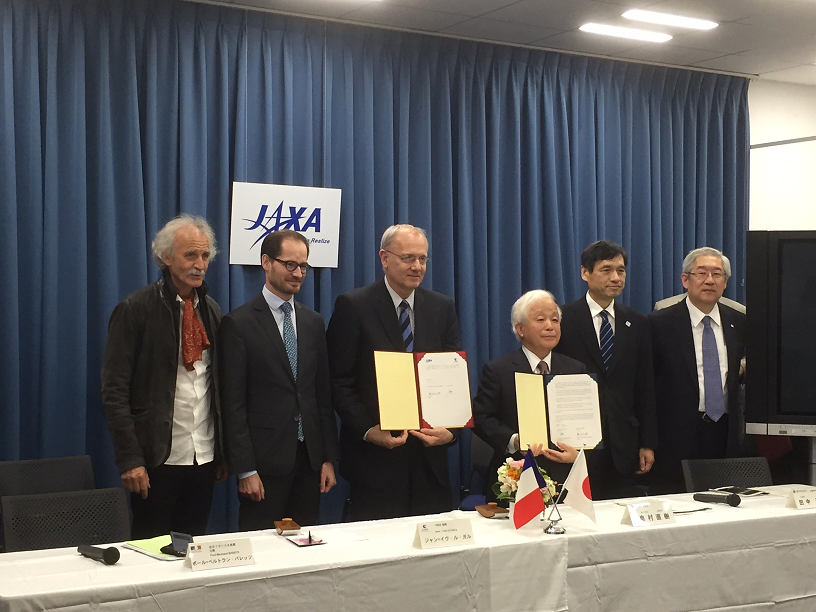
The signed agreement outlines three contributions from CNES: the provision of one of the probe's main instruments (the MacrOmega infrared hyperspectral imager, developed under the responsibility of IAS), the contribution of space mechanics teams (CNES Toulouse) to the preparation of flight operations, and the study of the instrumented mobile rover, which would be developed under the responsibility of CNES. Overall, this is a highly significant framework agreement, as it associates CNES with one of the most ambitious missions of the next decade for the space exploration of the solar system. Scientifically fundamental, MMX entails major technological leaps, both in instrumentation and in the realization of onboard systems (particularly with a highly miniaturized, high-performance rover), featuring an automatic sample collection and return device. IAS will be extensively involved in MMX through the development of MacrOmega, participation in the scientific definition of the rover, and the analysis of the returned samples.