
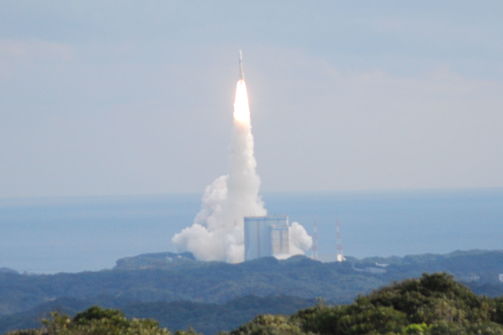
On Wednesday, December 3, 2014, JAXA, the Japanese space agency, successfully launched the Hayabusa 2 probe, which is headed for a primitive asteroid named 1999JU3 and is scheduled to reach it in 2018. This mission aims to analyze the object in three complementary ways: remotely, using cameras and spectrometers; in situ, using landers; and finally, through laboratory analysis of samples that will be collected and returned to Earth in 2021.
The main lander, MASCOT, with a total mass of 10 kg, was developed in cooperation between the DLR (Bremen) and CNES; its main instrument is MicrOmega, manufactured at the IAS: this is a hyperspectral microscope that provides, for each pixel, a spectrum in the infrared range containing diagnostic signatures of the main constituents—minerals, ices, and organic molecules. Thus, for the first time, an analysis of the surface of a small primordial body will be conducted at the microscopic scale. This information will make a critical contribution to our understanding of the processes and ingredients that led to the diversity of planetary evolution.