
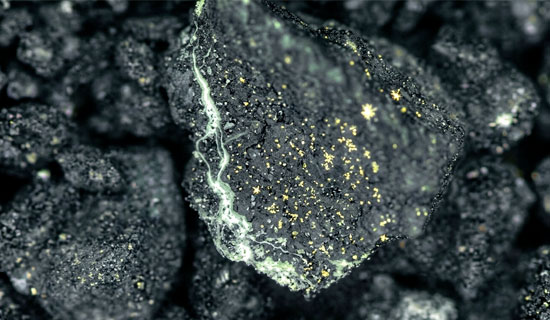
Analysis of samples from Ryugu and Bennu yields valuable insights into nitrogen chemistry within the primitive solar system
A team of scientists from IAS has identified an ammonium-rich phyllosilicate phase (NH4+) in samples collected from the surfaces of both asteroids, Ryugu and Bennu. This is a first for this type of extraterrestrial material. Published in Nature Communications, this discovery demonstrates that ammonium is a key link in nitrogen chemistry across all "primitive" small bodies, whether carbonaceous asteroids or comets.
Ryugu and Bennu are two near-Earth asteroids. Both belong to the class of carbonaceous asteroids—small bodies that are remnants of the primitive solar system. Studying their composition helps us understand how matter formed, evolved, and was distributed throughout the solar system.
The analysis of samples from asteroids Ryugu and Bennu collected by space missions
Hayabusa2 (JAXA) and OSIRIS-REx (NASA) has thus enabled major advancements in these questions, notably thanks to several unexpected discoveries. Among the latter, work led by IAS scientists, involving a broad international collaboration, has just been published in Nature Communications. They identified the presence of ammonium-rich phyllosilicates (NH4+) in both collections, marking a first for this type of extraterrestrial material. By questioning the origin of this ammonium and the physico-chemical processes that led to the formation of this specific phase, this discovery decisively contributes to refining the history of these small objects and the matter that constitutes them.
The discovery of these ammonium-rich phyllosilicates was made possible through a detailed analysis of infrared spectra measured systematically across all samples in the Ryugu collection, as well as a fraction of those in the Bennu collection. All these samples are preserved at ISAS (Japan) in cleanrooms, shielded from any contact with the Earth's atmosphere. This conservation center houses the MicrOmega instrument, a near-infrared hyperspectral microscope designed and developed at IAS with CNES support. It is operated jointly by teams from IAS and ISAS, and is dedicated to characterizing all Ryugu and Bennu samples preserved at ISAS. The measurements from this instrument are complemented by those from an optical microscope and a Fourier-transform infrared (FTIR) mid-infrared spectrometer.
The analysis of all these infrared data allowed the team to highlight the presence of ammonium (NH4+) carried by a phyllosilicate phase spanning regions of a few hundred micrometers and optically brighter than the rest of the very dark phyllosilicate matrix dominating these two asteroidal materials. The spectral signatures of this mineral assemblage are nearly identical in both collections, though significantly more abundant in the Bennu sample fraction than in the Ryugu collection.
Following HAMP inclusions (1)—magnesium- and ammonium-rich hydrated phosphates—this represents the second ammonium-bearing mineral phase discovered in these two asteroidal sample collections. The ammonium detected in this manner is of particular interest as it traces a chemistry that began in ices mixed with dust grains in the protosolar disk, in regions necessarily located beyond the current positions of Jupiter and Saturn. Initially in the form of highly soluble ammonium salts (similar to those detected on comet 67P/Churyumov-Gerasimenko) trapped in ices mixed with anhydrous silicates, these ammonium ions were released following the progressive heating of Ryugu and Bennu's parent bodies and the subsequent "aqueous alteration" process. A new generation of compounds ultimately formed: ammonium salts such as HAMPs, which are less soluble in the aqueous phase than the first generation of salts, and silicates transformed by the action of water and the ammonium it contained into ammonium-rich phyllosilicates.
This discovery thus reinforces the concept that ammonium, whether trapped in salts or phyllosilicates, is a vital component of nitrogen chemistry for all these "primitive" small bodies: carbonaceous asteroids and comets. The phases highlighted in this study may also have played an efficient role in delivering this chemically reactive form of nitrogen to the surfaces of terrestrial planets.
(1) English acronym for "Hydrated Ammonium-Magnesium-Phosphorous-rich grains" [Pilorget et al., Nature Astronomy, 2024 and Pilorget et al., Nature Communications, 2025]
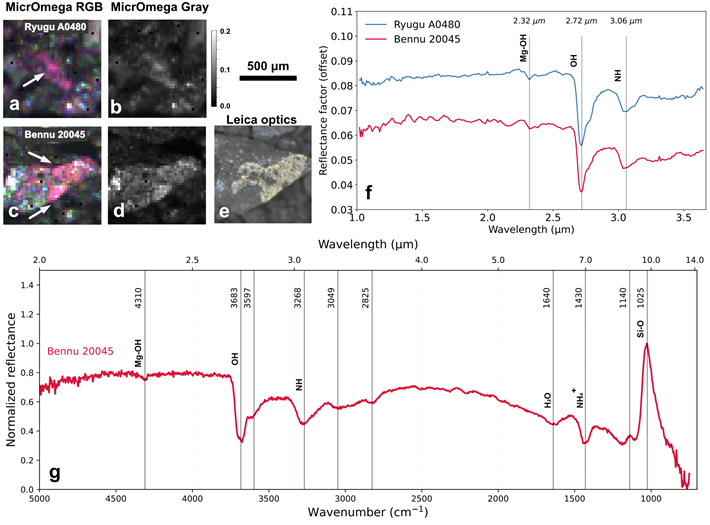
Figure: Example of infrared signatures and images of ammonium-rich phyllosilicates discovered in the Ryugu collection (grain A0480) and the Bennu collection (grain 20045). The images were captured by the MicrOmega hyperspectral microscope (shown in grayscale (b and d) and as RGB maps (a and c) where cyan/red highlights the presence of the phase discovered here) and by the optical microscope (e). Graph (f) shows the corresponding near-infrared spectra measured by MicrOmega on the Ryugu grain A0480 and the Bennu grain 20045. Figure (g) shows the mid-infrared spectrum measured by FTIR on the Bennu grain. Credit: Jiang, T. et al. Nature Communications, 2026.
Contacts
Jean-Pierre Bibring, Professor at Université Paris-Saclay, Solar System and Planetary Systems Physics Team
References
Jiang, T. et al. Ammonium-bearing phyllosilicate grains detected in Ryugu and Bennu samples via infrared spectroscopy. Nature Communications, 2026
- UPSaclay Press Release