
MicrOmega’s analysis of samples from the asteroid Ryugu reveals new insights into the early evolution of the solar system
A new study based on data from the MicrOmega instrument—which is currently being used to analyze samples from the asteroid Ryugu brought back by JAXA’s Hayabusa2 mission—has characterized and mapped various types of carbonate minerals within the samples, revealing valuable insights into the early history of the Solar System.
A unit of the MicrOmega instrument, designed and developed at the IAS, is currently installed in Japan at JAXA’s “Curation Facility” (ISAS, Sagamihara). MicrOmega is a hyperspectral microscope that operates in the near-infrared and can map minerals and organic molecules on the surface of samples at a scale of a few tens of micrometers. It was originally developed as an instrument for the Mars rover on ESA’s ExoMars mission. The instrument has been in operation since December 2020 to analyze all samples returned from Ryugu before they are removed from their protected environment.
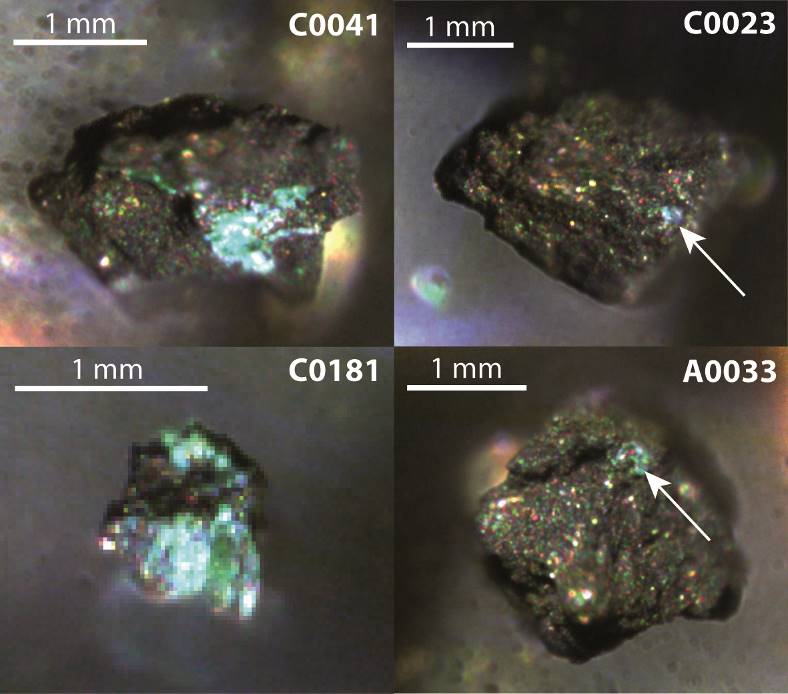
Analysis of the observations obtained from “bulk” samples, followed by analysis of several hundred millimeter-sized grains, led to the detection of several hundred carbonate-rich zones ranging from 50 µm to nearly 1 mm in width. These detections take the form of small grains composed entirely of carbonates, or carbonate inclusions within millimeter-sized grains. Two distinct populations of carbonates can be identified: most of the smaller detections are rich in calcium and magnesium (dolomite), while the larger detections are rich in iron and magnesium (breunnerite). For some of the larger inclusions, flat, elongated structures are visible on the grain surfaces, suggesting formation between grains or along fractures.
These carbonates formed within the first few million years after the Solar System’s formation, and the observation of two distinct populations would suggest two different formation processes or episodes, potentially linked to different sources of carbon.
Similarities with carbonates detected in CI-type chondrite meteorites also suggest that the properties observed in the Ryugu samples may be characteristic of material formed beyond the main asteroid belt.
Four grains from Ryugu with carbonate inclusions, visible here in blue/green (color composites of infrared images taken by MicrOmega). (Loizeau et al. 2023)
Contacts
Damien Loizeau, Postdoctoral Researcher, Solar System and Planetary Systems Physics Group