
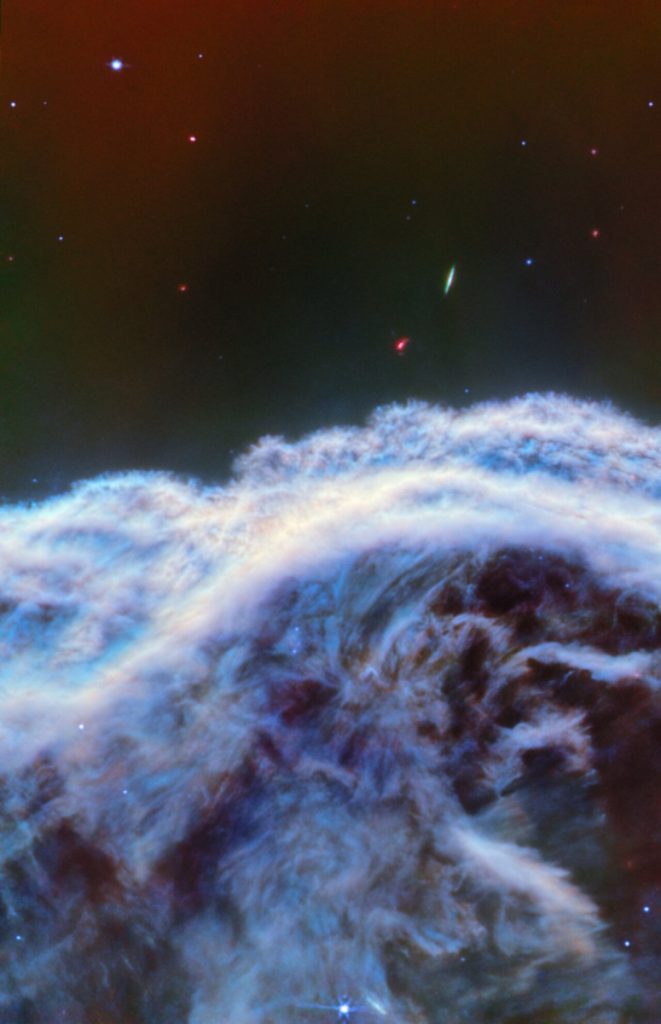
The Horsehead Nebula Revealed by the JWST
The Horsehead Nebula was discovered in the visible spectrum as a dark cloud that appears to be in extinction at the edge of a giant molecular complex in Orion. It is actually a photodominated region illuminated by a massive star. It is of great interest to astrophysicists because it is the ideal object for understanding the interactions between the UV radiation emitted by stars and interstellar matter, how radiation propagates within dense clouds, and the impact of radiation on matter (photoevaporation, ionization, dissociation, fragmentation, heating, etc.).
Infrared images from the JWST’s NIRCam and MIRI instruments reveal, for the first time, the small-scale structure of the illuminated edge of the Horsehead Nebula—where material is being photoevaporated, where atoms are ionized, where molecules (particularly dihydrogen) form and dissociate, where grains fragment, …
In addition to its angular resolution and sensitivity, the JWST has unique imaging capabilities that have yielded images in more than twenty different spectral bands, enabling a detailed analysis of the emission and extinction of gas and dust particles, which has just been published in Abergel et al. 2024 (https://www.aanda.org/articles/aa/pdf/forth/aa49198-24.pdf). The work will continue with the analysis of spectroscopic data and the modeling of the observations.
The observations of Cheval’s Head were obtained as part of the guaranteed observation time allocated to the MIRI and NIRCam instruments. The IAS is a member of the European consortium for the JWST’s MIRI mid-infrared instrument. The laboratory was involved in the optical testing of the MIRI imager, is responsible for processing and disseminating data from the imager within the French MIRI center of expertise, and established the INCLASS joint laboratory with the SME ACRI-ST to merge imaging and spectroscopic data.
Contacts
People involved: Alain Abergel, Olga Kannavou, Emilie Habart, Meriem Elyajouri, Laurent Verstraete, Antony Jones, Dan Pineau, Nicolas Monnier, Pierre Dell’Ova, Loïc Maurin
References
Press release: https://esawebb.org/news/weic2411/