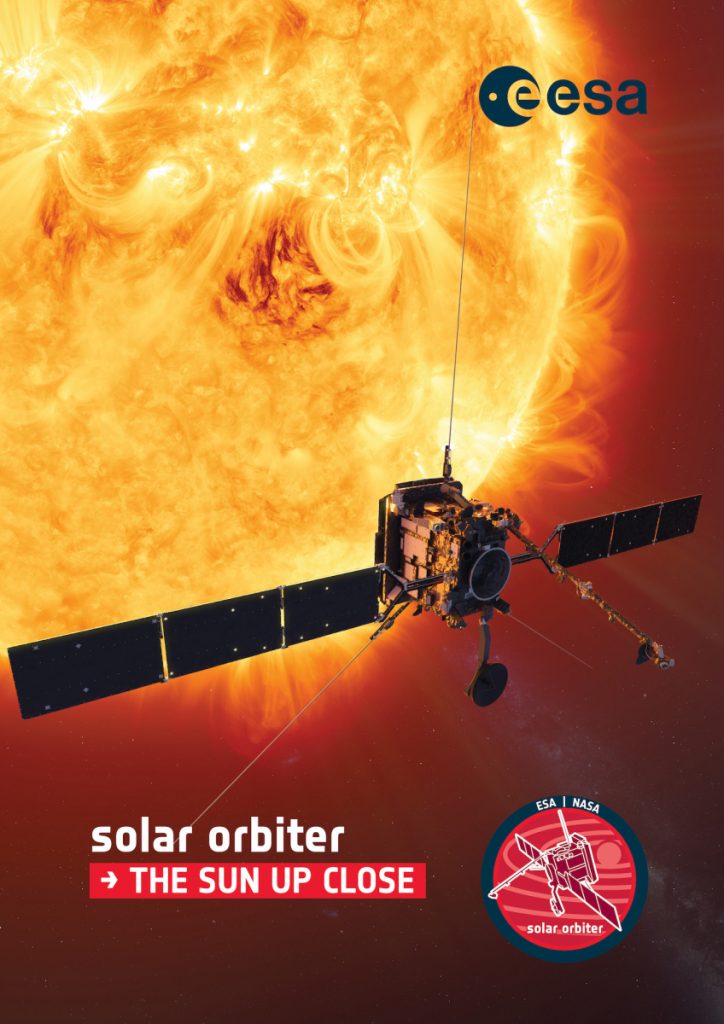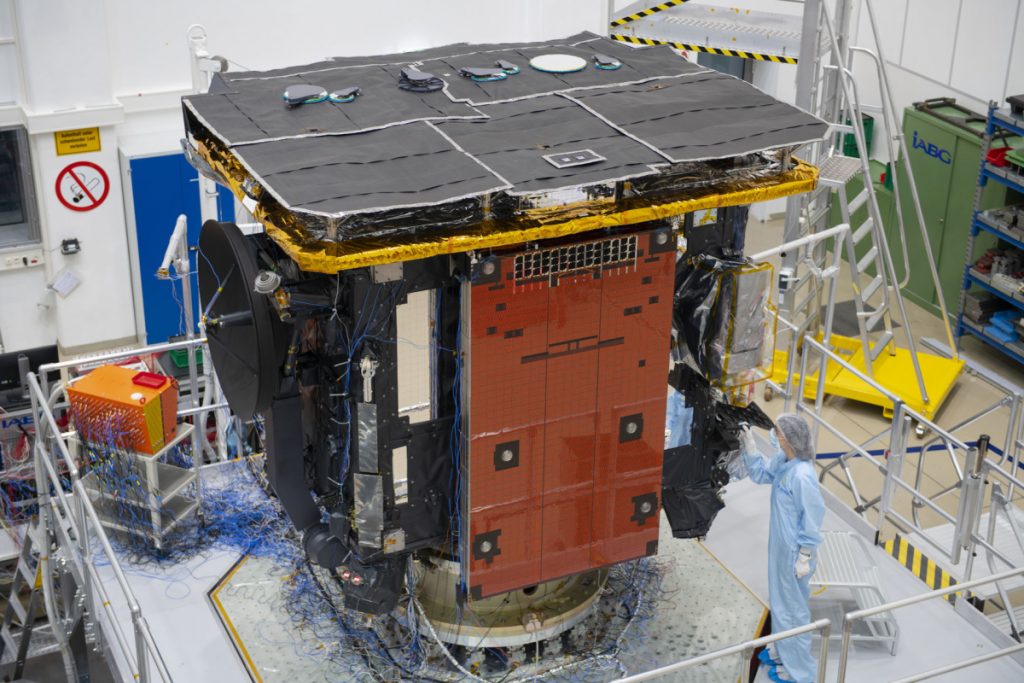
The spacecraft was presented today for the final time in Europe at the IABG testing facility near Munich, Germany. Built by Airbus in the United Kingdom, it has spent the past year at IABG undergoing critical testing, including verification of deployment mechanisms and its capacity to withstand launch vibrations, extreme temperatures, and the vacuum of space. The spacecraft has now been cleared for shipment to the launch site and will be transported by an Antonov cargo aircraft on October 31.
“Solar Orbiter is poised to answer some of the most profound scientific questions about our star. Its data will help us better protect our planet from the global challenges of space weather,” stated Günther Hasinger, ESA Director of Science.
Solar Orbiter will be launched on a NASA-provided Atlas V 411 rocket. Liftoff is currently scheduled for the early hours of February 6 (UTC). Once in space and over the course of several years, it will use gravity assists from Venus and Earth to raise its orbit out of the ecliptic plane and over the Sun's poles, providing an entirely novel vantage point for observing our star, including the first-ever images of the Sun's polar regions. The mission is essential for advancing our understanding of Sun-Earth connections. Indeed, we inhabit a giant plasma bubble generated by the Sun that envelops the entire solar system, within which we are subject to the effects of solar activity known as space weather.
Solar Orbiter is an ESA mission with strong NASA participation. The IAS has been heavily involved in this mission since the design, fabrication, and operations of the instruments, as demonstrated by an IAS co-PI for the Extreme Ultraviolet Imager (EUI), a lead co-I for the Polarimetric and Helioseismic Imager (PHI), and the PI-ship for the operations and exploitation of the Spectral Imaging of the Coronal Environment (SPICE) instrument.