
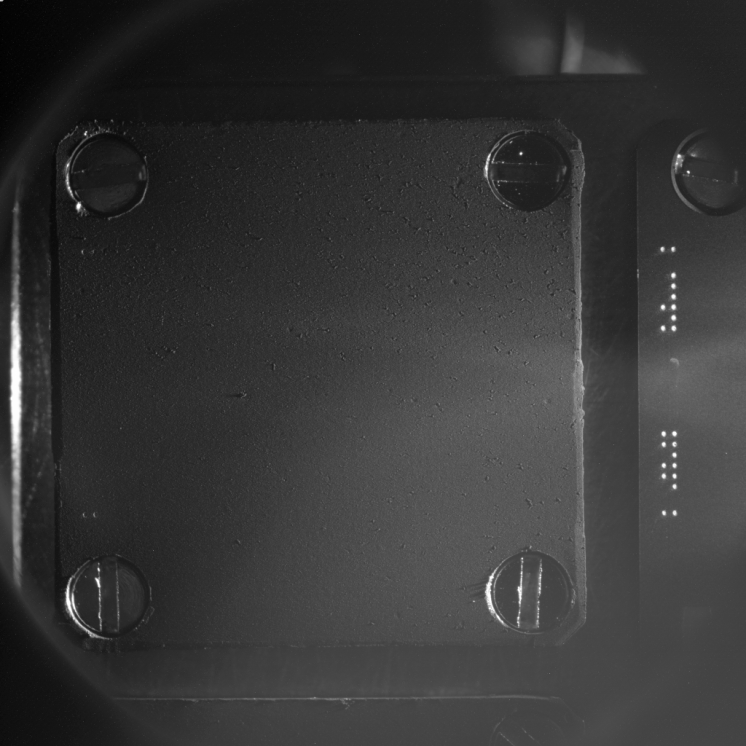
The COSIMA instrument is under the responsibility of the Max Planck Institute for Solar System Research (Göttingen, Germany). Dust densities beyond 3 astronomical units (450 million km, the current distance between the Sun and Comet 67P/Churyumov-Gerasimenko) are low, and the first three targets (each 10 mm x 10 mm) have been exposed for one month since August 10. Identifying the cometary grains collected by the targets is a crucial step.
To do this, COSIMA takes images of the targets before and after exposure using a camera, COSISCOPE, built by the Institute of Space Astrophysics. Two LEDs illuminate the targets at a grazing angle from two opposite directions to identify small grains protruding from the smooth, porous layer of “metallic black” that covers the first exposed targets (see figure). The COSIMA science team will select the regions to be placed under the ion gun to obtain mass spectra of cometary grains based on the images obtained by COSISCOPE after exposure toward the comet.