
The Planck mission, a vital milestone in the history of cosmology
The Planck collaboration has just published its final series of papers, bringing the total number to 164. Together, these publications have been cited over 90,000 times, demonstrating the enduring impact of this experiment on cosmology as a whole, particularly regarding constraints on neutrino mass, dark matter density, the characteristics of primordial fluctuations, the formation and evolution of galaxies and clusters, and the magnetic field of the Milky Way.
Launched in 2009, the Planck satellite carried two instruments: the Low Frequency Institute (LFI), under Italian responsibility, and the High Frequency Instrument (HFI), which was designed, built, operated, and analyzed under the leadership of Jean-Loup Puget and the IAS. Physicists and astronomers worldwide continue to utilize data from the Planck collaboration, combining and comparing them with state-of-the-art cosmological measurements.
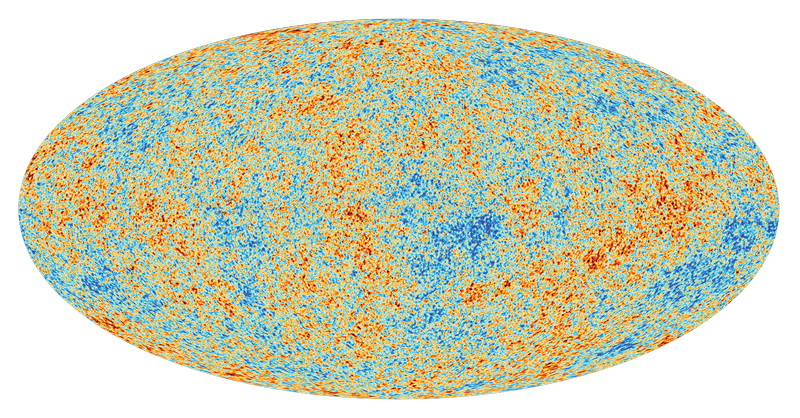
Our understanding of cosmic history is punctuated by a few rare, essential discoveries and observations. The Planck mission achieved one of them: the definitive map of the Cosmic Microwave Background (CMB) intensity, a luminous echo of the Big Bang. It is considered "definitive" because it covers the entire sky and reveals even the faintest signals of primordial origin with extreme sensitivity.
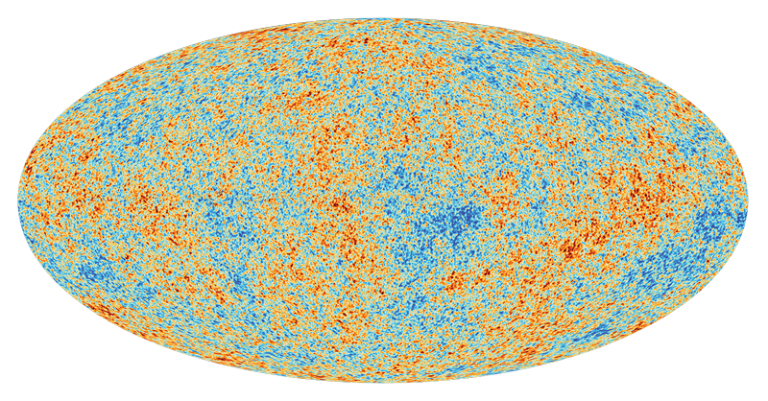
Map of temperature fluctuations in the cosmic microwave background. Credits: ESA — Planck collaboration.
This sky map was produced by a collaboration of astrophysicists, physicists, instrumentalists, and engineers; it is the combination of their expertise that made this success possible. This is arguably the first in a series of large-scale astrophysical collaborations. The map has firmly anchored the cosmological model and precisely determined the values of the six parameters required to describe the content and dynamics of the Universe, as well as the origin of its structures.
Other pioneering observations have likewise provided fresh insights into the evolution of structures in our Universe, ranging from the density fluctuations of the primordial epochs to our own galaxy. Researchers at the IAS have notably led studies on:
- microwave sky polarization,
- the reionization history of the Universe,
- hot gas content in galaxy clusters and the local Universe,
- protoclusters and galaxy clusters,
- infrared galaxies,
- the largest structures and voids in our universe,
- dust and gas within our galaxy.
The French website for the Planck collaboration provides a summary of the collaboration's key contributions to:
References
For more detailed information:
- Cosmological results from the Planck mission, Reflets de la Physique
- Planck 2018 results. I. Overview and the cosmological legacy of Planck”, Astronomy and Astrophysics.