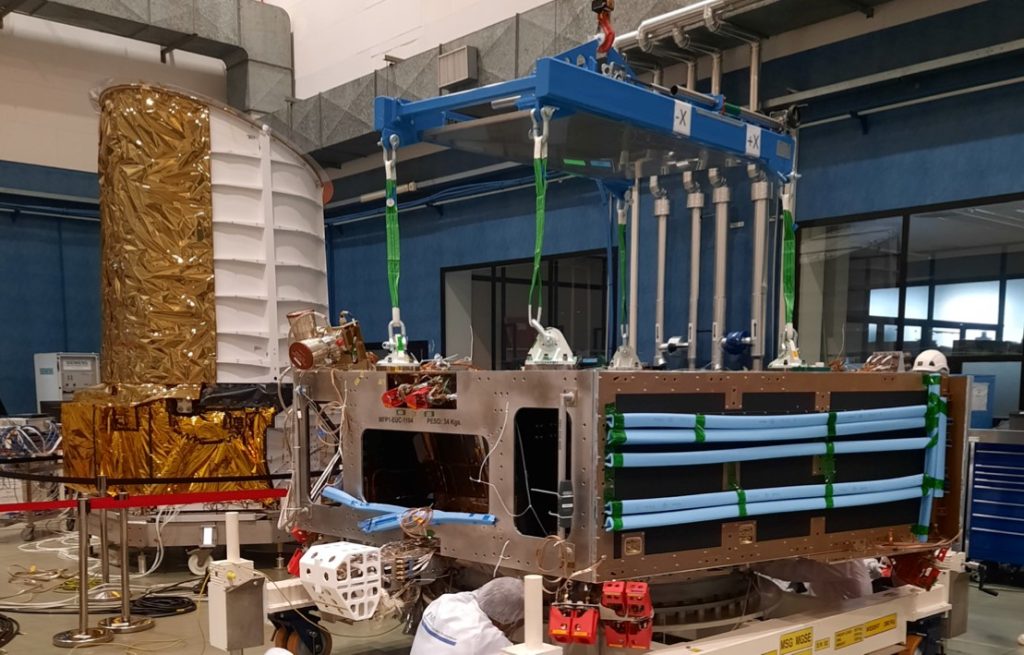
The environmental and performance testing campaign for the Euclid payload module (PLM) flight model, conducted at Airbus Defence and Space (Toulouse), was successfully completed in September 2021.
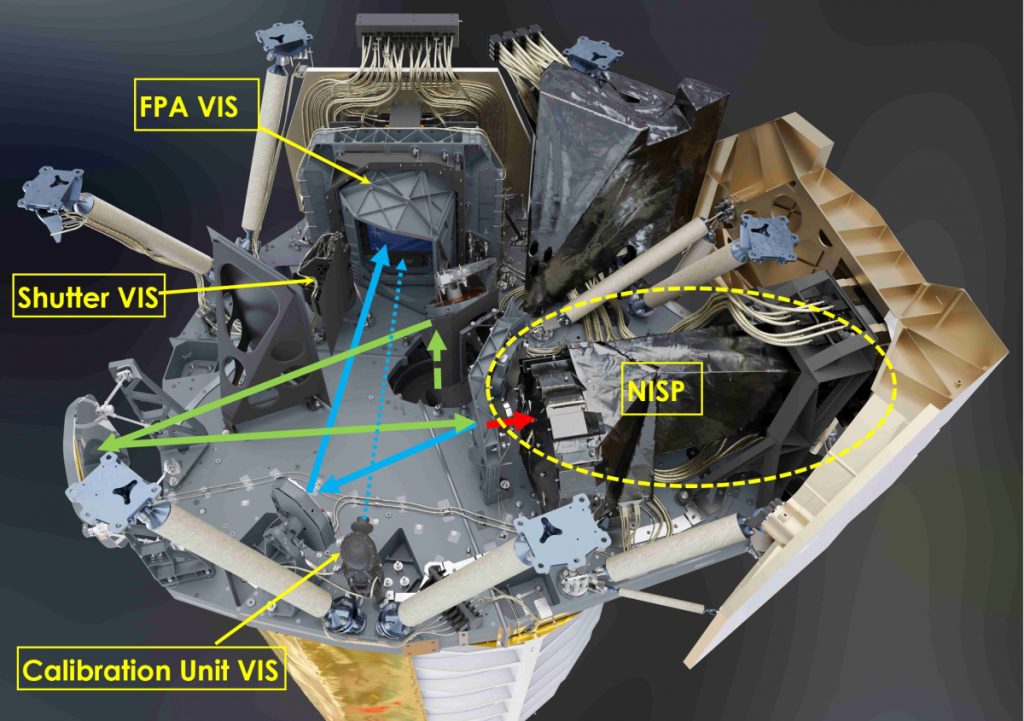
These tests verified the proper functioning of the instruments: the visible-light imager (Visible Instrument—VIS) and the near-infrared spectrometer and photometer (Near Infrared Spectrometer and Photometer—NISP). Aside from a non-conformity in the VIS electronic control unit, the performance of both instruments met expectations.
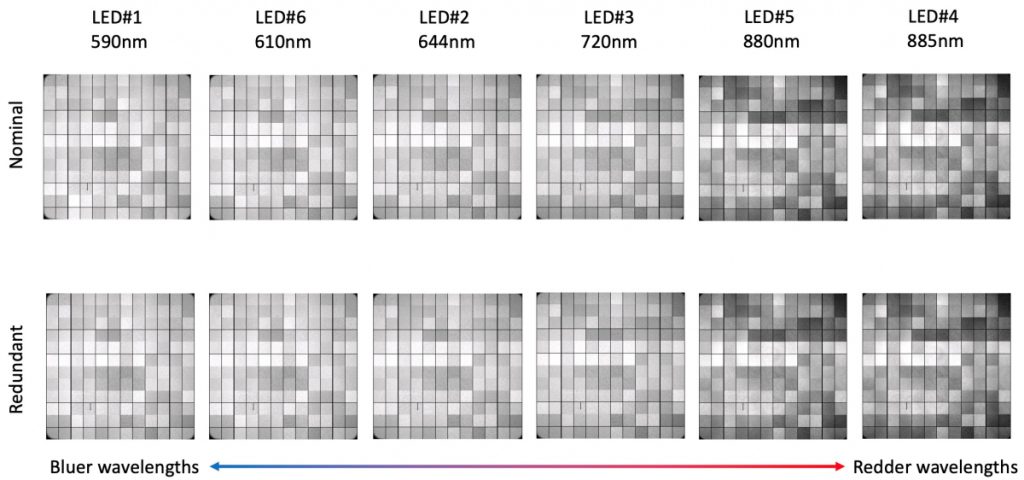
During these tests, the Calibration Unit (CU)—a subsystem developed by the IAS—was tested for the first time in its flight configuration. The CU is correctly aligned with the focal plane, and its performance fully meets specifications. The CU will generate flat fields of the VIS focal plane throughout the mission, thereby enabling the instrument’s calibration to be corrected as needed.
The PLM has since been delivered to Thales Alenia Space (Turin, Italy) for integration onto the service module (SVM). Satellite integration and testing will take place throughout 2022, prior to its shipment to the Guiana Space Center in Kourou. Euclid’s launch is currently scheduled for February 5, 2023, aboard a Soyuz rocket.
The scientific objective of the Euclid mission is to map the dark matter and dark energy of the Universe in an effort to understand the acceleration of the Universe’s expansion. To do this, the VIS instrument will image galaxies across more than one-third of the sky with excellent image quality to measure the shapes of more than one billion galaxies, and the NISP instrument will observe the spectral shifts of tens of millions of them using infrared spectroscopy.
The mission will take advantage of gravitational lensing, which refers to the distortion of distant galaxies caused by matter lying between them and Euclid’s instruments. This allows for the measurement of the spatial distribution of galaxies and their clustering, yielding a 3D image of the evolution of dark matter distribution. This will allow scientists to reconstruct the last few billion years of the history of the Universe’s expansion; they will thus be able to estimate the acceleration caused by the mysterious dark energy with an accuracy of within one percent, and any variations in acceleration with an accuracy of 10%.