
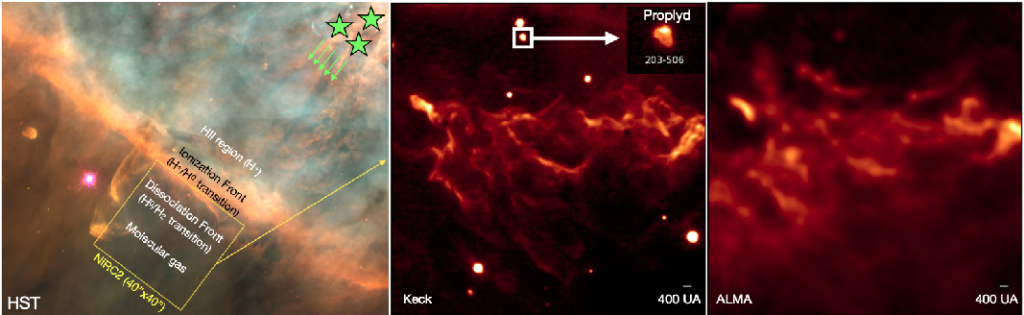
The most detailed images ever taken of a photo-dissociation region (PDR) in the closest massive star-forming region, the Orion molecular cloud, were obtained with the Keck telescope and offer a glimpse of what the JWST is expected to achieve soon. These observations are essential for understanding how young massive stars interact with the cloud of gas and dust in which they are born and where Sun-like stars form.
Young, massive stars emit large amounts of ultraviolet (UV) radiation that affect the physics and chemistry of their surroundings. How this energy is injected into the parent cloud and impacts the formation of stars, such as the Sun, is not yet well understood.
Using Keck-II’s NIRC2 and its adaptive optics system, we observed the iconic Orion Bar. This neutral zone, illuminated and heated by starlight, is a prototypical photon-dominated region (PDR) representative of many star-forming regions in our Galaxy and distant galaxies. The Orion Nebula is the closest region of massive star formation to Earth and may be comparable to the environment in which our solar system formed.
The new Keck observations allow us to examine the nebula down to scales of 40 AU (10 AU is the distance from Saturn to the Sun). We were able to resolve and spatially distinguish the various substructures of the Orion Bar—such as ridges, filaments, globules, and proplyds (photo-evaporated protoplanetary disks)—which formed when massive stars sculpted the nebula’s gas and dust. We can see in detail where the gas in the PDR transitions from a hot, ionized phase to a cold, atomic phase and then to a cold, molecular phase. Mapping this transition is important because dense, cold molecular gas is the fuel necessary for star formation.
Never before have we been able to observe, on such a small spatial scale, how interstellar matter organizes itself and how planetary systems can form in environments heavily irradiated by massive stars. This may help us better understand the influence of the interstellar medium on planetary systems.
These Keck observations offer a glimpse of what is expected to be achieved with the JWST and how it will complement ALMA observations.
These observations contributed to the planning of the JWST Early Release Science (ERS) program “PDRs4All: Radiative Feedback of Massive Stars.” Very soon, we will be using three of the four instruments on board JWST: NIRCam, NIRSpec, and MIRI. JWST will provide access to multiple spectroscopic images with similar spatial resolution but will improve the signal-to-noise ratio and contrast, and will offer a unique insight into the local physical conditions (temperature, density, and pressure) and the chemical composition of these regions.
Émilie Habart, Assistant Professor, Head of the AMIS Team