
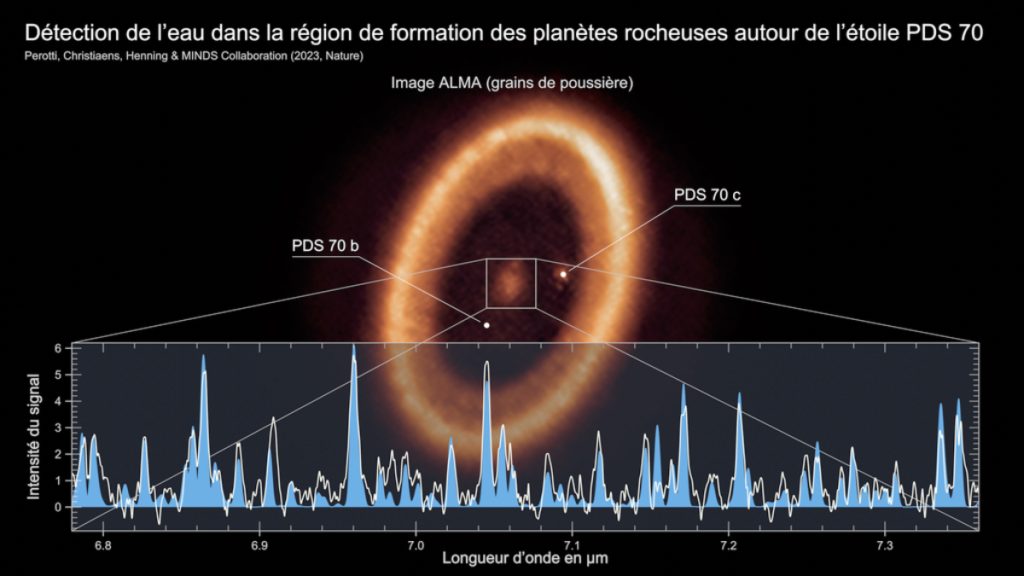
JWST detects water in a planet-forming disk
Water is essential for life on Earth. However, the origin of water on Earth remains a matter of ongoing debate within the scientific community. The prevailing mechanism is the delivery of water-bearing asteroids bombarding the surface of a young planet. An international research team involving scientists from the IAS has just discovered water in the inner region of a gas and dust disk orbiting the young star PDS 70. This star is notable for hosting two forming gas planets.
This is the first relatively old disk—approximately 5.4 million years—in which astronomers have detected water. Over time, the amount of gas and dust in protoplanetary disks decreases, either through stellar radiation or due to giant planets in formation sweeping up the gas and blocking the supply of matter to the inner regions where rocky planets form. Observations of PDS 70 demonstrate that the rocky planet-formation region remains rich in water, despite the formation of giant planets analogous to Jupiter or Saturn. Thus, in addition to water delivered by a long-term process involving water-rich asteroids, this new finding suggests that water is already available when rocky planets form.
These findings were published on July 24, 2023, in the journal Nature by the MINDS collaboration, which includes researchers from the IAS. The observations were obtained using the MIRI instrument, developed by a consortium of laboratories in Europe and the United States of which the IAS is a member. These results provide us with an initial glimpse into the potential of the JWST space telescope for unraveling the physical and chemical conditions governing planet formation.
Contacts
Benoît Tabone, Researcher, Interstellar Matter Astrophysics Team
References
- View the NASA/ESA Press Release: https://www.esa.int/Science_Exploration/Space_Science/Webb/Webb_detects_water_vapour_in_rocky_planet-forming_zone
- The article in Nature: https://www.nature.com/articles/s41586-023-06317-9