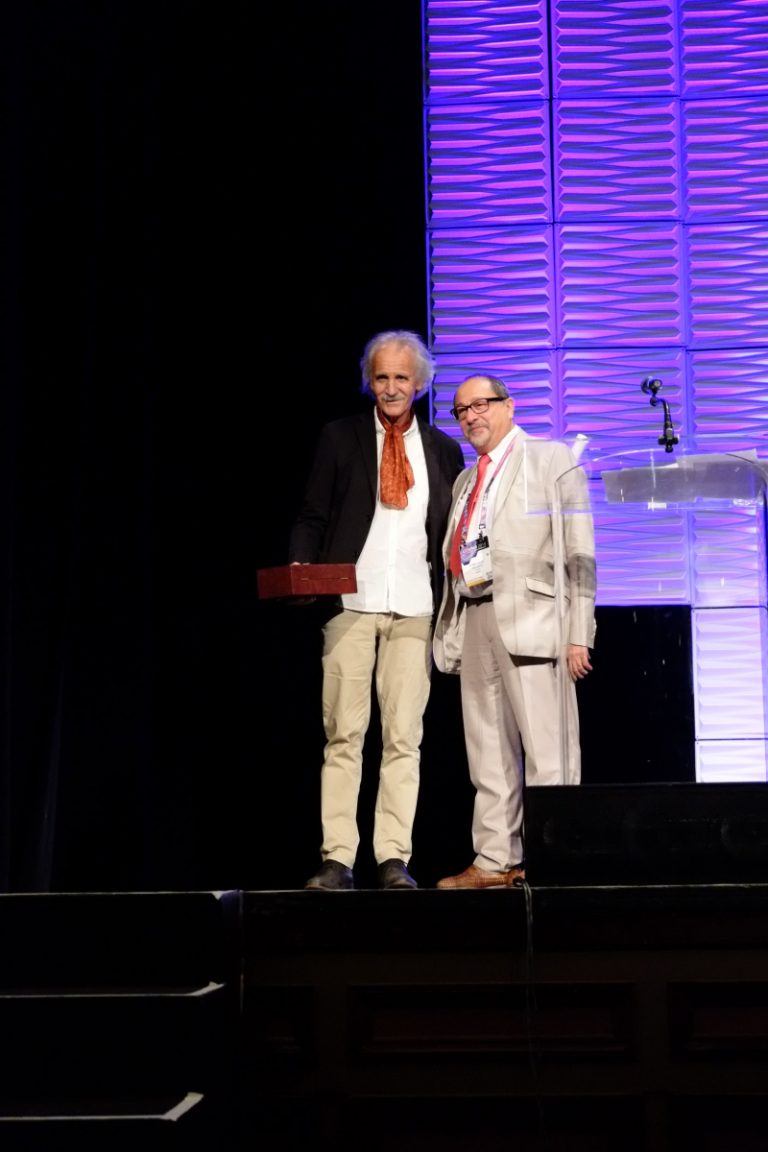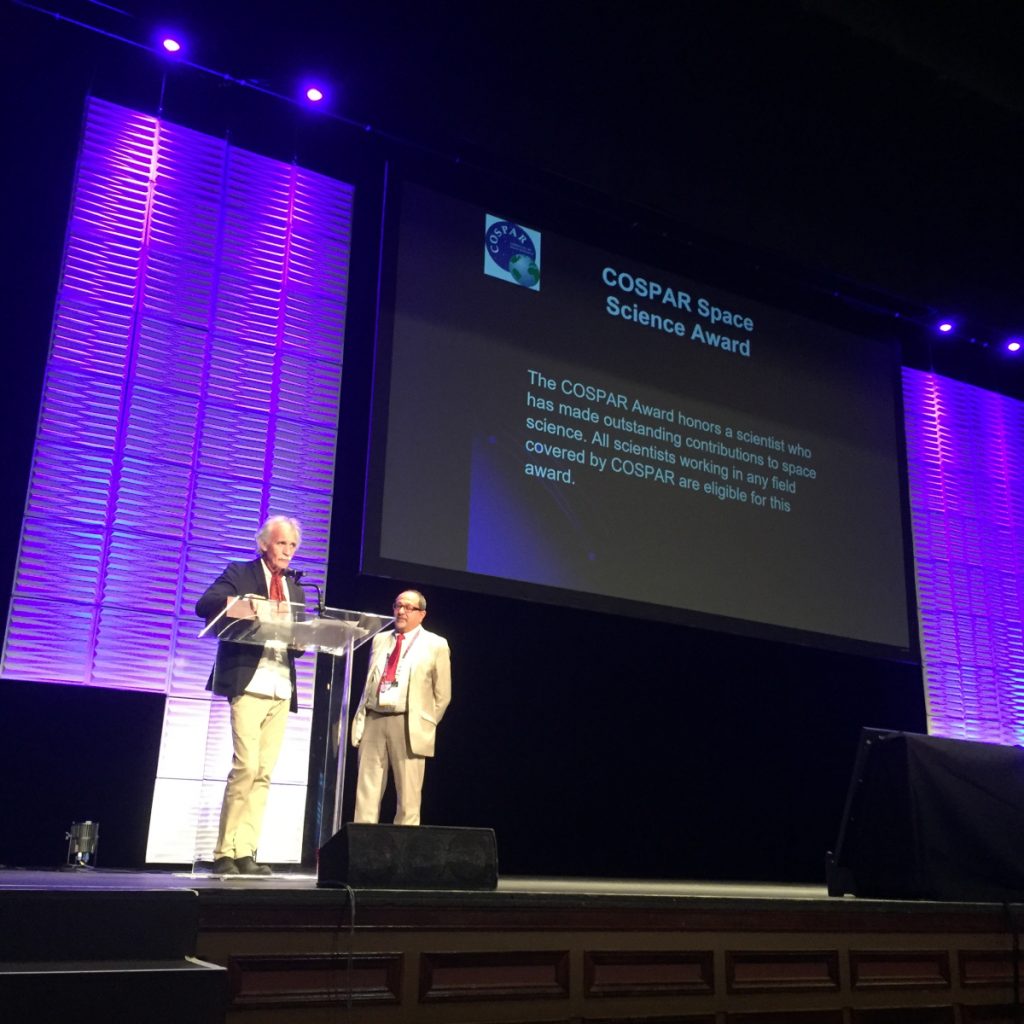
Jean-Pierre Bibring, Professor Emeritus at the Institut d'Astrophysique Spatiale (CNRS / Université Paris-Sud), received the COSPAR Space Science Award on July 15, 2018, for his contributions to the space exploration of the solar system. This medal is the most prestigious accolade awarded by COSPAR (Committee on Space Research) during its biennial general assemblies. Among Jean-Pierre Bibring's numerous achievements, COSPAR specifically highlighted his leadership roles in the Mars Express and Philae/Rosetta missions.
Below is the press release issued by COSPAR:
COSPAR Space Science Award: Jean-Pierre Bibring (France) What are the processes that shaped the history of terrestrial planets? What modeled their present uniqueness, primarily that of Earth? How did life emerge on Earth? Has life emerged elsewhere? Throughout his career, Jean-Pierre Bibring has addressed these questions by developing cutting-edge instruments deployed on various space missions primarily targeting Mars, thereby unraveling the planet's history through pioneering diagnostic measurements. Specifically, Jean-Pierre Bibring has developed infrared imaging spectrometers flown on a wide range of Russian, European, American, and Japanese space missions. Of paramount importance is the OMEGA investigation, which he continues to lead on ESA's Mars Express mission: for the first time, high-resolution imaging and spectroscopic capabilities were combined into a single instrument, enabling global coverage at sub-kilometer resolution while characterizing the composition of both the surface and atmosphere at each pixel. A key discovery by OMEGA is the identification of minerals resulting from aqueous alteration on the Martian surface, following a sequence from phyllosilicates (clays) to sulfates, which records the environmental evolution of Mars over time and highlights the role of water. A critical finding is the indication that Mars may have harbored "habitable" conditions in its very early history, shortly after planetary formation. Furthermore, Jean-Pierre Bibring served as one of the two Philae Lead Scientists, overseeing overall operations and scientific activities while coordinating 10 Principal Investigator (PI) investigations. Landing on a completely unknown object with extremely limited resources to manage and react to real-time conditions, while successfully achieving the first in-situ characterization of pristine solar system material, firmly establishes Philae as one of the most challenging and seminal space ventures ever undertaken.
Combining instrumental expertise with a conceptual approach, Jean-Pierre Bibring has made major breakthroughs in planetary and solar system science. Moreover, given his deep involvement in upcoming asteroid and Mars missions, his potential for future discoveries remains exceptionally high. He is a most deserving recipient of the COSPAR Space Science Award.