INGMAR

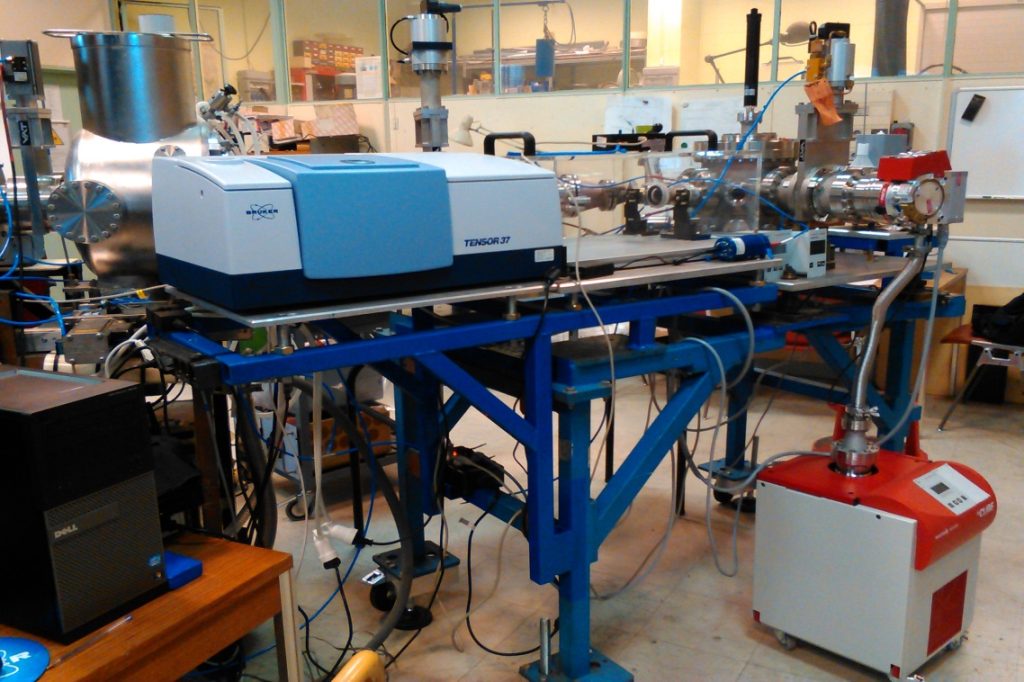
The INGMAR project (Irradiation of Ice and Meteorites Analyzed by VIS-IR Reflectance) enables the ion irradiation of ice, meteorites, or planetary analogs, as well as their in situ VIS-NIR reflectance analysis. The vacuum chamber is installed on the SIDONIE isotope separator at the IJCLab’s MOSAIC platform.

The Role of the IAS

Most small bodies in the solar system undergo surface weathering (“space weathering”) due to irradiation by solar wind particles and higher-energy cosmic rays. Interpreting the observed reflectance spectra requires an understanding of the mechanisms and processes that determine the evolution of such surfaces. Laboratory experiments simulating the space weathering of small bodies and the corresponding spectral variations provide valuable insights into this issue.
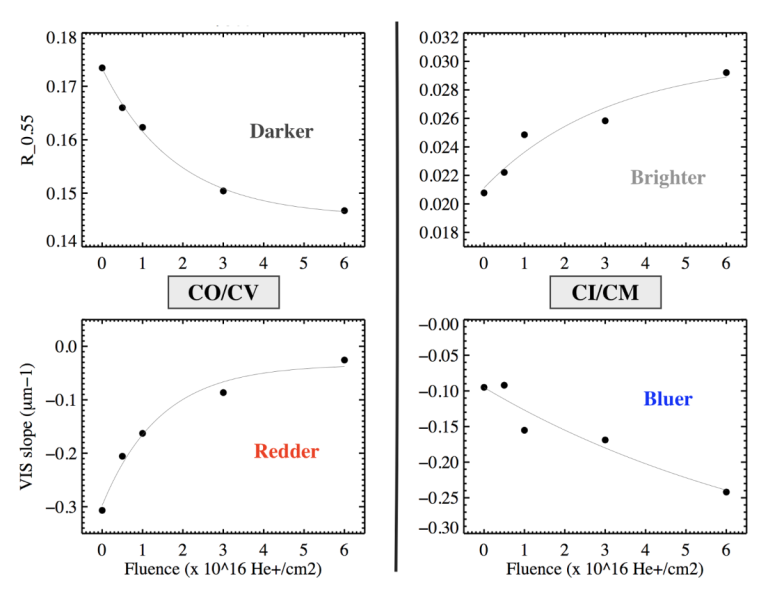
Prior to 2010, most experiments studying this weathering in the VIS-NIR were conducted on high-albedo objects (in the context of lunar sample returns and, later, the Itokawa asteroid mission). In contrast, very few studies have focused on low-albedo bodies (rich in carbonaceous material). The INGMAR project (launched in 2015) was initially designed to address this lack of experimental data by establishing a laboratory program dedicated to the ion irradiation of carbon-rich ices and meteorites, and their in situ VIS-NIR reflectance analysis. This took place within a very favorable international context, particularly thanks to the Hayabusa 2/JAXA and OSIRIS-REx/NASA space missions to retrieve samples from carbonaceous asteroids. The experiment demonstrated the influence of the samples’ initial composition on their spectral response to irradiation.

Caption = Influence of initial composition on the spectral response to ion irradiation. Objects richer in anhydrous silicates (left) will see their surfaces darken (top) and their spectra “redden” (increased slope toward longer wavelengths; bottom) as the irradiation dose increases. In contrast, objects with higher carbon content (and enriched in hydrated material; right) exhibit the opposite spectral behavior, with a lightening of the surface and a “bluer” slope. Figure adapted from Lantz et al. 2017.

Since then, we have conducted projects on numerous bodies in the Solar System, often to support the interpretation of data from space missions. We have studied analogs of OTNs (JWST/NASA), Mercury (BepiColombo/ESA-JAXA), and Phobos (MMX/JAXA), among others.    Future experiments will enable us to provide fundamental support for the JUICE mission (ESA). We are also developing a sample holder system that allows for the irradiation of millimeter-sized grains (rather than centimeter-sized grains, as has been the case until now).

We are expanding our analyses to include other techniques (mid- and far-infrared spectroscopy, Raman spectroscopy, SEM, TEM, etc.) in order to gain a better mineralogical and chemical understanding of the processes in question.

This program has received financial support from the RD program of the P2IO Labex (Physics of the Two Infinities and Origins) and the National Planetology Program (PNP). We also receive regular support from CNES.

In operation

  • Before 2010: Studies onspace weathering focused primarily on objects with high albedo (e.g., lunar samples, the asteroid Itokawa).

  • 2015: Launch of the INGMAR project to address the lack of experimental data on bodies with low albedo (rich in carbonaceous material). Deployment of the vacuum chamber on the SIDONIE isotope separator (MOSAIC platform, IJCLab).

  • 2015–2026:

    • Conductingion beamirradiation experiments on ice, meteorites, and planetary analogs, coupled with in situ VIS-NIR reflectance analyses.
    • Publication of results (e.g., figure adapted from Lantz et al., 2017) showing the influence of initial composition on the spectral response.
    • Support for Space Missions :
      • Hayabusa 2 (JAXA) and OSIRIS-REx (NASA): Returning samples from carbonaceous asteroids.
      • BepiColombo (ESA-JAXA): Study of Mercury.
      • MMX (JAXA): Study of Phobos.
    • Development of a sample holder system for the irradiation of millimeter-sized (rather than centimeter-sized) grains.
    • Expansion of analyses using complementary techniques (mid-infrared/far-infrared, Raman, SEM, TEM).
    •  
  • 2026 :

    • Current status: Project in progress.
    • Preparations for supporting the JUICE mission (ESA).
    • Continuation of experiments and collaborations with space missions.
  1. Initial Context (Before 2010) :
    • Focus on objects with high albedo (the Moon, Itokawa).
    • There are few studies on carbonaceous bodies (low albedo).
  2. Project Launch (2015) :
    • Development of a vacuum chamber on the MOSAIC platform (IJCLab).
    • Integration with the SIDONIE isotope separator for ion irradiation experiments.
    • Objective: To study the influence of the initial composition of the samples on their spectral response.
  3. Notable Results :
    • Demonstration of the impact of composition on the spectral response:
      • Objects rich in anhydrous silicates: Darkening of the surface and “redshift” of the spectrum (increased slope toward longer wavelengths) upon irradiation.
      • Carbon-rich/water-rich objects: A lighter surface and a more “blue” gradient.
    • Publication of results.
  4. Methodological Extensions :
    • Development of a sample holder system for millimeter-sized grains (instead of centimeter-sized ones).
    • Additional Analyses :
      • Mid- and far-infrared spectroscopy.
      • Raman, SEM (Scanning Electron Microscopy), TEM (Transmission Electron Microscopy).
  5. Support for Space Missions :
    • Hayabusa 2 (JAXA) and OSIRIS-REx (NASA): Returning samples from carbonaceous asteroids.
    • BepiColombo (ESA-JAXA): Study of Mercury.
    • MMX (JAXA): Study of Phobos.
    • JUICE (ESA): Future mission to Jupiter (ongoing support).

SIDONIE, VIS-NIR, Raman, SEM, MET

Contacts

Advisors (scientific and technical)

  • Rosario Brunetto, Research Fellow, Astrochemistry & Origins Team
  • Cateline Lantz, Assistant Astronomer, Solar System and Planetary Systems Physics Team
Scroll up