
Computer Science
Overview
The IAS IT department covers both laboratory IT activities (information systems, systems and network administration, IT infrastructure management, application management, user support, etc.) and scientific computing activities, which are integrated into the IDOC (Integrated Data and Operation Center) platform.
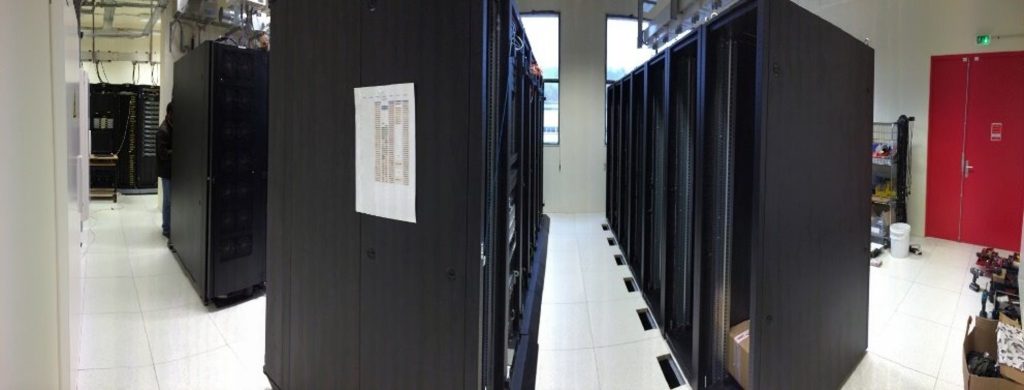
Scientific computing at the IAS aims to support scientific teams throughout the data lifecycle, from data production, processing, and analysis to data utilization and dissemination. The IT department is heavily involved in the ground-based segments of the space missions in which the IAS participates, both in the operational aspects (observation planning, uplink and downlink communications with satellites) and in the scientific aspects (processing raw data to produce scientifically usable data, archiving, and making data available).
The IT team is structured to meet the needs of IAS projects by leveraging the complementary skills of its members, who are organized into three divisions: technical engineering and production, software engineering, and scientific computing. The IAS’s experience in ground-based segments of space missions also enables it to take on project management responsibilities for space agencies (CNES, ESA). The MEDOC (solar physics) and IDOC (originally covering all IAS scientific areas, now part of OSUPS) operations and data centers also serve as data repositories to make the most of the data produced by the scientific teams.
The Team
Technical and Production Engineering
- Stéphane Caminade – IRHC – Infrastructure and Databases
- Hervé Ballans – IRHC – Infrastructure and Interfaces
- Simon Bibitchkov – Fixed-Term Contract, MEDOC
- Bastien Siguier – Fixed-Term Contract at PLATO
Software Engineering
- Marc Dexet – IRCN – Development and Interfaces
- Khalil Ashkar – CDD MEDOC
- Lucas Guillerot – Fixed-Term Contract, PLATO
Computational Science and Data Analysis
- Elie Soubrié – IRCN – Scientific Interface
- Martine Chane-Yook – IGRHC – (University) Scientific Interface & Web
- Iryna Chemerynska – JWST Fixed-Term Contract
- Lucie Correia – Fixed-Term Contract, MAJIS
- Nicolas Ligier – Fixed-Term Contract, MAJIS/OMEGA
- Dinil-Bose Palakkatharappil – Fixed-Term Contract (PLATO)
- Vilasini Tinnaneri – (CNRS Fixed-Term Contract)
- Alfred Voyeux – Fixed-Term Contract at SPICEOPS
UAR OSUPS members assigned in part to IAS projects
- Loïc Maurin – IGRCN – Head of IDOC
- Pierre Dell’ova – IRCN – Development and Scientific Interfaces
- Nicolas Monnier – IRCN – Scientific Interface & Computing
Projects
The IAS IT Department is involved in ground segments for space missions, the analysis of data from space missions, and data warehouses related to the IAS’s scientific areas of focus. Currently, the main projects are as follows.
Solar Orbiter/SPICE Ground Segment
Staff involved: Stéphane Caminade, Alfred Voyeux
The IAS is responsible for the SPICE instrument’s scientific operations consortium. The IT department led the development of tools for planning operations and provides technical support for planning activities. It participates in data processing and is responsible for delivering data to ESA. It coordinates the project documentation intended for CNES and ESA.
MAJIS/JUICE Ground Segment
Staff involved: Marc Dexet, Pierre Dell’Ova, Lucie Correia, Nicolas Ligier
Members of the IAS IT department are heavily involved in the ground segment of the MAJIS/JUICE mission. Its engineers design, maintain, and operate processes and software to support instrumental and scientific activities during critical phases such as observation planning, command preparation, monitoring, and data processing.
EUCLID Scientific Ground Segment
Staff involved: Elie Soubrié, Loïc Maurin, Vilasini Tinnaneri
Within the Euclid ground segment, we designed, developed, and validated certain functions of the data processing pipeline, specifically those relatedto PSF homogenization, masking of the brightest stars, and the galaxy-star classification of objects in the catalog created by MER (the pipeline function that “merges” the detections made in the images from the various VIS, NIR, and EXT instruments).
Since the launch, we have been analyzing the outputs of these algorithms for each new tile processed to verify that performance is acceptable, and when necessary, we modify these algorithms to adapt them to the needs of each new “data release” in the project.
PLATO/SAS Scientific Ground Segment
Staff involved: Hervé Ballans, Bastien Siguier, Lucas Guillerot, Dinil Bose Palakkatharappil, Nicolas Monnier
JWST/MIRI Center of Expertise
Staff involved: Nicolas Monnier, Pierre Dell’Ova, Iryna Chemerynska
The JWST/MIRI Center of Expertise at the IAS maintains and updates a local branch of the data reduction pipeline to ensure up-to-date, high-quality processing for the MRS, MIRIM, and NIRSpec instruments.
It develops and implements complementary processing techniques designed to correct for subtle instrumental effects (fringes, scintillation noise, astrometric alignment, photometric calibration, cosmic rays), as well as an innovative data fusion approach aimed at combining information from imaging (MIRIM) and field-integral spectroscopy (MRS).
Finally, it ensuresthe archiving and availability of Level 3data, ready for scientific analysis of the observations.
MEDOC Data Warehouse
Staff involved: Stéphane Caminade, Khalil Ashkar
The IAS IT department bears technical responsibility for the MEDOC center in collaboration with the scientific directors. It participates in steering and user committees and manages the resources necessary to achieve the center’s objectives, in collaboration with CNES and the overseeing agencies.
The IT department helps implement the technical tools necessary for the smooth operation of the MEDOC data center. It provides online data visualization services (Helloviewer), tools for the SWESNET space weather network, and distributes solar mission data through the REGARDS interface, developed by CNES.
It also managesthe hardware infrastructure for data storage and service hosting.