
Identification of the Crater That Is the Source of Martian Meteorites
Martian meteorites have been known since the 1970s, but their region of origin remained unknown until researchers from Oslo, Lyon, and the IAS recently identified the crater believed to be the source of the largest group of Martian meteorites, the shergottites. This impact crater likely formed 3 million years ago, and the meteorites reached Earth a few thousand years ago.
Meteorites from certain well-differentiated planetary bodies, such as Mars, offer the only opportunity to analyze rocks from other bodies in the solar system in a laboratory setting, using methods and protocols that are not available to space exploration. The age and composition of these samples can be determined, providing unique insights into the evolution of their parent planetary bodies. Meteorites have thus provided important insights into the formation and evolution of Mars. However, the lack of knowledge regarding the location of the impact(s) that ejected these fragments of Mars toward Earth has called into question the relevance of these meteorites for understanding Mars’s evolution.
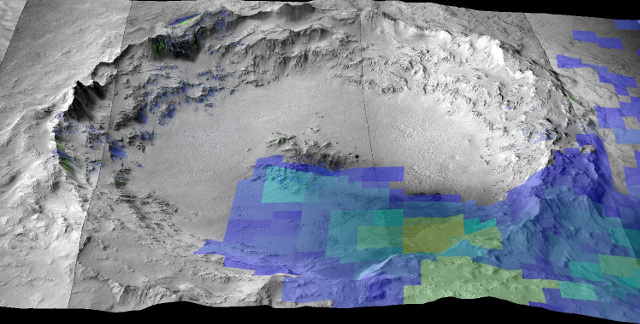
Accurately determining the geological location of these meteorites is therefore crucial for placing our understanding of their mineralogy and age within a planetary context. The identification of the crater that is almost certainly the source of the shergottites, particularly through the analysis of data collected by the OMEGA instrument aboard Mars Express and the CRISM instrument aboard the Mars Reconnaissance Orbiter, has thus resolved the heated debate over the age of these meteorites (less than 600 million years or more than 4.1 billion years) in favor of a much older age for these meteorites. Their source is indeed the Mojave crater, which was likely formed about 3 million years ago and is located in ancient terrain near the Martian equator.
These new constraints on the origin of these meteorites should provide a better understanding of the information they offer about Mars’s mineralogical and chemical composition and help guide the selection of future Mars sample returns—this time carried out by robots.
The Mojave Crater, formed several million years ago and identified as the source of the largest group of Martian meteorites (the shergottites). The colored pixels indicate the presence of mafic minerals (pyroxene and olivine) identified by OMEGA and CRISM, which have also been found in Martian meteorites through laboratory analyses.
Contacts
Advisors (scientific and technical)
François Poulet, Astronomer, Solar System and Planetary Systems Physics Team
References
Scientific article: Werner, S. C., Ody, A., and Poulet, F. (2014). Science.