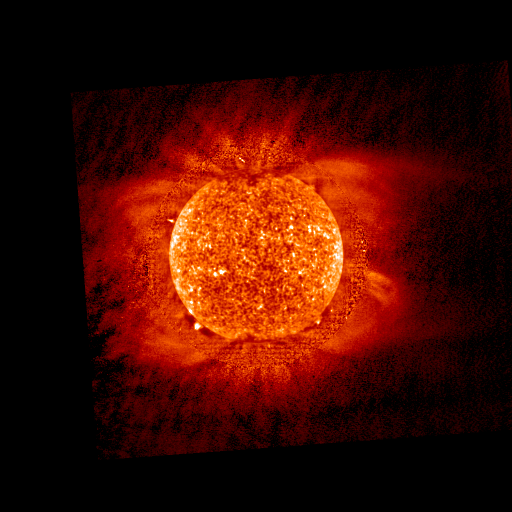
HEIT images provide information on the intensity distribution across the solar disk at the time of the flyby, which is necessary for analyzing HECOR data. The HECOR image is the best ever obtained of the solar corona in the 30.4-nm resonance line of ionized helium. Preliminary analysis suggests that the “horn-like” structures are produced by local variations in the abundance of helium in the corona, at the boundaries of structures called “streamers.”
Determining the abundance of helium in the solar corona was one of HECOR’s main objectives. To confirm the presence of local variations in abundance, work is needed—and is currently underway—to model the formation of the observed line under the physical conditions prevailing on the day of observation. The scientific results from HECOR are therefore expected later this year.
The HEIT instrument is a replacement model for the EUVI telescopes on the STEREO spacecraft. The IAS and the IO developed its optics. The HECOR instrument was designed entirely by the IAS, and the IO (Institut d’Optique) applied the optical coatings. The design, fabrication, testing, and delivery were all completed within the tight timeframe of one and a half years. HECOR is the first coronagraph built by the IAS. It has laid the technical groundwork for future space missions using this type of instrument by building on expertise in optics and mechanics.
Scientific Findings
- HEIT: Provides images of the solar disk to provide context for the HECOR data.
- HECOR :
- First high-resolution image of the solar corona in the 30.4 nm (He II) line.
- Preliminary finding: The “horn-like” structures may be related to local variations in helium abundance at the boundaries of the streamers.
- Modeling is currently underway to confirm these variations and publish the results.
- Technical Legacy :
- The first coronagraph designed by theIAS.
- Leveraging expertise in optics and mechanics for future space missions.