
Distant Formation and Early Evolution of the Carbonaceous Asteroid Ryugu: Direct Evidence from Samples Returned by Hayabusa2
The Japanese JAXA Hayabusa2 mission returned samples from the primitive carbonaceous asteroid Ryugu. Analysis of these samples by an international team led by Prof. Tomoki Nakamura (Tohoku University, Japan) has led to a proposed scenario tracing Ryugu’s history, including its formation following the fragmentation of its parent asteroid.
The French laboratories involved are IAS, ICP, IJCLab, ISMO (Paris-Saclay University/CNRS), SOLEIL Synchrotron, IMPMC (Sorbonne University/CNRS/MNHN), IPAG (University of Grenoble-Alpes/CNRS), IPGP (University of Paris Cité/CNRS), and LESIA (Paris-Meudon Observatory/CNRS), with support from CNES.
The Ryugu samples contain minerals (hydrated silicates, carbonates, magnetite) as well as organic materials and carbonated water. A small proportion of the minerals on Ryugu’s surface formed near the Sun. Ryugu has a composition remarkably similar to that of the Orgueil meteorite, which fell in France in 1864 and is housed at the MNHN in Paris. Orgueil belongs to a rare class of meteorites and is used as a reference for the average composition of the solar system. The Ryugu samples thus offer a unique insight into this type of primitive material.
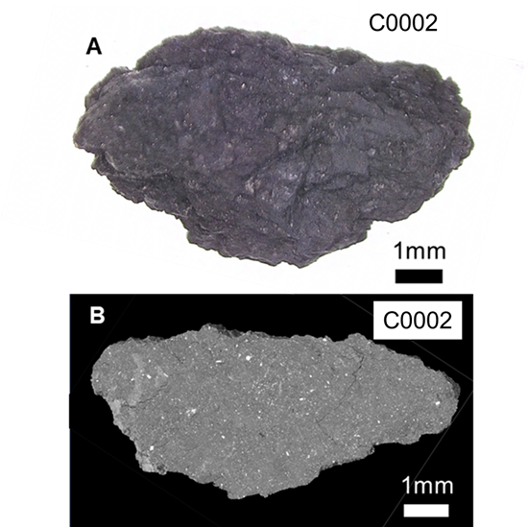
Fig. 1 (A) Optical microscope image of the largest sample analyzed (C0002) and (B) Tomographic view of the sample’s interior obtained through synchrotron X-ray microtomography at SPring-8 (Japan). It can be seen that the entire sample consists of a fine-grained material (gray).
Le champ magnétique primordial enregistré dans les minéraux magnétiques de Ryugu suggère que son astéroïde parent s’est formé dans des régions éloignées du Soleil. Une simulation numérique tenant compte des caractéristiques mesurées dans les échantillons de Ryugu, suggère que le corps parent de Ryugu faisait une taille ~100 km et s’est formé ~2 millions d’années après la formation du Système Solaire. Au cours des 3 millions d’années suivantes, sa température a atteint ~50°C, entraînant des réactions d’altération aqueuse. Par la suite, un impacteur (de taille < ~10 km) a désagrégé l’astéroïde parent. L’astéroïde Ryugu s’est ensuite agrégé à partir de matériau qui était éloigné du point d’impact.
The findings of the Hayabusa2 “Stone” Initial Analysis Team (led by Prof. Tomoki Nakamura of Tohoku University, Japan) were published in *Science* on Thursday, September 22:
T. Nakamura et al., Science 10 .1126/science.abn8671 (2022).
Contribution from the IAS and the SOLEIL synchrotron
Teams from the IAS and the SMIS beamline at the SOLEIL synchrotron focused on studying the mineral composition of various Ryugu samples, ranging from small grains a few microns in size to millimeter-sized rocks. This work utilized infrared hyperspectral imaging (2D and 3D) across a wide range of wavelengths, coupled with Raman microscopy and electron microscopy (ICMMO, CentraleSupelec), using sample preparations developed specifically for this mission (a collaboration between CentraleSupelec and IEMN-Lille). The infrared spectra of Ryugu’s grains were compared to those of various primitive meteorites to constrain its origin and evolution.
Contacts
- Rosario Brunetto, Research Fellow, Astrochemistry & Origins Team
- Alice Aléon-Toppani, Associate Professor, ÉAstrochemistry & Origins Team
- Zélia Dionnet, Assistant Astronomer, Astrochemistry & Origins Team
References
- The full text of the JAXA press release:
https://global.jaxa.jp/press/2022/09/20220923-1_e.html.
- The link to the INSU news article:
https://www.insu.cnrs.fr/fr/cnrsinfo/formation-et-evolution-de-lasteroide-carbone-ryugu