Euclid
Euclid is a space mission ofthe European Space Agency (ESA), selected as part of the Cosmic Vision program (M2 mission). Its scientific objective is to map the Universe to uncover the cause of its accelerating expansion by observing up to 10 billion years into the past. The mission aims to understand the nature ofdark energy, dark matter, and gravity by measuring the shape and distribution of galaxies with high precision. It relies on two instruments:
- VIS (Visible Instrument, operated by MSSL, United Kingdom)
- NISP (Near-Infrared Spectrometer and Photometer, led by LAM, France).
The launch took place on July 1, 2023, from Cape Canaveral aboard a SpaceX Falcon 9 rocket. The nominal mission will last 6 years, with a 3-month verification phase following launch. The first scientific images were released in November 2023, and the first sets of sky surveys were delivered in March 2025.
The mission will study the relationship between distance andredshift, as well as the evolution of cosmic structures by measuring the shapes and redshifts (z) of galaxies and galaxy clusters up to z ~ 2 (or, equivalently, a lookback time of 10 billion years). In this way, Euclid’s observations will cover the entire period during which dark energy played a significant role in accelerating the expansion of the Universe.
The Role of the IAS
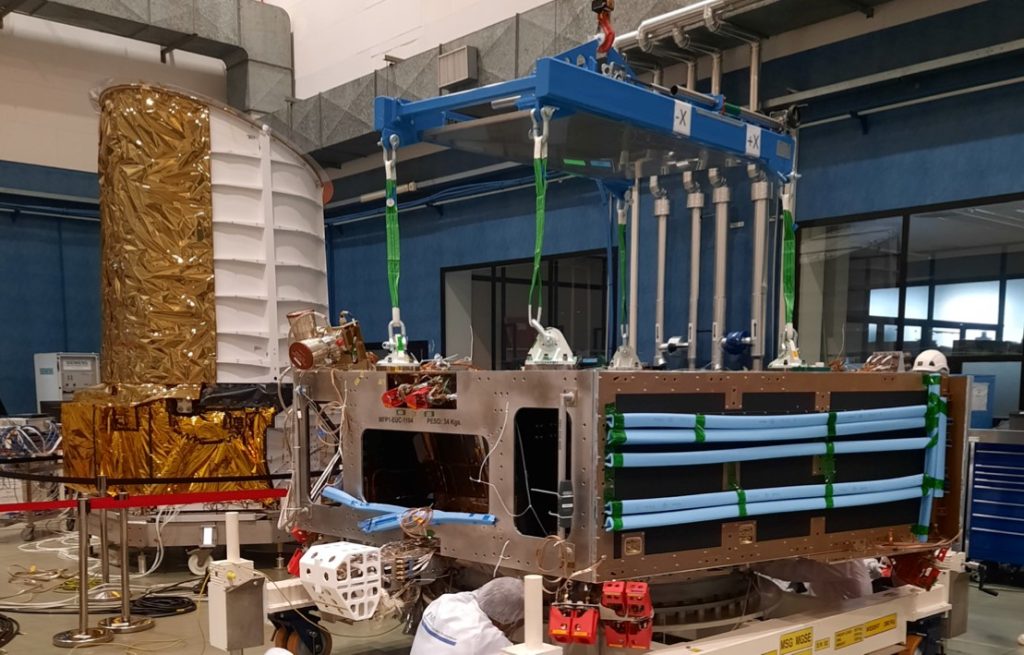
The IAS designed, built, and tested the Calibration Unit (CU) for the VIS instrument. This in-flight calibration system provides a highly uniform light beam that covers the focal plane, enabling the production of flat fields throughout the mission.
The CU consists of an integral sphere illuminated by 6 LEDs covering a spectral range from 590 to 885 nm.
The IAS also contributes to the Scientific Ground Segment (SGS), particularly to the Instrument Data Fusion Unit (OU-MER), as well as to the Science Working Groups (SWG).
Status
In operation
Key Dates (tentative)
- March 2019: Delivery of the CU flight model
- 2022: Satellite Integration and Testing
- July 1, 2023: Launch
- July–October 2023: Verification phase
- November 2023: First scientific images
- March 2025: Delivery of the first sky survey segments
- 2029: End of the nominal mission
Key Steps
- Design, development, and testing of the Calibration Unit (CU) for the VIS instrument
- Delivery and Integration of the CU into the VIS Instrument
- Environmental and Performance Tests of the Payload Module (PLM)
- Launch and insertion into orbit toward the L2 point
- Instrument Validation Phase (3 months)
- Start of nominal scientific observations
- Delivery of the first sky surveys
Contacts
Advisors (scientific and technical)
- Nabila Aghanim, Research Director, Cosmology Team
- Anne Philippon, Technical Director of the IAS, Optics Team
- Hervé Dole, Professor, Cosmology Group
Work Team
- Julien Grain, Research Fellow, Cosmology Team