
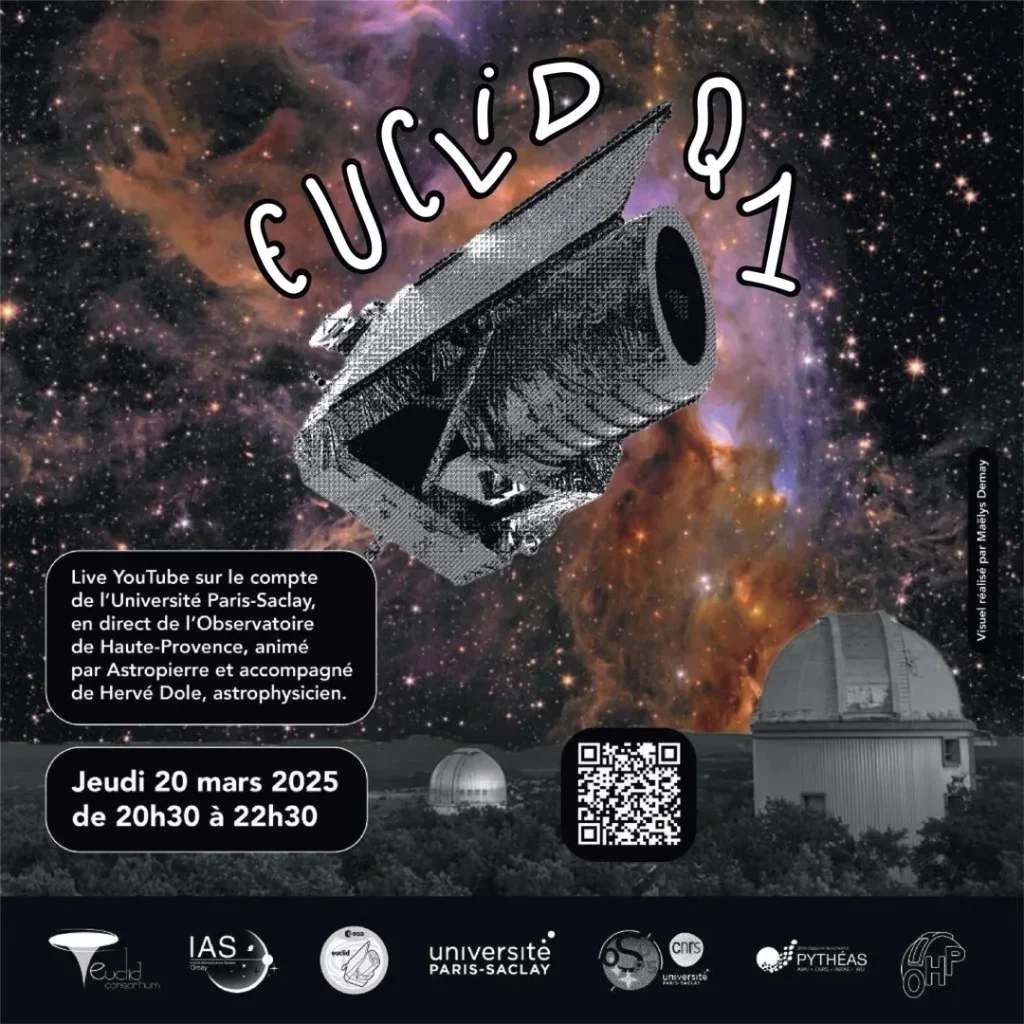
At noon on Wednesday, March 19, 2025, ESA released the first data from the Euclid space mission survey.
Three regions of the sky, covering a total area of 63 square degrees, were observed and analyzed by scientists from the collaboration, resulting in the detection of 29 million sources. These data, known as Q1 and representing only 0.45% of the observations planned for Euclid in the coming years, have already led to numerous breakthroughs illustrating Euclid’s extraordinary ability to contribute to all fields of astrophysics. The Euclid Consortium is publishing new scientific results today to accompany the data.
The teams at the IAS in Orsay have actively contributed to the various phases of the Euclid mission—from the initial proposal to ESA through to the latest scientific results. Initially focused on instrumentation—including the design and delivery of the calibration unit (CU) for the VIS imager, as well as numerous pre-launch tests—this involvement has remained significant. It now extends to scientific analyses, as well as the ground segment—particularly the OU-MER group. The OU-MER group is responsible for merging images from other observatories—which serve as essential complements to Euclid’s data—and for providing the official catalog of astrophysical sources to the scientific community.
The first 34 scientific papers, including 7 related to the scientific ground segment, have been submitted and are associated with these data. More papers will follow soon.