Euclid is a space mission of the European Space Agency (ESA) scheduled to launch in 2022. This cosmology mission aims to better understand the source of the accelerating expansion of the universe, as well as the nature of dark energy and gravity, and to better map the distribution of dark matter by observing several billion galaxies, tracing the history of the universe over more than 10 billion years.
A global benchmark, this major mission—part of ESA’s European “Cosmic Vision” program—brings together more than 1,500 researchers, engineers, and technicians from numerous European countries, with participation from the U.S. and Canada.
As a key participant in this project, France—through CNES—has provided laboratories with the resources needed to contribute to this mission. With approximately 500 Euclid members in France, CNES, CNRS, CEA, and partner universities provide significant human resources and technical infrastructure.
In Orsay, the Institute of Space Astrophysics (IAS, a joint research unit of CNRS and Paris-Sud University / Paris-Saclay University) designed, manufactured, and tested the (CU, Calibration Unit) for the VIS instrument and is contributing to the development of the scientific ground segment (SGS)—notably the unit that merges data from the various instruments, called OU-MER—as well as to the Science Working Groups (SWGs). The CU (flight model) has already been built, tested, delivered, and is currently being integrated into the VIS instrument.
From November 27 to 29, 2019, the French community of the Euclid collaboration gathered to exchange ideas and take stock of the mission. This event, organized by the IAS and held at the new premises of the Orsay Institute of Mathematics (IMO), provided an excellent opportunity to explore the full range of French contributions to the Euclid mission, learn more about the mission’s progress, and facilitate discussions among participants.
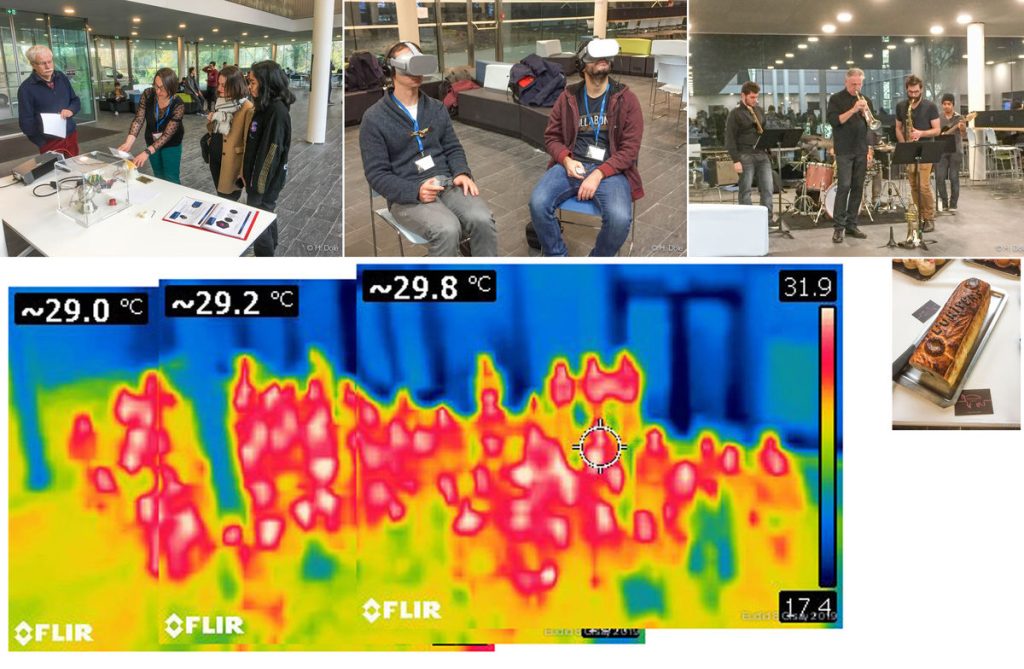
In addition, the IAS teams organized side events at the university, such as a demonstration by the IAS instrument team of how the qualification model for the Calibration Unit of Euclid’s VIS instrument works. A jazz concert was performed by musicians from the Paris-Saclay Conservatory. Colleagues from the CPPM and the LAM brought their 3D headsets, enabling the screening of virtual reality films. Finally, caterer Sylvain Gasdon offered a tasting of a “universe pâté en croûte” (which replicates the proportions of the universe’s composition—dark energy, dark matter, baryonic matter, and relativistic species—as measured by the Planck satellite, in which the IAS played a major role), made especially for the occasion. A group photo was taken in visible and infrared light, as a nod to future Euclid data, which will cover precisely the visible and near-infrared spectrum. These side events illustrate how astronomy, gastronomy, and music can come together harmoniously.