
Recent Flows on Mars: What Roles Do Dry Ice and Water Play?
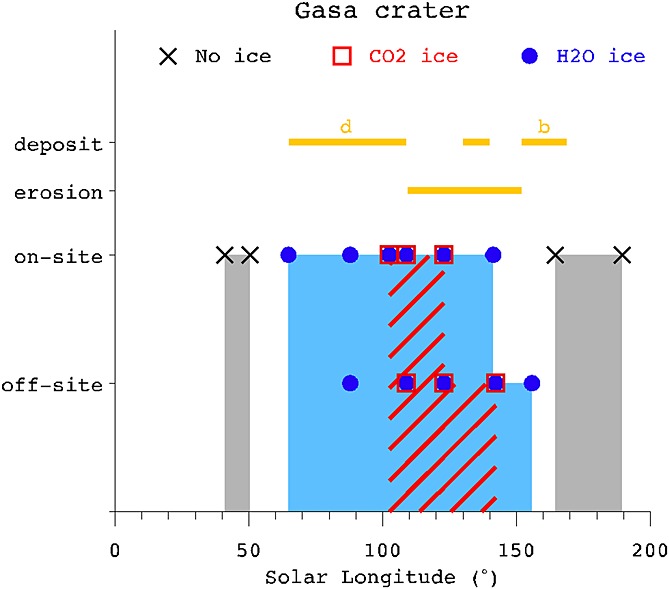
Since the arrival of high-resolution cameras on Mars, we have known that flows are currently occurring on the planet. There are different types (new gullies, dark streaks, bright deposits, etc.), and their origin is a matter of debate: dry avalanches? liquid water? dry ice? A study conducted at the Institute of Space Astrophysics provides, for the first time, the composition of the layers of snow and ice that accumulate in winter near certain flows. These results suggest the coexistence of several current formation mechanisms.
While a recent study suggests the presence of liquid water in some of the dark streaks observed on sunlit slopes on Mars, most of the current flows occur in cold regions that become covered with ice in winter. These flows are thought to form without water and are believed to be caused by one or more mechanisms involving the sublimation of dry ice.
A study conducted at the Institute of Space Astrophysics provides, for the first time, the composition of the layers of snow and ice that accumulate near these flows. Dry ice has indeed been observed in association with many of these flows, particularly those leading to the formation of new ravines. However, some of the flows occur in areas where only water condenses in winter. These results show that several mechanisms—some involving dry ice and others involving water ice—are in fact currently at work in forming these new flows.
Contacts
Advisors (scientific and technical)
Mathieu Vincendon, Associate Professor, University of Paris-Saclay, Head of the Solar System and Planetary Systems Physics Team
References
Vincendon, M. (2015), “Identification of Mars gully activity types associated with ice composition,” J. Geophys. Res. Planets, 120, doi:10.1002/2015JE004909