
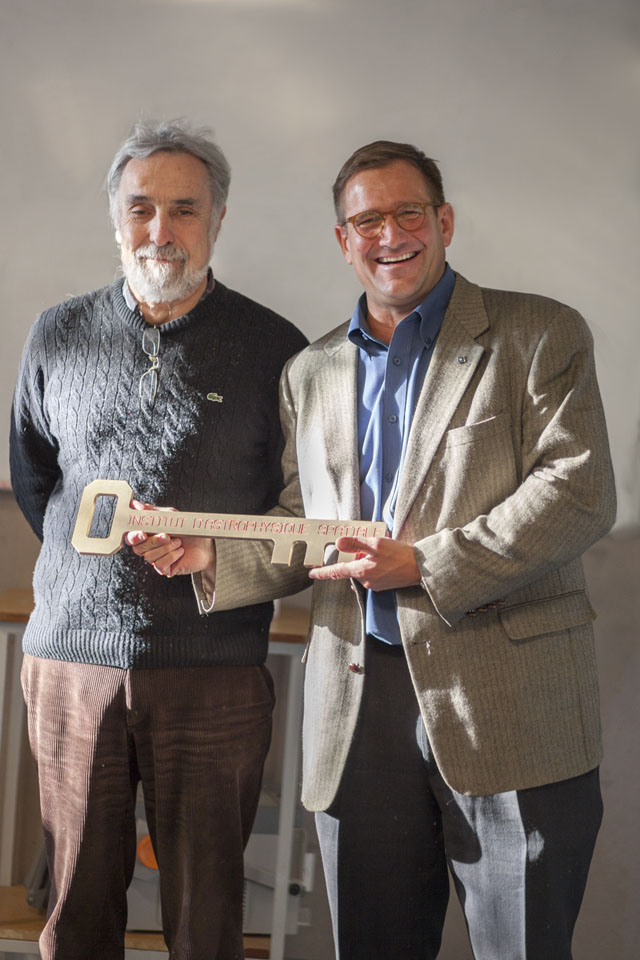
Don Hassler will become director of the Institute of Space Astrophysics (IAS) on February 1, 2014, for a five-year term. He succeeds Yves Langevin, who remains director of the Observatory of Universe Sciences at the University of Paris-Sud (OSUPS). Don Hassler was previously director of the scientific program at the Southwest Research Institute (SwRI) in Boulder, Colorado, United States. Aged 52, Don Hassler earned his Ph.D. in 1990 and is an internationally recognized scientist in the fields of planetary science (he is the principal investigator for the RAD instrument on NASA’s Mars Science Laboratory) and solar physics (principal investigator for the SPICE instrument on the ESA and NASA Solar Orbiter).
Don Hassler is taking the helm of the IAS, a major player in astrophysics research. The IAS’s primary objective is the development and scientific operation of experiments carried aboard space missions, particularly those of the European Space Agency. It participates in research aimed at answering fundamental questions about the origin and evolution of the universe and its constituents, as well as the physical laws governing the universe.
The IAS has achieved recent successes, notably with the Planck satellite for cosmology, the Mars Express and Rosetta probes for planetary science, the Corot and Kepler satellites for exoplanetology and stellar physics, and the SOHO and Stereo observatories for solar physics.
Among the major recent scientific results are the discovery of hydrated minerals on Mars (OMEGA/Mars Express)—direct evidence of the presence of liquid water in the early stages of the planet’s history—the characterization of the internal structure of stars and the discovery of exoplanets (CoRot), the characterization of distant galaxies, interstellar gas, and shock regions (Spitzer/Herschel), the comprehensive mapping of the cosmic microwave background (Planck/HFI), which provides insight into the early stages of the Universe’s evolution, and the discovery of mechanisms for the formation of prebiotic organic molecules through irradiation in astrophysical environments.
The IAS is also involved, on the one hand, in analyzing data from these scientific instruments and, on the other hand, in participating in the development of future instruments, which are flagship projects within the scientific community.
Notable European Space Agency (ESA) projects include Rosetta, Bepi-Colombo, exoMars, and JUICE for planetary science; Solar Orbiter for solar physics; Plato for exoplanetary science and stellar physics; and Euclid for cosmology and galactic physics. These projects receive support from CNES, the French space agency.
The IAS is a joint research unit of the CNRS and the University of Paris-Sud. Together with the IDES laboratory, the IAS forms the University of Paris-Sud Observatory of Universe Sciences (OSUPS), which provides observational services linked to the CNRS Institute of Universe Sciences (INSU). The laboratory employs approximately 170 people: 46 researchers, faculty members, and astronomers; 89 engineers, technicians, and administrative staff; and about 30 doctoral and postdoctoral students. Research activities are organized into four teams: astrochemistry and origins; interstellar matter and cosmology; solar and stellar physics; and the solar system and planetary systems. The IAS houses a center for space data operations, processing, and archiving—IDOC—as well as a calibration station for space instruments.