
Detection of sugars in a laboratory simulation of interstellar and pre-cometary organic matter derived from ice photo/thermochemistry
Ten aldehydes, including two sugars potentially important for prebiotic chemistry, have been identified for the first time in the organic residue resulting from the photochemistry of interstellar ice analogues, produced in the laboratory by the IAS MICMOC/SUGARS experiment.
The MICMOC experiment (Interstellar and Cometary Matter: Complex Organic Molecules) includes Chiral-MICMOC at SOLEIL, which focuses on the chiral excess in prebiotic molecules obtained from the photochemistry of interstellar ice analogues in the laboratory—an experiment whose success was reported in 2011 and 2014. The MICMOC/SUGARS experiment is a variant of this. This highly interdisciplinary approach, bringing together scientists from the fields of astrophysics, physics, and chemistry within the ANR Chirgen project, proposes an experimental framework linking astrophysics through the simulation of interstellar ices, molecular physics, and analytical chemistry for the detection of molecules of prebiotic interest.
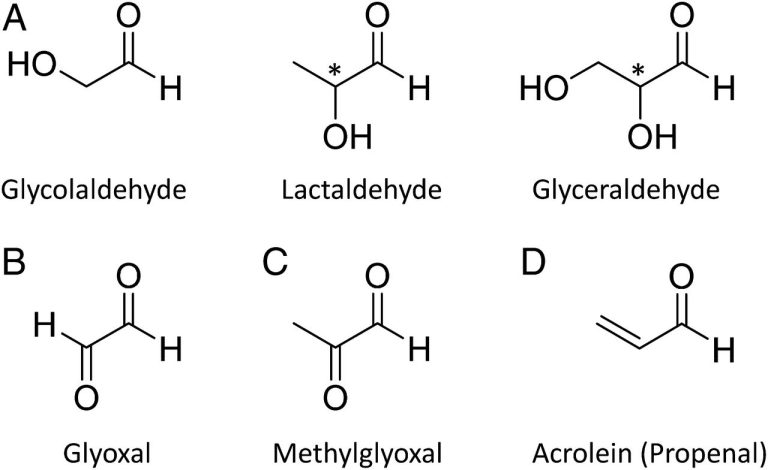
The presence of numerous amino acids in the organic residue resulting from the photochemistry of these ices has been repeatedly observed thanks to this collaboration. Recently, the analytical protocol applied at the ICN (Nice Institute of Chemistry) was modified to enable the detection of a new family of molecules: aldehydes, including potential sugars. Ten aldehydes were identified, notably two sugars potentially important for prebiotic chemistry: glycolaldehyde and glyceraldehyde. According to a recent prebiotic chemistry experiment, these are potential precursors of ribonucleotides, themselves the building blocks of RNA, just as amino acids are for proteins. The detection of these molecules in our samples thus reinforces the hypothesis that extraterrestrial organic matter may have seeded the primitive Earth with molecules essential for the functioning of prebiotic chemistry leading to the origins of life.
Finally, while glycolaldehyde has already been detected in the interstellar medium, this is not yet the case for glyceraldehyde, which therefore represents an attractive target for radioastronomy instruments such as ALMA. This molecule could also be searched for in primitive meteorites.
References
Article: P. de Marcellus et al. (2015). Aldehydes and sugars from evolved precometary ice analogues: Importance of ices in astrochemical and prebiotic evolution. PNAS. DOI: 10.1073/pnas.1418602112