
Signatures of nitrogen-rich organic matter in ultra-carbonaceous micrometeorites
An interdisciplinary team of researchers from IAS, CSNSM, and the SMIS beamline at the SOLEIL synchrotron has conducted the first systematic laboratory study of organic matter originating from exceptional interplanetary dust particles known as Ultra-Carbonaceous MicroMeteorites (UCAMMs).
Interplanetary dust particles travel through the solar system and represent the primary flux of extraterrestrial matter to our planet in the form of micrometeorites, ranging in size up to a few hundred microns. The UCAMMs characterized in this study were collected in the Antarctic snow near Concordia Station (*). UCAMMs account for only a small fraction of the micrometeorite flux, but they contain unusually high proportions of organic matter, whose characteristics differ from those observed in the organic matter of other extraterrestrial materials.
In this work, the authors performed the first systematic study of eight UCAMMs using synchrotron infrared micro-spectroscopy (µ-FTIR), visible Raman spectrometry, and electron microprobe analyses. The results reveal an organic component with a low ratio of aliphatic CH to aromatic C=C bonds. Its nitrogen content is significantly higher than that observed in organic matter extracted from meteorites or conventional interplanetary dust, whereas its oxygen content is lower. The µ-FTIR spectra are consistent with the presence of ketone or aldehyde functional groups, and certain IR and Raman spectra exhibit signatures of nitrile-type bonds. The spectra are consistent with the presence of C-N bonds within a carbon network distinct from that observed in meteorite-extracted organic matter. Finally, the silicon-to-carbon ratio of the UCAMMs is considerably lower than that of any extraterrestrial material analyzed to date (meteorites, interplanetary dust).
Taken together, these results indicate that the physicochemical processes responsible for the formation of organic matter in UCAMMs occurred in a cold, nitrogen-rich environment exposed to energetic radiation (photons, cosmic rays). Such conditions are met on the surface of small icy bodies located in the outer solar system. The C/Si and N/C abundance ratios in the UCAMMs analyzed in this study are the highest ever observed in the solar system. They support the existence of a gradient in the elemental abundance ratios of major elements, C/Si and N/C, within the solid phases of the protoplanetary disk that surrounded the young Sun.
UCAMMs offer the potential to gain new insights into the surface composition of distant icy small bodies in our solar system and contribute to a better understanding of the origin of interplanetary organic matter.
This experimental research is described in an article recently published in Astronomy & Astrophysics and has been selected as a journal "highlight".
(*): Concordia Station, located at Dome C (73° S, 123° E), is operated by the French and Italian polar institutes (IPEV and PNRA).
Notes:
This work was supported by national programs (PNP, PCMI), the French National Centre for Space Studies (CNES), the ANR, DIM-ACAV, Université Paris-Saclay, and CNRS. Work at the Concordia station was carried out with the financial and logistical support of IPEV.
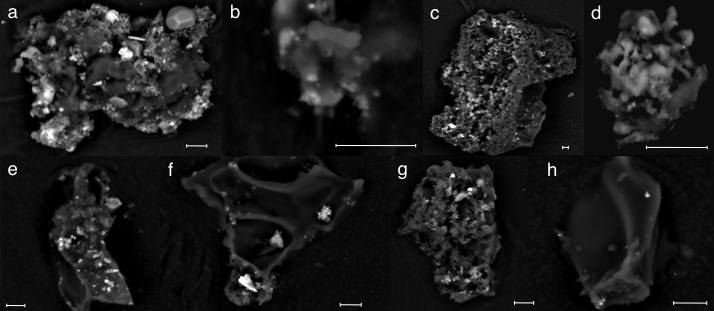
Figure 1: Backscattered electron images measured at 15 kV of the micrometeorite fragments (UCAMMs) analyzed in this study. The scale bars correspond to 5 µm for each image.
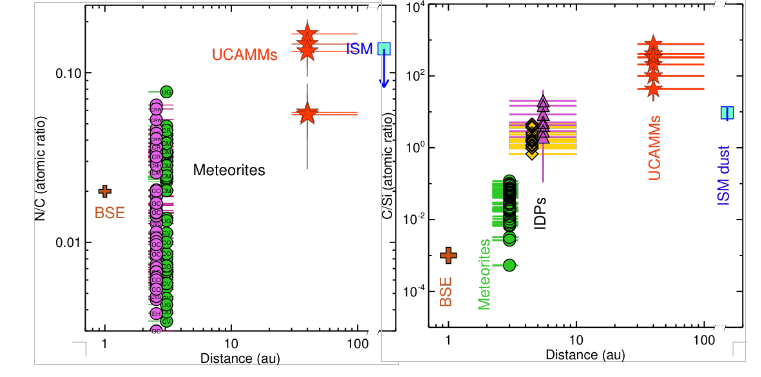
Figure 2: On the left, the relative atomic nitrogen/carbon abundances of the UCAMMs (stars) are compared with those of Solar System solid bodies as a function of distance from the Sun. On the right: the same figure for the relative atomic carbon/silicon abundances.
Contacts
Emmanuel Dartois, IAS
References
“Dome C ultracarbonaceous Antarctic micrometeorites – Infrared and Raman fingerprints” E. Dartois, C. Engrand, J. Duprat, M. Godard, E. Charon, L. Delauche, C. Sandt, and F. Borondics, Astronomy & Astrophysics 609, A65 (2018), DOI: https://doi.org/10.1051/0004-6361/201731322